A cryptographic asset inventory built manually has one fundamental problem; it might get outdated the moment it is complete. As a result, the following occurs:
- A developer commits a dependency using a deprecated algorithm.
- A certificate renews with a weaker signature.
- A cloud service rotates a key with no notification to the security team.
None of these changes appear in a spreadsheet updated quarterly.
This is why CBOM automation exists. It replaces periodic, manual inventory work with continuous discovery, structured generation and real-time monitoring. How does it help you? By making sure your cryptographic posture reflects what is running, not what was running the last time someone checked.
Problems with manual CBOM generation
Cryptography is distributed across more layers than most security teams could track. It lives in source code, container images, cloud infrastructure, hardware security modules (HSMs), certificate stores, third-party libraries and vendor-supplied components. Each of these layers change independently and continuously.
A manual approach to building a CBOM means periodically reviewing each layer by hand, normalising findings into a consistent format and updating a central record. At small scale, this is slow. At enterprise scale which include hundreds of applications, multi-cloud environments, active DevSecOps pipelines, it is not feasible.
The result is a CBOM that is structurally incomplete due to partial coverage, stale entries and no visibility into cryptography introduced through dependencies or vendor updates. That gap is precisely where regulatory exposure and post-quantum risk accumulate.
The many benefits of CBOM automation
Cryptography Bill of Materials or CBOM automation connects discovery, generation, policy enforcement and compliance reporting into a continuous pipeline. The four components work together:
Automated discovery across all cryptographic surfaces
Automated scanners pull cryptographic assets from every layer where they exist. It includes source code, build artifacts, container images, cloud KMS services, HSMs, network endpoints and third-party SBOMs.
Discovery runs continuously, triggered by code commits, deployments and infrastructure changes, not by scheduled reviews. This coverage extends to cryptography embedded in open-source dependencies and vendor-supplied components, assets that point-in-time audits rarely reach at full depth.
Structured CBOM generation in standard formats
Raw findings are normalised into a machine-readable schema. CycloneDX 1.6 and 1.7 are the current standards, with native support for cryptographic asset representation including algorithms, key metadata, certificate details and protocol configurations. Output is generated per application, version-controlled and linked to the broader SBOM for full software supply chain visibility.
This structured output is what makes CBOM consumable by downstream tools such as vulnerability feeds, compliance dashboards, audit workflows and CI/CD policy gates.
Continuous policy enforcement
Once assets are catalogued, automated policy rules run against them continuously. A deprecated algorithm detected in a new dependency triggers an alert before it reaches production. A certificate approaching expiry surfaces in the dashboard with ownership assigned. A non-FIPS algorithm introduced in a regulated environment is flagged at the build stage, not discovered six months later during an audit.
Policy enforcement moves cryptographic governance from reactive to preventive, closing the window between introduction of a risk and detection of it.
On-demand compliance output
Regulated entities under RBI Advisory 11/2024, the RBI’s 31 July 2026 Cybersecurity Directions and CERT-In Technical Guidelines v2.0 are required to maintain cryptographic asset inventories and prove audit readiness. The 2026 Directions make cryptographic governance and vendor audit rights legally binding – raising the bar beyond the 2024 advisory alone. CBOM automation generates compliance-mapped reports from live data, eliminating the pre-audit scramble of manually assembling evidence from scattered sources.
Reports map directly to regulatory frameworks like CERT-In, RBI, NIST SP 800-131A, NIST PQC standards, and reflect the current state of the environment, not its state at a point in the past.
Read our blog: How to Choose CBOM Tools
How CBOM automation fits into a DevSecOps pipeline
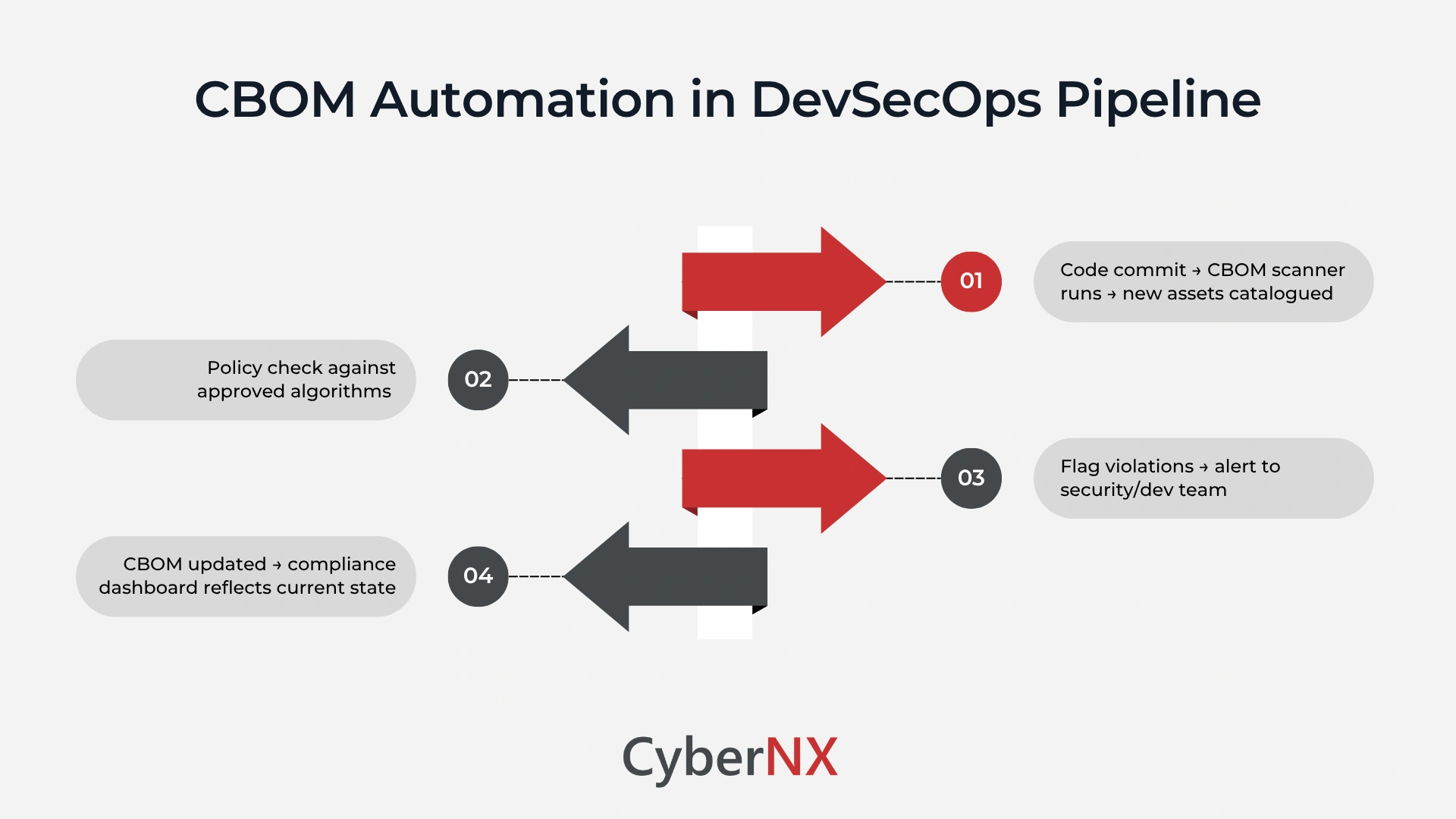
CBOM automation integrates at the pipeline level, not as a separate security process running alongside development.
When a developer commits code, the scanner runs and adds any new cryptographic assets to the application’s CBOM. Policy checks execute against the updated inventory. Violations surface in the same workflow the developer is already using, not in a quarterly security report. This integration is what makes cryptographic governance operationally sustainable at scale.
For post-quantum migration planning, this integration is especially significant. Identifying every instance of RSA, ECC or Diffie-Hellman across hundreds of applications is the prerequisite for structured migration to NIST-approved post-quantum algorithms. Without automation, that identification exercise alone takes months and is incomplete before it finishes.
What CyberNX delivers with CBOM solutions
CyberNX’s CBOM solutions combine multi-source scanning – code repositories, network endpoints, container artifacts, HSM and KMS integrations – into a continuously maintained CBOM per application.
Findings are prioritised by exploitability. Our team runs penetration tests and red team exercises daily, which means the output is structured as a clear action plan, not a flat list of algorithm names for your team to interpret independently.
CyberNX’s CBOM solutions generate app-level migration roadmaps for post-quantum readiness, tracking adoption of NIST-approved PQC algorithms for your systems over time. Deployment options include managed SaaS or on-premise within your VPC or data centre, with full data residency for BFSI and regulated sectors.
Conclusion
Manual cryptographic inventory cannot keep pace with the rate at which cryptographic assets are introduced, changed and retired across modern enterprise environments. CBOM automation replaces the periodic snapshot with continuous visibility, covering every layer, enforcing policy in real time and generating audit-ready evidence from live data.
For organisations governed by RBI, SEBI and CERT-In, that continuous visibility is no longer a best practice. It is an expected control. The earlier cryptographic governance shifts from reactive to automated, the less friction post-quantum migration and regulatory audit preparation carry. If you want help with generating bill of materials, and to know what our CBOM solutions offer, contact our experts.
CBOM automation FAQs
What is CBOM automation?
CBOM automation is the continuous, tool-driven process of discovering, generating and monitoring a Cryptographic Bill of Materials across code, infrastructure and third-party dependencies – without manual inventory work.
Is CBOM automation relevant for BFSI organisations in India?
RBI Advisory 11/2024 and CERT-In Technical Guidelines v2.0 both require regulated entities to maintain cryptographic asset inventories. The RBI’s 31 July 2026 Cybersecurity Directions further reinforce this, making cryptographic governance and vendor audit rights legally binding across all regulated entity classes. Automation is the only practical way to meet that requirement across enterprise-scale application portfolios.
Does CBOM automation replace a cryptographic audit?
No. Automated CBOM keeps the inventory current and flags policy violations continuously. A structured cryptographic audit validates whether controls are correctly implemented. Both serve different governance functions and work best together. To know more, read our blog CBOM vs Traditional Cryptographic Audit.