Gartner published its first Magic Quadrant for Software Supply Chain Security. It treats SCA and continuous SBOM management as core capabilities of the same market. That’s because SBOM and SCA have matured.
In the past, Software Composition Analysis (SCA) has long been the standard way to find risk in open-source code. Software inventories (the traditional output of an SBOM) grew out of a different need: transparency across the supply chain. But now SBOM tools no longer stop at producing a file. They monitor components continuously, which changes how the two fit together.
These developments have led to “Should we invest in SBOM or SCA?” question in supply chain security planning.
For security and compliance teams under pressure from SEBI CSCRF, RBI and CERT-In mandates, understanding exactly where SBOM ends and SCA begins matters, because auditors could ask for both. This blog breaks down the distinction, where the two overlap and how to build them into your programme.
SBOM is an inventory, SCA is a process
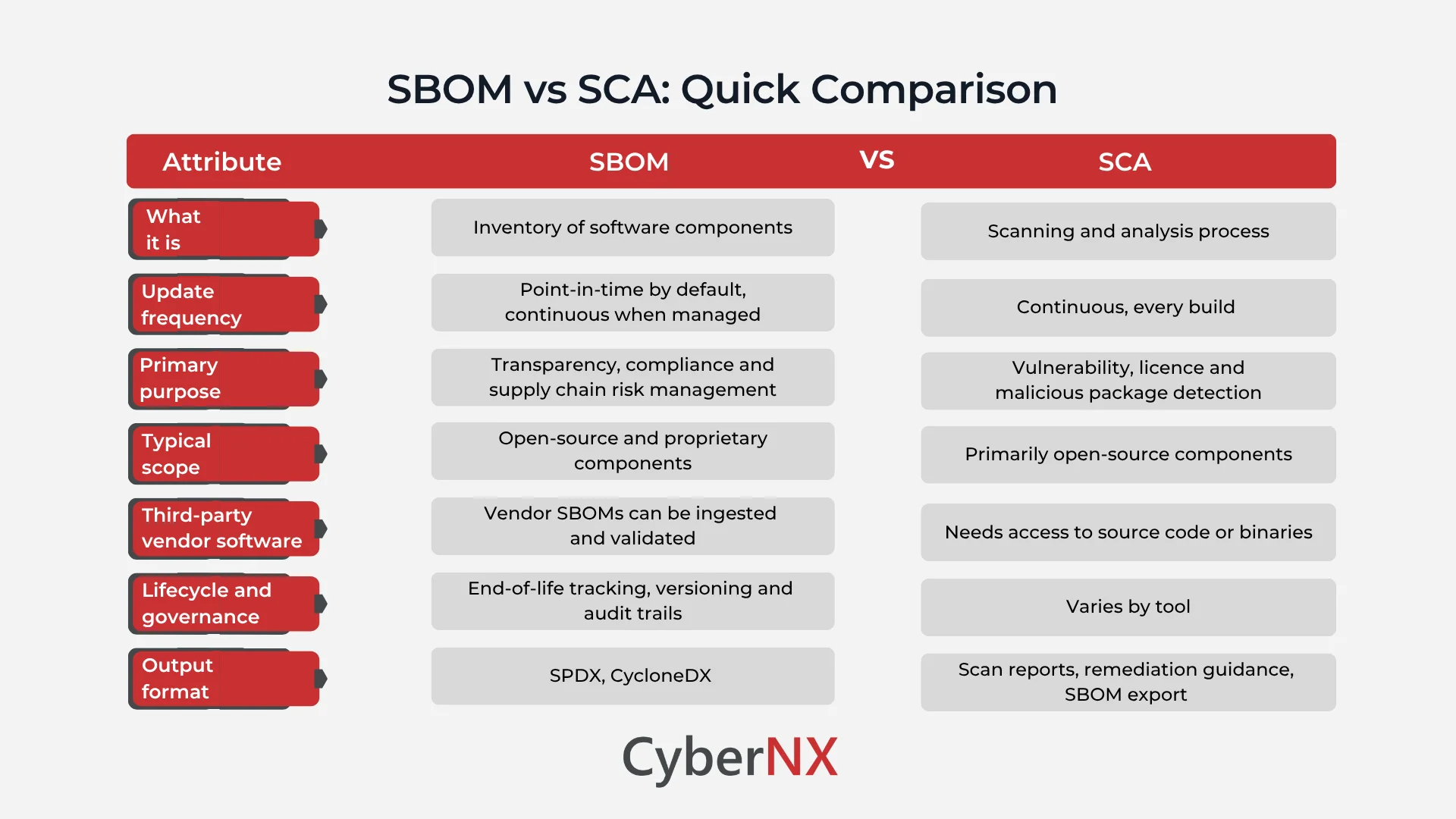
The clearest way to separate the two is that an SBOM is what you have, while SCA is how you find out.
What an SBOM is
In a traditional sense, a Software Bill of Materials is a structured, point-in-time inventory of every component in a software application. It lists component names and versions for both open-source and proprietary elements, supplier information, licence data for every included component, and dependency relationships including transitive dependencies pulled in indirectly. An SBOM is typically published in a standard format such as SPDX or CycloneDX.
However, at this point, it is important to emphasize the fact that SBOMs have evolved and can do everything what SCA does, except for malware detection.
What SCA does
Software Composition Analysis is an active scanning process. It identifies components within a codebase and checks them against vulnerability and licensing databases. Many SCA tools also detect malicious packages, such as typosquatted or compromised libraries. SCA typically runs on every commit, build or deployment.
Why the static versus active distinction is fading
This distinction explains why teams have traditionally treated SBOM and SCA as separate tools. It still describes how SBOMs were first used. It no longer describes how they can be managed today.
A traditional SBOM is a snapshot
An SBOM file documents what existed in a build at a specific point in time. When it is generated once and filed away, it does not pick up vulnerabilities disclosed after that date. It also misses components added in later releases. This is how many organisations first produced SBOMs, often to meet a one-time customer or audit request.
SCA is continuous
SCA tools re-scan on every build cycle, matching components against live vulnerability feeds such as the National Vulnerability Database. When a new Common Vulnerabilities and Exposures (CVE) entry is disclosed for a library already in your environment, SCA surfaces that exposure quickly.
A managed SBOM is continuous too
SBOM management platforms close the snapshot gap. They regenerate SBOMs automatically on every build through CI/CD integration. They also monitor each component over time against vulnerability feeds and vendor advisories. When a previously clean dependency becomes vulnerable, the platform raises an alert. The SBOM stops being a document that ages and becomes a live view of your software supply chain.
The practical test is simple. Ask whether your current SBOM would reflect a CVE disclosed this morning. If the answer is no, you have a snapshot, not a managed inventory.
Quick comparison
Where the two overlap
Modern SCA tools do not just scan for vulnerabilities. They generate SBOMs as a by-product of that scan. At the same time, SBOM platforms have taken on core SCA capabilities. This two-way overlap is where most of the confusion starts.
SCA as an SBOM generation engine
Most enterprise SCA platforms produce SBOMs in SPDX or CycloneDX format automatically once a scan completes. Many organisations already have SBOM capability inside their existing SCA tooling and simply have not activated the reporting output.
SBOM platforms with SCA capabilities
A managed SBOM platform maps every component to known CVEs and vendor advisories. It detects and classifies licences and flags restrictive or incompatible ones. Stronger platforms also prioritise risk using more than severity scores.
They combine the Common Vulnerability Scoring System (CVSS), the Exploit Prediction Scoring System (EPSS), reachability analysis and business criticality. For vulnerability and licence risk, this covers much of what teams expect from SCA.
Malicious package detection is the notable exception and typically remains the job of a dedicated SCA tool.
What SBOM covers that SCA usually does not
SCA works best on code you build and control. Much of your risk, however, sits in software you buy. A managed SBOM platform lets you ingest and validate vendor SBOMs in CycloneDX or SPDX format, so third-party applications enter the same inventory as your own.
It also tracks end-of-life and end-of-support dates, keeps versioned and tamper-proof records and maps fields to regulatory schemas. In India, that includes the 21 fields in the CERT-In SBOM guidelines and the 9 fields SEBI expects. These are governance needs, and scanners were not designed to meet them.
Why one artefact is not enough
An SBOM produced by a one-off SCA scan is only as current as that scan. If your SBOM refresh cadence does not match your deployment frequency, the inventory you hand an auditor may not reflect what is running in production. Aligning SBOM generation with every build closes this gap.
Building both into your supply chain security programme
Those working toward SEBI CSCRF or CERT-In SBOM mandates, the practical approach is building visibility first, then layering the right capabilities on top.
- Start with a complete, continuously updated inventory. Generate SBOMs across source code, binaries and container images, and ingest SBOMs from your vendors. Integrate generation into your CI/CD pipeline so every release produces an auditable, versioned record.
- Next, turn the inventory into risk intelligence. Monitor components against live vulnerability feeds, track end-of-life dates and prioritise fixes by exploitability and business impact. Link findings to your ticketing workflow so a flagged CVE maps straight to every affected application.
- Finally, fill the remaining gaps. If your threat model calls for malicious package detection, run a dedicated SCA tool alongside your SBOM platform. The SBOM then becomes the system of record that ties every finding back to a specific application and release.
Conclusion
Treating SBOM and SCA as alternatives leaves a gap either way. A one-off SBOM gives you a document that ages the moment it is generated. SCA without a governed SBOM leaves you without the auditable artefact regulators expect. The strongest programmes run a managed SBOM as the foundation and add SCA where specific risks demand it.
CyberNX’s SBOM solutions generate SBOMs from source code, binaries and containers, ingests vendor SBOMs and regenerates your inventory on every build. It monitors components against live vulnerability feeds and prioritises risk using CVSS, EPSS, reachability and business criticality.
In addition, it also detects licence risks, tracks end-of-life dates and maps outputs to CERT-In, RBI and SEBI CSCRF requirements. The document you hand an auditor reflects what is running now, not what was running at last quarter’s scan.
If your software supply chain security programme relies on point-in-time SBOMs, or has SCA in place with no governed SBOM layer behind it, talk to our SBOM experts for more details.
SBOM vs SCA FAQs
Can an SBOM replace an SCA tool?
Not on its own. An SBOM file is an inventory and cannot scan for new vulnerabilities. A managed SBOM platform, however, covers much of SCA’s vulnerability and licence detection. You may still need a dedicated SCA tool for malicious package detection.
Do regulators accept an SBOM generated by an SCA tool?
Generally yes, provided the SBOM is in a standard format such as SPDX or CycloneDX and is current enough to reflect the audited system’s actual state. Continuous regeneration makes this much easier to demonstrate.
Which should a BFSI organisation implement first, SBOM or SCA?
Start with visibility. A managed SBOM platform gives you a continuously updated inventory, vulnerability and licence monitoring and audit-ready evidence in one place. Add a dedicated SCA tool if you need malicious package detection.
How do we get an SBOM for third-party software we do not build?
Ask your vendors for SBOMs in CycloneDX or SPDX format. A managed SBOM platform can ingest, validate and monitor them alongside your own applications. This matters for BFSI organisations, since regulators increasingly expect SBOM coverage for vendor-supplied critical software.