One of the first things many attackers do after breaking in is quiet, and easy to miss: they clear the logs. Deleting or altering event records after a breach is such a common step that MITRE’s ATT&CK framework lists it as a named technique, precisely because it works so well. Without those records, there is often very little left to show how an intruder got in or what they touched.
That is exactly why security log analysis matters. It means collecting and reviewing those records while they still exist, using patterns across systems to catch an intrusion while it is still happening, rather than piecing it together after the damage is done. This guide explains what security log analysis in cyber security involves, why it matters for Indian enterprises and how you can build it into your security services.
What is security log analysis?
This practice is the process of reviewing records that servers, applications, firewalls and other systems generate, to find signs of unauthorised activity. Every login, file access, configuration change and network connection leaves a trace. On its own, one log entry does not mean much. Patterns across thousands of entries tell a different story.
Analysts and automated tools look for things that do not fit the usual flow. For example, a login at an unusual hour, a spike in failed authentication attempts, or a large data transfer to an unfamiliar destination. When these patterns line up with known attack behaviour, they turn a mass of raw data into an early warning.
Security log analysis in cyber security: Why it matters for Indian enterprises
CERT-In’s Directions under Section 70B of the IT Act, issued in April 2022, require organisations to retain ICT system logs for a rolling period of 180 days within Indian jurisdiction and produce them to CERT-In on request. Meeting that requirement only helps if the logs are actually reviewed, not just stored.
Cyberattacks against Indian organisations, particularly in BFSI, continue to grow in volume. CERT-In handled 29.4 lakh cybersecurity incidents in 2025, according to its own incident data. At that scale, regular analysis is what turns a compliance requirement into a working early-warning system, rather than an archive nobody checks until after a breach.
Key elements of security log analysis
A working process usually includes:
- Log collection: Gathering records from servers, endpoints, applications, firewalls and cloud platforms into one place
- Normalisation: Converting logs from different formats into a consistent structure so they can be compared
- Correlation: Linking related events across systems to build a full picture of an incident
- Alerting: Flagging patterns that match known threats or fall outside normal behaviour
- Retention: Storing logs long enough to support investigation and meet regulatory requirements such as CERT-In’s 180-day rule
Without these elements, gaps appear. Missing retention means no evidence to investigate. Missing correlation means related signals across systems go unnoticed.
How security log analysis works in practice
The process follows a similar path across most organisations, though the tools involved vary. The core workflow has five steps:
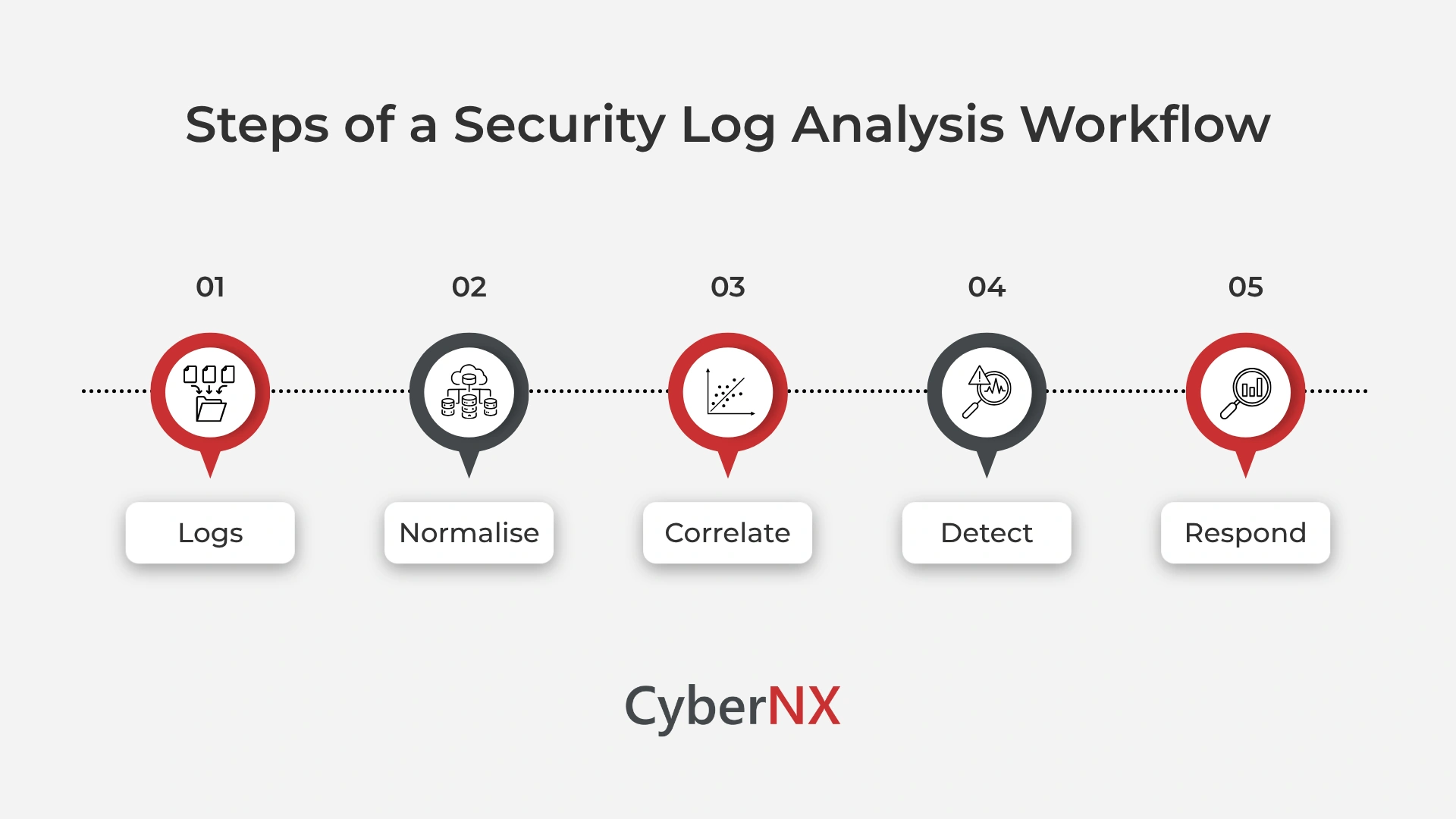
- Collect logs: Records from endpoints, networks, applications and cloud services are pulled into a central system.
- Normalise the data: Logs in different formats are converted into a consistent structure for comparison.
- Correlate events: Related activity across systems is linked to build a fuller picture of what happened.
- Detect anomalies: Patterns that deviate from normal behaviour or match known threats are flagged for review.
- Investigate and respond: Analysts examine flagged events, confirm genuine incidents and trigger a response.
Conclusion
This practice uses the records every system already produces into an early warning for genuine threats. For Indian firms that manage complex, fast-growing environments, that early warning directly reduces both the damage and the cost of an incident.
CyberNX delivers this through its AI-enabled Managed Detection and Response (MDR) service, which collects, normalises and correlates logs across endpoints, networks and cloud environments around the clock. A dedicated team of analysts and threat hunters investigates every flagged event, supported by machine learning, generative AI and real-time reporting through a live threat management dashboard. To bring security log analysis into your security operations, connect with our team of experts today.
Security Log Analysis FAQs
What is security log analysis?
This practice is the process of reviewing records generated by servers, applications, firewalls and other systems to identify signs of unauthorised activity or a potential security incident.
Why is security log analysis in cyber security important for compliance in India?
CERT-In’s Directions under Section 70B require organisations to retain ICT system logs for 180 days and produce them on request. Reviewing those logs regularly turns that retention requirement into an active early-warning system.
What is the difference between log management and log analysis?
Log management covers the collection, storage and retention of logs. Log analysis goes a step further, reviewing that data to detect patterns, anomalies and potential threats.
Can security log analysis be automated?
Yes. Most organisations pair automated correlation and alerting with analyst review, since automation handles volume while people validate genuine incidents and lead the response.