Zero Trust architecture is usually discussed in terms of identity, network segmentation and access control. Verify every user, device and request, and trust nothing by default. Interestingly, the same principle governs software supply chain security. Who gets access to a network applies just as directly to what code is allowed to run inside it.
For security teams building out Zero Trust architecture, treating software components as another category of entity requiring verification, rather than as an assumed-safe layer beneath the application, closes a gap that identity and network controls alone cannot address.
This blog looks at where SBOM and Zero Trust intersect and why mature security programmes are starting to treat them as complementary rather than separate initiatives.
When Zero Trust’s principle is applied to software components
Zero Trust rests on a simple premise: nothing is trusted by default, regardless of where it sits, and every access request must be explicitly verified.
The gap in most Zero Trust implementations
Most Zero Trust programmes verify users, devices and network requests thoroughly, then run those verified requests through applications built on hundreds of open source and third-party components that were never subjected to the same scrutiny.
A user can pass every identity check the architecture demands, only to interact with a vulnerable or compromised library sitting several layers deep in the application they’re using. Zero Trust, applied only at the perimeter and identity layer, leaves the software supply chain as an implicitly trusted zone.
Why this gap matters more as attacks move up the stack
Attackers increasingly target the software supply chain directly, compromising a build pipeline or a widely used dependency rather than attempting to breach a hardened perimeter. A Zero Trust architecture that verifies identity and network access but has no visibility into what components make up the applications running behind those checks has extended trust to exactly the layer attackers are choosing to target.
What SBOM contributes to a Zero Trust model
An SBOM gives Zero Trust architecture the one thing it cannot function without at the software layer: something concrete to verify.
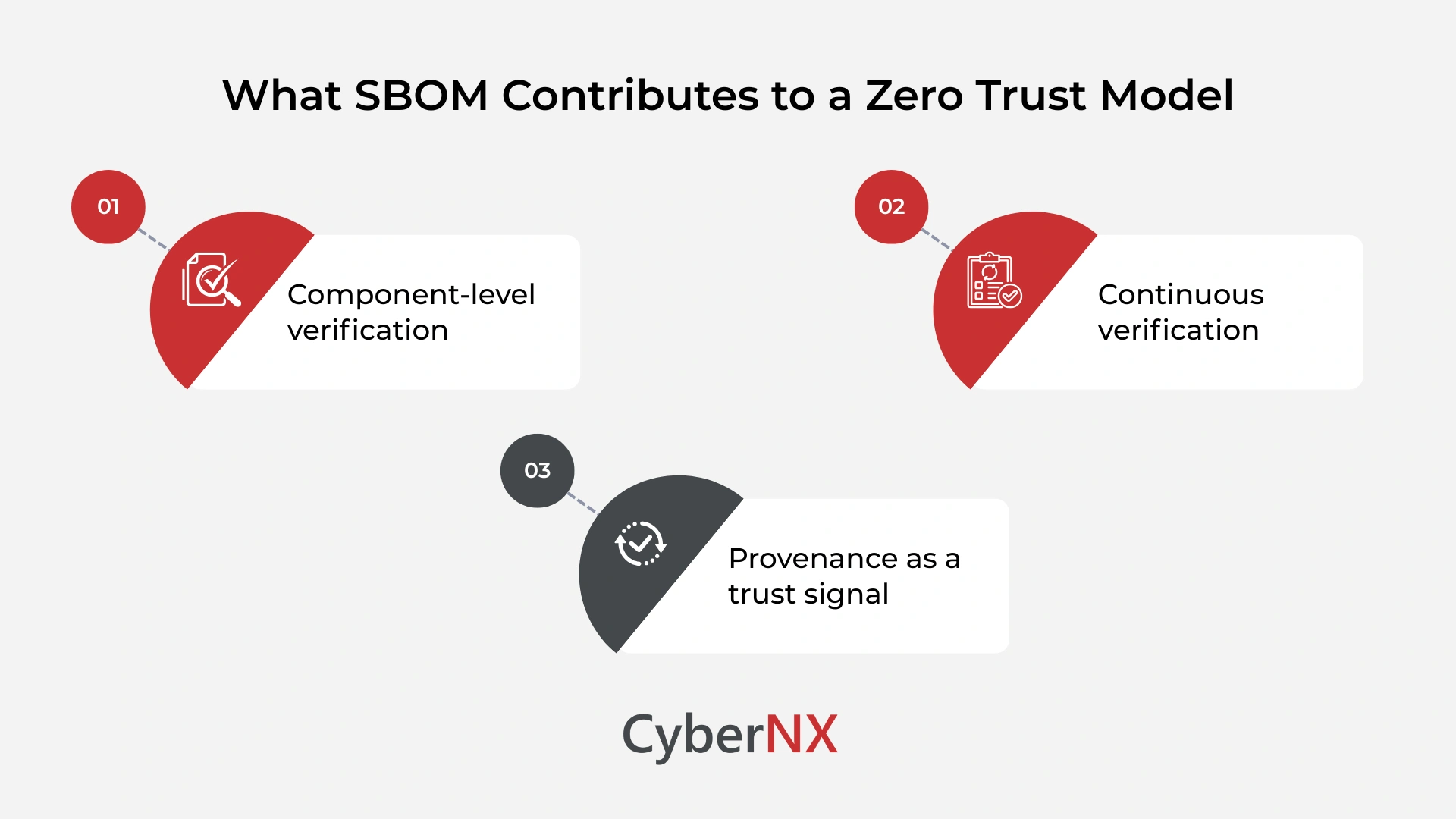
1. Component-level verification
Rather than trusting an application as a single opaque unit, an SBOM breaks it down into every component, version and dependency, giving security teams a basis to assess each one individually rather than extending trust to the whole because the top-level application passed a review. This mirrors exactly how Zero Trust treats identity, verifying each entity rather than trusting an entire network segment because one device on it was authenticated.
2. Continuous verification
Zero Trust’s principle of continuous verification, rather than a one-time login that grants standing trust, maps directly onto how SBOMs need to function. A static SBOM generated once at release is the software equivalent of a login that never expires. An auto-regenerating SBOM, refreshed as components change and correlated against live vulnerability feeds, is what continuous verification looks like applied to software composition.
3. Provenance as a trust signal
Zero Trust relies on verifying the identity of who or what is making a request. Applied to software, provenance data, knowing where a component came from and whether that source can be trusted, serves the same function. An SBOM that captures supplier and origin data gives security teams a provenance signal to weigh, rather than accepting a component’s presence in the codebase as sufficient trust on its own.
Practical points where SBOM and Zero Trust intersect
The overlap between the two is not theoretical. It shows up at specific, practical points across the software lifecycle.
Vendor and third-party risk assessment
Zero Trust’s supply-chain principle explicitly extends to vendor assessments and dependency verification. An SBOM is the artefact that makes this assessment possible for software, giving procurement and security teams something concrete to review before extending trust to a vendor’s product, rather than relying on a vendor’s own assurances.
CI/CD pipeline gating
Applying Zero Trust thinking to a build pipeline means every new component introduced during a build should be verified before it’s trusted into the release, not assumed safe because the pipeline itself is secured. SBOM generation integrated directly into CI/CD gives this verification step something to check against in real time.
Incident response and blast radius assessment
When a Zero Trust architecture assumes breach and focuses on limiting blast radius, an accurate SBOM is what allows a security team to answer the first question in that scenario quickly: which systems run the affected component. Without that inventory, blast radius assessment during a live incident becomes guesswork under time pressure.
Building the two together rather than separately
Organisations building Zero Trust architecture and organisations building SBOM programmes are often different teams working toward the same underlying goal without realising it.
Avoid treating them as parallel, unconnected initiatives
Security architecture teams driving Zero Trust adoption and DevSecOps teams driving SBOM adoption benefit from coordinating rather than running independent roadmaps, since the component-level visibility one team is building is exactly the verification data the other team’s model requires.
Feed SBOM data into existing Zero Trust tooling
Where an organisation already has Zero Trust policy engines evaluating access requests, integrating SBOM and vulnerability data into that evaluation layer extends the “verify explicitly” principle down to the software composition level, rather than leaving it as a separate compliance artefact sitting outside the security architecture.
Conclusion
Zero Trust and SBOM solve different parts of the same problem: knowing exactly what you’re extending trust to, and verifying it continuously rather than assuming it’s safe by default. Applied only to identity and network access, Zero Trust leaves the software layer as an unexamined exception.
Paired with SBOM, that same verify-everything principle extends all the way down to the individual components running inside the applications your Zero Trust architecture is meant to protect.
CyberNX’s SBOM solutions provide the continuous, auto-regenerating SBOM data that supports component-level verification – correlating against live vulnerability feeds so visibility stays current, not static.
Your Zero Trust model is only as strong as what it can verify. If software composition is still a gap in your architecture, talk to our team today about closing it.
SBOM and Zero Trust FAQs
Is SBOM a formal requirement of Zero Trust architecture?
Zero Trust frameworks generally emphasise supply chain and dependency verification as a principle rather than mandating a specific artefact, but SBOM is the practical mechanism most organisations use to implement that principle for software.
Do organisations need to fully implement Zero Trust before adopting SBOM?
No. The two can and often should be built in parallel, since SBOM adoption delivers value independently, and later integration with Zero Trust tooling extends that value rather than depending on it.
Does SBOM alone satisfy Zero Trust’s software supply chain expectations?
SBOM provides the visibility and verification data Zero Trust needs, but it works best paired with continuous monitoring and vulnerability correlation, rather than as a static document treated as a one-time compliance step.