Ask your engineering team one question: which applications use this exact version of this library? In most companies the answer takes days and sometimes it never even arrives. That delay can lead to a ton of problems for your systems.
Modern software is basically assembled, not written. One application pulls in hundreds of open-source packages, each with its own dependencies, updated on somebody else’s schedule. A Software Bill of Materials (SBOM) generated once at release and then filed away is stale and almost useless by the time anyone needs it.
Supply chain attacks now move at machine speed while most software inventories find it difficult to keep up. An automated SBOM management lifecycle closes that gap. It treats your component inventory as a live system instead of treating it as a compliance record.
This blog breaks down what it looks like in practice, the five key stages, what Indian regulators expect and how to start without disrupting your release schedule.
What is an automated SBOM management lifecycle?
It is a connected set of workflows that generate, store, analyse and share your software component inventory with lesser manual effort at each step. Most teams stop at generation. They run a tool, produce a file, attach it to a release note and move on. That is SBOM production, not SBOM lifecycle management.
If anything goes wrong, the SBOM lifecycle management tells you within minutes which builds carry a flagged component, whether it is reachable and who needs to know.
Three shifts separate manual work from real SBOM automation:
- From document to database: SBOMs become queryable records, not attachments in a shared drive
- From release to build: automated SBOM generation runs on every build, instead of just once a quarter
- From snapshot to stream: new advisories are matched against stored SBOMs continuously
Why manual SBOM handling breaks at scale
Manual SBOM work feels manageable when you have less applications. When the number starts to increase, it falls apart – and the timelines are unforgiving. It sometimes fails in predictable ways:
- Version drift: your dependency tree changes every week, your SBOM does not
- Mixed supplier formats: vendors send files in different standards, and nobody normalises them
- No single view: SBOMs sit across repositories, email threads and ticket attachments
- Slow audit evidence: proving coverage to an auditor turns into a week-long scramble
- Blind spots: an advisory drops and no system maps it back to your components
These are not only tooling gaps. They are also lifecycle-management and process gaps that another scanner may not fix.
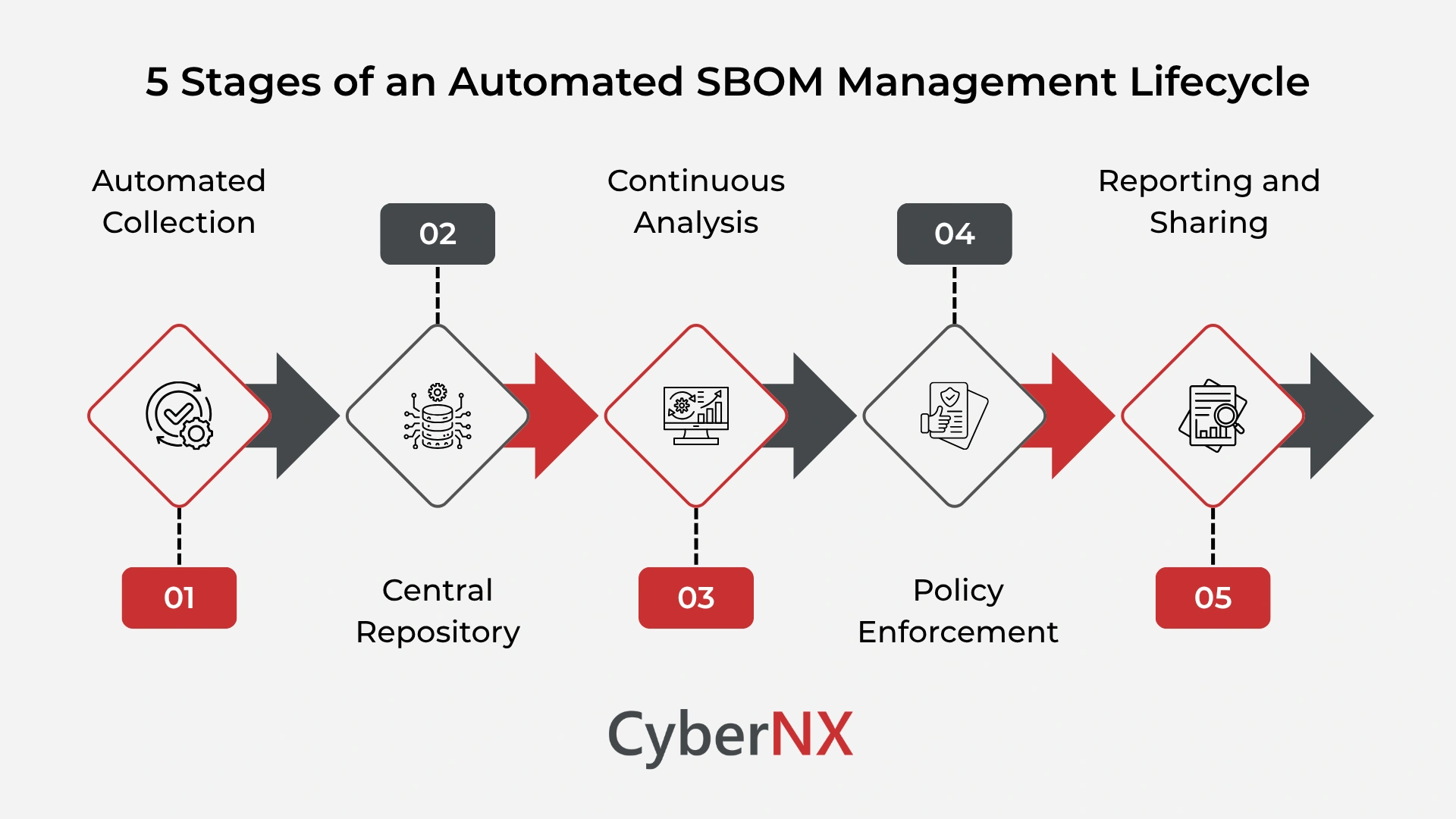
The five stages of an automated SBOM management lifecycle
Every stage in an automated SBOM management lifecycle either adds delay or removes it. The goal is to shorten the distance between a new advisory and a clear answer about your exposure.
1. Automated collection
Pull SBOMs from every source without asking anyone to run a command: build pipeline scans, container and registry scans and an intake path for supplier SBOMs. Support both CycloneDX and SPDX so vendor files need no rework.
2. Central repository
An SBOM management tool should hold every SBOM in one place with version history. When a component is flagged, you search one system, not fifteen repositories. Version control also lets you compare releases and see what changed.
3. Continuous analysis
Match stored SBOMs against fresh vulnerability and licence data as it arrives. Nothing needs rescanning. The inventory is already there, so exposure becomes a lookup instead of a project.
4. Policy enforcement
Define rules once and let the pipeline apply them. A build can fail on a critical vulnerability or a disallowed licence. Use VEX statements to record what is not exploitable, so teams stop chasing findings that carry no risk.
5. Reporting and sharing
Produce regulator-ready reports and share SBOMs through a controlled channel, not email. Log every access, because sharing evidence is itself an audit trail.
What Indian rules expect from your SBOM lifecycle
India now has three reference points, and all these frameworks favour SBOM processes that can be kept current and managed at enterprise scale.
- CERT-In Technical Guidelines v2.0, give detailed technical guidance for implementing SBOM and related BOM practices in India. It extends the model beyond software to cryptographic, quantum, AI and hardware bills of materials, ties SBOM generation to the software development lifecycle and points to VEX and CSAF for vulnerability status. The guidance is advisory, but sectoral regulators lean on it.
- SEBI CSCRF, issued through circular SEBI/HO/ITD-1/ITD_CSC_EXT/P/CIR/2024/113, is binding. Regulated Entities must maintain SBOMs for new and existing software supporting critical business activities. Where a legacy system cannot produce one, the entity needs a documented, board-level risk justification.
- The 2026 Minimum Elements for a Software Bill of Materials, published on 29 Jul 2026, is co-authored by CERT-In alongside CISA and other national agencies. It replaces the 2021 NTIA baseline and adds fields such as component hash algorithm, component licence, SBOM tool name and generation context. The emphasis is on machine-processable delivery, which is hard to meet manually.
How to start without disrupting delivery
An automated SBOM management lifecycle can be built in stages:
- Scope first: start with internet-facing and core business applications, not the whole estate
- Fix the format: pick CycloneDX or SPDX as your default and ask suppliers to match it
- Wire into CI/CD: attach automated SBOM generation to the build, so coverage grows on its own
- Write three policies: one for licences, one for vulnerability severity thresholds, one for supplier SBOM quality
- Set update triggers: regenerate on every release and on every dependency change
It is a good practice to measure progress by response time instead of file count. If your answer window drops from days to hours, the lifecycle is working.
Conclusion
Software supply chain risk is no longer about whether you hold an SBOM. It is about how quickly that inventory answers a question when there is a threat looming at odd hours. Manual processes cannot match systems that republish packages on their own, and Indian regulators have moved to machine-readable expectations.
An automated lifecycle gives you continuous collection, a searchable inventory and evidence that can hold in an audit. At CyberNX, our automated SBOM management lifecycle capabilities help you automate collection, centralise SBOM data and produce compliance-ready reporting for SEBI, RBI and CERT-In requirements. Talk to our experts and find out how our SBOM solutions can help you improve your software efficiency.
Automated SBOM management lifecycle FAQs
What is an automated SBOM management lifecycle?
It is an end-to-end process that generates, stores, analyses and shares software component inventories without manual effort at each step. Unlike one-time generation, an automated SBOM management lifecycle keeps the inventory current and searchable, so teams can confirm exposure to a new vulnerability in minutes.
How often should SBOMs be updated?
Regenerate an SBOM on every build or release and whenever dependencies change. CERT-In guidance links SBOM generation to the development lifecycle, and SEBI CSCRF expects Regulated Entities to keep SBOMs current for critical business software.
Does SEBI CSCRF require SBOM automation?
SEBI CSCRF does not name a specific tool or method. It does require Regulated Entities to maintain and update SBOMs across new and existing critical software, with a board-approved risk justification where legacy systems cannot produce one. At scale, meeting that consistently is difficult without an SBOM management tool.
What is the difference between SBOM generation and SBOM lifecycle management?
Generation produces the file. SBOM lifecycle management covers everything after that: storage, version control, continuous vulnerability matching, policy enforcement, reporting and secure sharing. Generation tells you what shipped. Lifecycle management tells you what it means today.