In Sep 2025, a self-replicating worm called Shai-Hulud began moving through the npm registry. It stole developer credentials, then used those credentials to poison more packages on its own. CISA issued a public alert on the attack, and fresh waves of the same campaign have surfaced repeatedly since.
The question every engineering team faced that week was straightforward: Does your stack contain any of those packages?
Without a current component inventory, answering that question can require a manual search across the systems. That gap is what a Software Bill of Materials (SBOM) is built to close. But an SBOM sitting untouched in a repository does nothing. Its value shows up only when teams put the data to work.
This post walks through the practical SBOM use cases that matter for Indian enterprises. You will see where the inventory helps security, compliance, procurement and legal teams, which use cases pay off fastest and how Indian regulations are shaping the order in which you should tackle them.
What is an SBOM and why do use cases matter?
An SBOM is a machine-readable inventory of every component inside a piece of software. It lists open-source libraries, third-party modules, versions, suppliers, licences and dependency relationships.
SBOM use cases are the specific jobs that inventory performs once it exists. Generating the file is the easy part. Feeding it into vulnerability management, audit evidence, procurement checks and incident response is where the return sits.
SBOM use cases list: Six jobs the inventory does well
Different teams pull different value from the same file. The six below consistently earn their keep in enterprise environments.
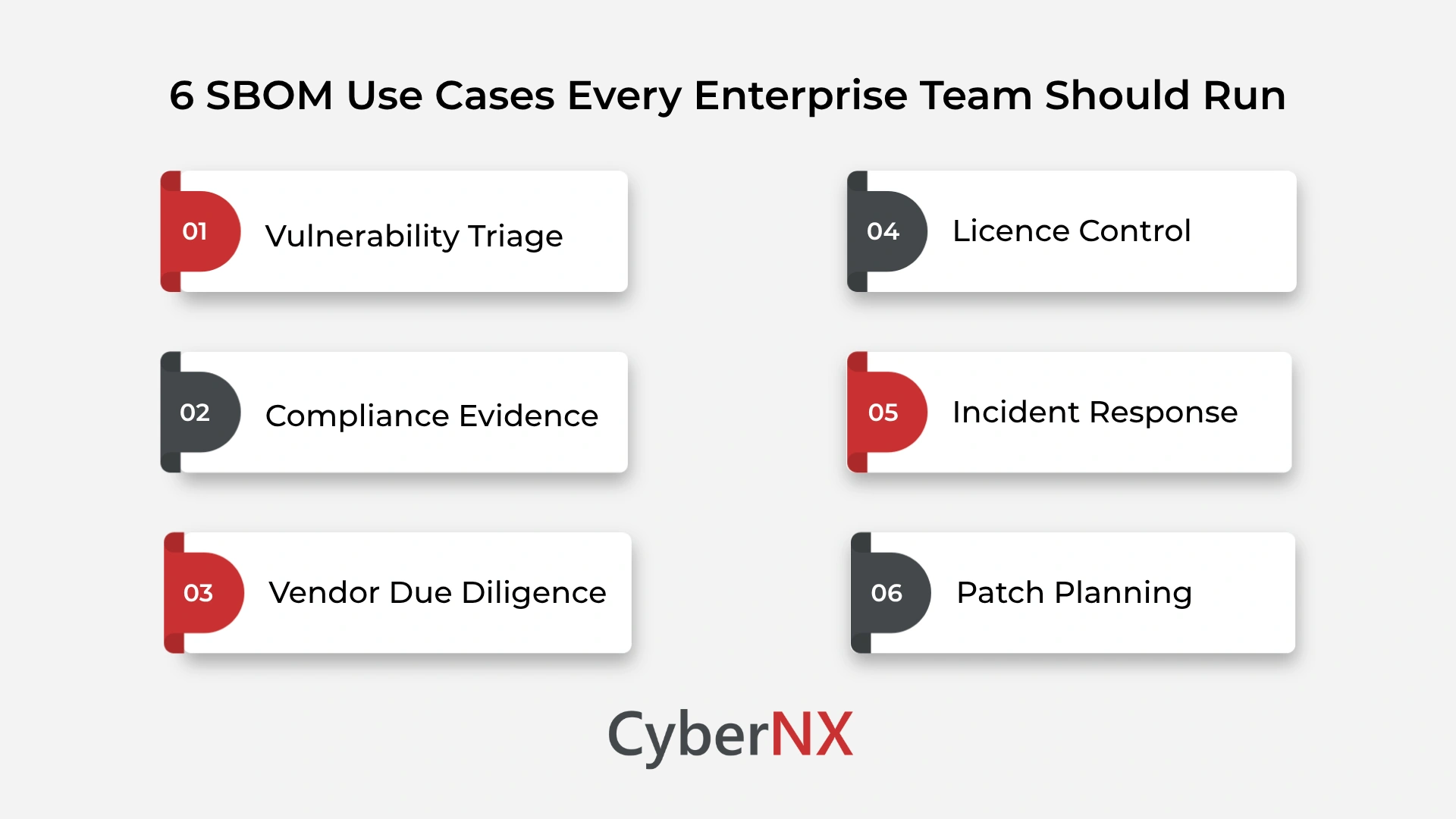
- Vulnerability triage: When a new CVE lands, a searchable component inventory turns a week of manual checking into a single query. This is the fastest payback of the lot.
- Compliance evidence: Regulators increasingly ask for component-level proof, not policy documents. An updated SBOM is the artefact that answers them.
- Vendor due diligence: Asking suppliers for an SBOM before signing shifts risk conversations to procurement, where you still have leverage.
- Licence control: Copyleft obligations buried in a transitive dependency can block a product launch. The inventory surfaces them early.
- Incident response: During a live incident, responders need blast radius fast. Component data with cryptographic hashes narrows the scope in minutes.
- Patch planning: Knowing which components are unmaintained or end-of-life lets teams retire risk on a schedule instead of under pressure.
SBOM use cases examples from Indian enterprise teams
Theory is quite easy. Here are practical examples of how Indian enterprise teams could apply SBOM data:
- A SEBI regulated broker maps each critical application to its component inventory, then produces the evidence its cyber audit requires without a scramble.
- An NBFC makes SBOM submission a clause in every new software contract, so vendor risk is documented before onboarding rather than after.
- A SaaS exporter ships an SBOM alongside each release, which shortens security questionnaires from overseas buyers and speeds up deal closure.
- A hospital group tracks embedded components inside connected medical devices, where patching windows are narrow and firmware is opaque.
How Indian rules shape the best SBOM use cases
Two Indian frameworks set the direction here. CERT-In published Technical Guidelines version 2.0 in Jul 2025, extending the model beyond software to cryptographic, quantum, AI and hardware bills of materials. Those guidelines provide an important technical reference for Indian firms designing SBOM programmes.
SEBI is stricter. Under the Cybersecurity and Cyber Resilience Framework (CSCRF) circular dated Aug 20, 2024, Regulated Entities must maintain SBOMs for critical systems, covering supplier names, licences, transitive dependencies, cryptographic hashes and update frequency. Where an SBOM cannot be obtained for a legacy system, the board has to approve a documented risk plan.
There is a global signal too. In Jul 2026, CERT-In was one of fifteen international agencies that joined CISA, the NSA and the FBI in publishing the 2026 Minimum Elements for a Software Bill of Materials. The practical effect for Indian firms is that procurement templates written against the older 2021 baseline are now out of date.
Conclusion
An SBOM is only as useful as the work it enables. The strongest ones share one trait: they connect component data to a decision someone has to make anyway, whether that is patching, buying, auditing or responding.
Getting there needs automated collection, a central repository and continuous analysis rather than a one-time scan. That is the difference between a compliance artefact and an operating control.
At CyberNX, our SBOM solutions help you automate collection, track vulnerabilities as components change and produce reporting aligned to SEBI and RBI expectations. Talk to our experts to understand all the SBOM use cases and find out where your software supply chain visibility currently stands.
SBOM use cases FAQs
What are the most common SBOM use cases?
These are vulnerability triage, regulatory compliance evidence, vendor due diligence, open-source licence management, incident response and patch planning. Vulnerability triage usually delivers value first because it converts a slow manual search into an instant query against a known component inventory.
What are some SBOM use cases examples for regulated Indian entities?
A SEBI Regulated Entity uses its inventory to produce component-level audit evidence. An NBFC writes SBOM delivery into vendor contracts. A software exporter ships an SBOM with each release to shorten buyer security reviews. Each example connects SBOM data to a practical security or compliance objective.
Which are the best SBOM use cases to start with?
Start with vulnerability response, then compliance reporting, then procurement. This sequence works because the first use case proves value to engineering teams quickly, the second reduces audit effort and the third depends on supplier cooperation that takes longer to secure.
How often should an SBOM be updated
An SBOM should be regenerated on every software change, release or upgrade. SEBI CSCRF states this directly for Regulated Entities. A stale inventory quietly breaks every use case built on it, because a query against last quarter’s component list will miss whatever shipped since.