When we assess APIs for clients, one pattern shows up almost every time. The team has tested the API, yet nobody has tested its security. Contract tests are green, and everyone feels safe. But in reality, the green signal doesn’t mean that there is no risk. There could be some hidden risks that you cannot even see.
Gartner predicted that APIs would become the most frequent attack vector for enterprise web applications. Moreover, in our service tenure, we have seen many API security risks that can expose organisations to potential attacks. This makes untested API security a real business risk.
In this blog, we explain DAST vs API contract testing in simple terms. You will learn what each method checks and where it falls short. We will also show how to use both without slowing your releases.
Why one testing method is never enough for APIs
An API can follow its documentation perfectly and still expose sensitive data.
You may run a payments platform, a patient portal or a retail app. In every case, your APIs carry some of your most valuable traffic. They connect mobile apps, partners and internal services, and every release can change something.
Functional checks tell you if the API works. Security checks tell you if it can be abused. These are two different questions, and each needs its own answer. That is why DAST vs API contract testing is not an either-or debate.
What DAST does well and where it struggles
DAST tests a running application from the outside, the way an attacker would.
It sends crafted requests and observes how the application responds. This helps it flag injection flaws, weak authentication and exposed endpoints. Runtime issues like missing rate limits and verbose error messages also show up here.
The biggest strength is that DAST needs no source code. It works with any language or framework, and it shows real runtime behaviour.
The limits show up when the target is an API rather than a web page:
- Token-based logins and multi-step flows often disrupt the scanner.
- Undocumented endpoints stay invisible, so they never get tested.
- Business logic flaws, such as one user reading another user’s data, are easy to miss.
Scans can also run for hours, so many teams schedule them late in the cycle.
What API contract testing checks
A contract is the agreement between an API and the apps that use it.
It usually lives in an OpenAPI file, a GraphQL schema or a gRPC definition. Contract testing confirms that requests and responses match that agreement. It checks field names, data types, status codes and required parameters.
Its real value is catching breaking changes early. A renamed field can break a mobile app, and a contract test flags it before release. In microservice setups, teams often use consumer-driven contracts. Each consuming service states what it expects, and the provider must keep meeting it.
There is one important point to note. Contract testing is not a security method. It proves the API matches its specification, but the specification itself may be unsafe. If your contract lets an endpoint return full customer records, the test still passes.
DAST vs API contract testing at a glance
Both methods look at the same API, yet they ask different questions. This table puts them side by side, so you can compare them quickly.
| Comparison area | DAST | API contract testing |
| Primary purpose | Find security vulnerabilities | Verify API compatibility |
| Testing target | Running application or API | API implementation against its contract |
| Main concern | Exploitable security weaknesses | Unexpected requests, responses, or changes |
| Typical timing | During testing and before release | During development and integration |
| Common findings | Injection flaws, access control weaknesses, information exposure | Missing fields, incorrect data types, breaking changes |
| Source code access | Usually not required | Usually unnecessary for consumer-driven tests |
| Security coverage | Tests selected runtime security behaviours | Does not provide comprehensive security testing |
| Input needed | A deployed environment, ideally with the API specification and login credentials | An OpenAPI, GraphQL or gRPC definition |
| Main limitation | Can miss undocumented endpoints and business logic flaws | Passes even when the contract itself is unsafe |
| Typical owner | Security team | Development or QA team |
| Main benefit | Identifies weaknesses in running applications | Helps maintain reliable integrations |
In short, one method checks safety and the other checks consistency.
DAST vs API contract testing: How to use both together
The two methods work best when each one covers the other’s blind spots.
You do not need to choose one. A layered approach is simple to set up, and it fits most pipelines. Here is the order we suggest:
- At commit: Run contract tests on every pull request to catch breaking changes.
- At build: Review the specification for weak definitions, such as missing authentication rules.
- At staging: Run authenticated DAST scans against the deployed API.
- After release: Schedule regular scans, because new endpoints appear over time.
Here is a practical suggestion from our own testing work. Provide your contract to the DAST scanner as an input. It then knows every documented endpoint and parameter, so the scan covers far more ground. Add credentials for each user role, too. That is how you catch one role reaching another role’s data.
Ownership matters as well. Developers usually own contract tests, since they know the specification best. Security teams own the DAST rules and the triage. Keep both sets of results in one place, so nobody works with incomplete information. It also gives auditors clear evidence of regular testing.
Where your API testing coverage still has gaps
Even a layered plan leaves some risks untouched. The graphic below shows what each method catches and what goes undetected by both.
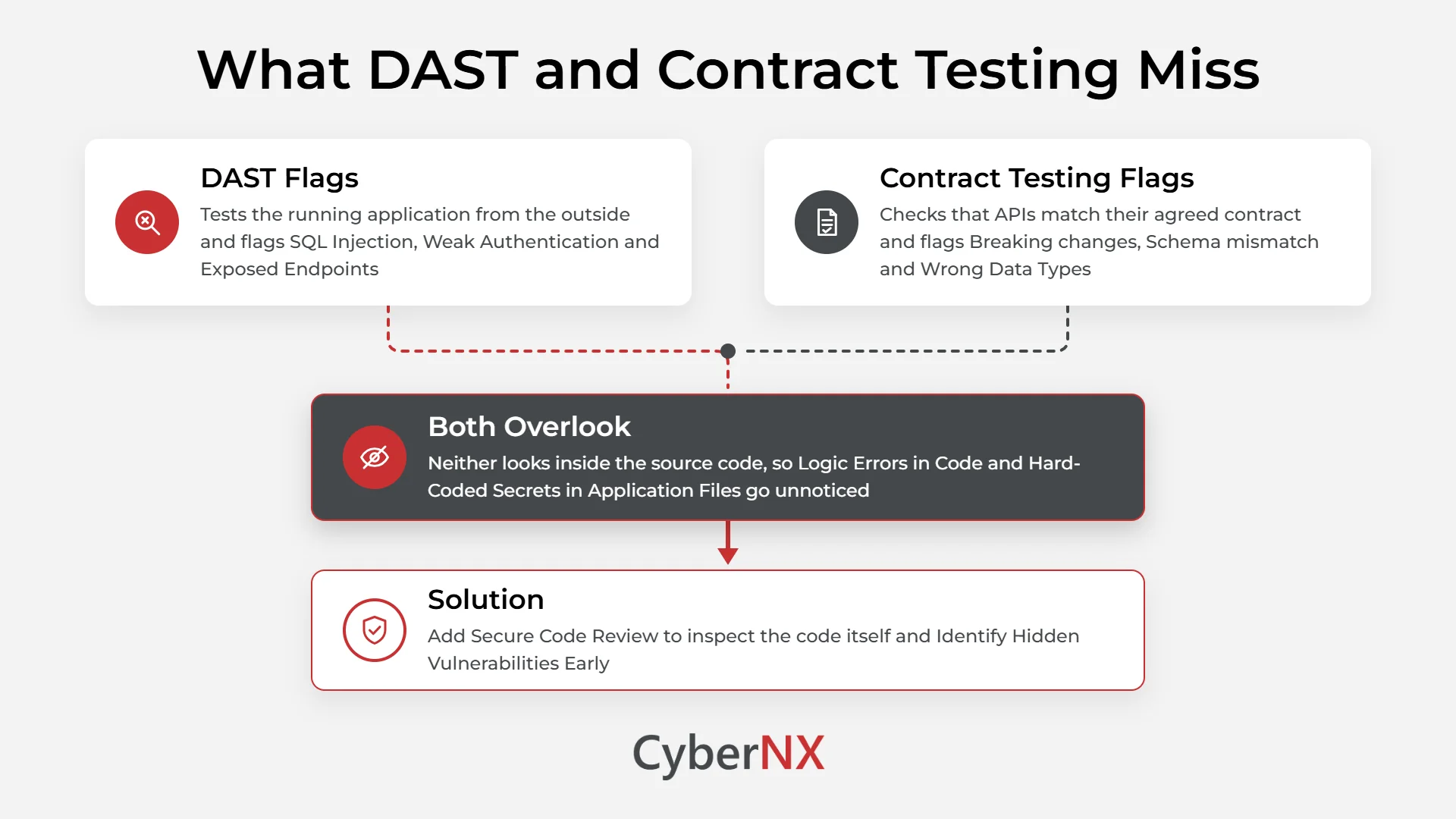
The flaws that remain undetected concern us most, because they stay hidden inside the source code. We also see a few habits that widen the gap:
- Treating a passing contract test as proof of security.
- Running DAST once before a big launch and never again.
- Scanning without login credentials, which leaves protected endpoints untested.
- Letting old endpoints keep running after the specification has moved on.
If you can only begin with one method, let your biggest risk decide. Teams with many internal services and frequent releases often start with contract testing. Teams that expose public or partner APIs should start with DAST. Either way, plan to add the second method within a quarter.
Conclusion
DAST and contract testing are partners, not rivals. DAST shows how your API behaves under attack, while contract testing keeps its behaviour consistent. Knowing the difference between DAST vs API contract testing helps you place each one where it works best.
Still, neither method reads your code. Logic errors, weak authorisation checks and hard-coded secrets can remain undetected in the source. This is where a secure code review service fills the gap. At CyberNX, our experts review your code line by line. We then test the running application to confirm what can really be exploited. If you want a clear view of your API risk, you can reach out to our team today.
DAST vs API contract testing FAQs
Can API contract testing replace DAST?
No. Contract testing checks that your API matches its specification. It does not look for attacks or weak security settings, so you still need DAST for security coverage.
Can DAST test APIs properly?
Yes, but only if the scanner understands APIs. Many older scanners were built for web pages, so they struggle with token-based logins and multi-step requests. Give the scanner your specification file and valid credentials for each user role. This helps it find every documented endpoint and test them as a real user would. Without these inputs, coverage remains limited.
Which method should we run first?
It depends on your biggest risk. If you expose public or partner-facing APIs, start with DAST. If you release often across many internal services, contract testing usually gives faster value. Plan to add the second method within a quarter.
How often should we run DAST on our APIs?
Run it on every major release in staging. Add scheduled scans as well, since new endpoints and configuration changes appear between releases. For high-risk APIs, such as payments or patient data, many teams scan weekly.
What do both methods miss?
Flaws that live inside the code, such as weak authorisation logic and hard-coded secrets.
Is a secure code review still needed if we already run DAST?
Yes. DAST sees only what the running application shows from outside. It cannot read your source code, so it misses logic errors, unsafe functions and stored credentials. A secure code review examines the code itself and finds these issues before they reach production. Used together, the two methods give you a much clearer view of your API risk.