A board asks a simple question: Are we ready for quantum? The CISO’s team comes back with two different answers on the same slide, one calling it a CBOM project and the other calling it a PQC readiness assessment. Both are correct but neither is the full picture.
That confusion is common, and it often costs teams a lot of time before anyone realises the two are not competing options. A Cryptography Bill of Materials (CBOM) and a PQC readiness assessment answer different questions, and getting the sequence wrong means either building a plan with no visibility behind it or building an inventory with no plan attached. This guide breaks down the real difference between CBOM and a PQC readiness assessment, and how the two fit together.
What is a CBOM, and how is it different from a PQC readiness assessment?
A CBOM is an inventory. It catalogues every cryptographic asset across your systems, including algorithms, key lengths, certificates, protocols and the libraries that implement them, built using recognised BOM formats like CycloneDX or SPDX. It answers one question: what cryptography exists, and where.
A PQC readiness assessment is broader. It uses the CBOM as an input, then layers on risk prioritisation, governance maturity, hybrid deployment planning and supply chain review. Current NIST guidance recommends testing cryptographic discovery, governance, migration planning, hybrid deployment and supply-chain dependencies as part of post-quantum readiness. In short, a CBOM tells you what you have. A PQC readiness assessment tells you what to do about it and by when.
CBOM vs PQC readiness assessment
Understanding where each one starts and stops keeps procurement conversations and internal planning from talking past each other.
- Scope: A CBOM is a technical inventory. A PQC readiness assessment covers inventory plus governance, risk and roadmap.
- Output: A CBOM produces a structured asset list. A readiness assessment produces a prioritised migration plan.
- Frequency: A CBOM needs continuous updates as systems change. A readiness assessment is typically run periodically to track programme progress.
- Ownership: A CBOM is usually built and maintained by security engineering. A readiness assessment involves security, risk, procurement and the board.
- Dependency: A readiness assessment cannot be accurate without a current CBOM feeding into it. The reverse is not true.
Why Indian BFSI needs both
SEBI’s CSCRF encourages detailed software and cryptographic asset visibility as part of cyber resilience, making both cryptographic inventories and migration planning very important.
CERT-In’s Technical Guidelines v2.0 go further, formally defining a CBOM for cryptographic assets and a QBOM for quantum-readiness planning, treating the two as connected but distinct deliverables.
Building only a CBOM leaves you with a detailed list and no roadmap to show a regulator or a board. Running only a readiness assessment without a current CBOM means the risk ratings and migration priorities are built on assumptions rather than a verified inventory. Institutions preparing for either SEBI, CERT-In or RBI scrutiny need both pieces in place, not a choice between them.
How to sequence CBOM vs PQC readiness assessment work
Trying to run both at once usually stalls, since the readiness assessment has nothing accurate to score. Sequencing avoids that.
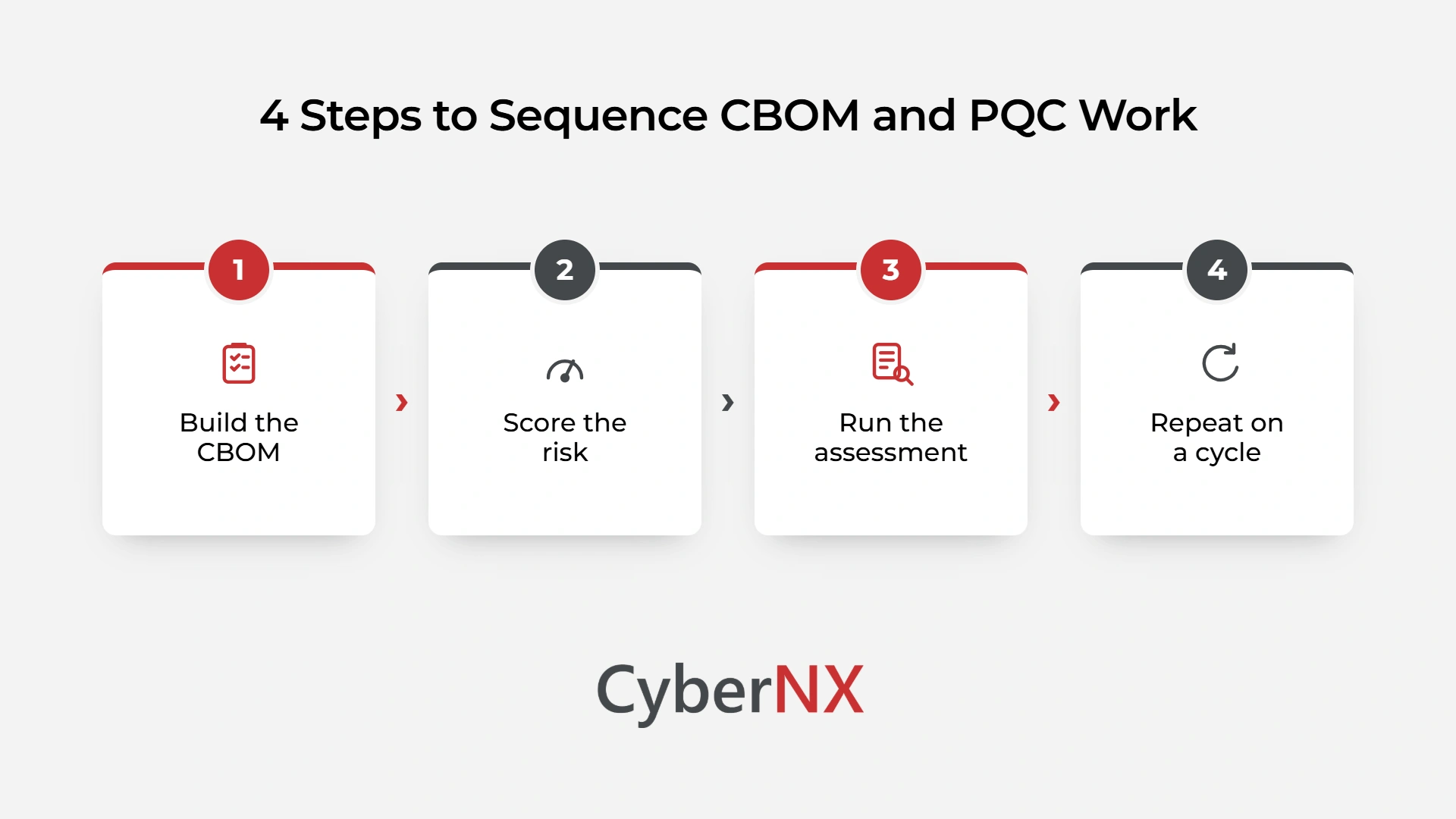
- Build the CBOM first: Discover and catalogue cryptographic assets across code, cloud and hardware security modules.
- Score the risk: Map each asset to data sensitivity and harvest now, decrypt later exposure.
- Run the readiness assessment: Layer governance, hybrid deployment and supply chain review on top of the verified inventory.
- Repeat on a cycle: Refresh the CBOM continuously and revisit the readiness assessment periodically as systems and regulations change.
Conclusion
Understanding CBOM and PQC readiness assessment is key to improving your organisation’s cryptographic health. One is the inventory, the other is the plan built on top of it, and Indian BFSI institutions preparing for SEBI, CERT-In or RBI scrutiny need both in sequence -not as a choice between them.
CyberNX’s NXRADAR platform builds your CBOM and feeds it directly into a structured readiness review, closing the CBOM vs PQC Readiness Assessment gap with one connected workflow. Connect with our experts to check our CBOM solutions and to see where to start.
CBOM vs PQC Readiness Assessment FAQs
Is a CBOM the same as a PQC readiness assessment?
No. A CBOM is a cryptographic inventory. A PQC readiness assessment is a broader review that uses the CBOM as an input along with governance, risk and migration planning.
Which one should an organisation build first?
Start with the CBOM. A readiness assessment run without a current inventory produces risk ratings based on assumptions rather than verified data.
Does SEBI or CERT-In require both?
SEBI’s CSCRF focuses on comprehensive asset visibility, cyber resilience and risk-based planning. CERT-In’s Technical Guidelines v2.0 define separate concepts for CBOM and QBOM, making them useful complementary practices for post-quantum readiness.
How often should each be updated?
A CBOM needs continuous updates as systems change. A readiness assessment is usually revisited periodically to track programme progress against migration milestones.