Adversaries are playing the waiting game. Encrypted data moving across networks today is being collected to decrypt it once a sufficiently powerful quantum computer exists. This is known as Harvest Now, Decrypt Later, and it changes the maths on encryption entirely.
It is important to emphasize the fact that data with a long confidentiality lifespan such as financial records and health data could be exposed the moment it is intercepted, and not the moment a quantum computer arrives.
That’s precisely why post quantum readiness is the conversation to have now. Because it is the work of closing that gap before it becomes exploitable.
To give you an overview, this guide covers:
- what post-quantum cryptography replaces
- why hybrid deployment is the practical path forward
- how regulation is shaping the timeline, and
- why a cryptographic inventory has to come before any migration begins
The dawn of post-quantum cryptography
Post-Quantum Cryptography (PQC) sounds like dystopian. However, the recent breakthroughs at breakneck speed points toward the fact that it will replace the public-key algorithms that quantum computers are expected to break. RSA, ECC and Diffie-Hellman all rely on mathematical problems, such as factoring large numbers or solving discrete logarithms, that classical computers find infeasible but quantum computers are expected to solve efficiently using Shor’s algorithm.
PQC substitutes these with algorithms built on different mathematical foundations that remain hard for both classical and quantum computers to break. ML-KEM handles key exchange, replacing the role Diffie-Hellman and ECC play in establishing a shared secret between two parties. ML-DSA and SLH-DSA handle digital signatures, replacing RSA and ECDSA in verifying that a message or document has not been tampered with.
This is a targeted replacement, not a wholesale rebuild of cryptography. Symmetric encryption, such as AES, and hashing algorithms, such as SHA-2, are not the primary concern. Quantum computers weaken symmetric algorithms less severely, and doubling key lengths is generally sufficient to maintain their security margin. The functions genuinely at risk are key establishment and signature verification, which is exactly where PQC concentrates its effort.
Is hybrid deployment the practical path to quantum resistance?
Moving directly from classical algorithms to post-quantum ones in a single step is not how most organisations approach migration, and for good reason. A hybrid approach combines a classical algorithm with a post-quantum algorithm in the same handshake or signature process. If either algorithm holds, the connection remains secure.
This matters for two practical reasons:
- First, it protects against a scenario where a flaw is later found in a newly standardised PQC algorithm, since the classical algorithm running alongside it provides a fallback.
- Second, it avoids a flag-day cutover, the kind of hard switchover date where every system must support the new standard simultaneously or risk breaking connectivity with partners, vendors and legacy infrastructure that have not yet migrated.
Crypto-agility is what makes this transition manageable over time. An organisation with crypto-agile infrastructure, where algorithms are configurable rather than hardcoded into applications and hardware, can swap or update cryptographic algorithms as a configuration change. Without that agility, each future algorithm update becomes its own re-architecture project rather than a scheduled change.
How global regulation is shaping post-quantum readiness
Regulatory direction has moved from advisory to specific over the past two years.
- NIST IR 8547 outlines the transition away from quantum-vulnerable algorithms and the timeline federal systems are expected to follow.
- The Commercial National Security Algorithm Suite (CNSA) 2.0 mandates quantum-resistant algorithms for national security systems, with phased deadlines already in motion.
- PCI DSS 4.0 has extended its cryptographic requirements to account for emerging threats, pushing payment card infrastructure toward the same quantum-safe direction. This regulatory weight sits on ratified ground rather than draft proposals.
ML-KEM, ML-DSA and SLH-DSA are formalised as FIPS 203, FIPS 204 and FIPS 205. This distinction matters for planning. Building a migration roadmap around finalised standards means the underlying algorithms will not change beneath a project already underway, unlike building around draft specifications that remain open to revision.
How Indian regulation is shaping post-quantum readiness
India’s regulators are moving on a parallel track.
1. RBI
The Reserve Bank of India has formed the Q-SAFE Expert Committee, an eight-member panel chaired by Dr Anil Prabhakar of IIT Madras with representation from SBI, NPCI, MeitY and DSCI, tasked with building a cryptographic inventory across the financial sector, assessing crypto-agility, and recommending a roadmap to quantum-secure Indian banking.
The committee’s terms of reference name a Cryptography Bill of Materials as the tool for that inventory, the same starting point this guide identifies as step zero.
2. SEBI
SEBI has set its own marker. Chairman Tuhin Kanta Pandey has confirmed 2028-29 as the target operational date for quantum-safe systems across regulated market infrastructure, describing the scale of preparation required as comparable to the Y2K transition.
For BFSI organisations, this means post quantum readiness is no longer a purely technical roadmap. It sits on a regulatory timeline with named committees, defined deliverables and a stated target date, which makes starting the cryptographic inventory now a compliance decision as much as a security one.
Why a cryptographic bill of materials comes before PQC migration
A cryptographic bill of materials (CBOM) is a structured inventory of every cryptographic asset across an organisation’s systems: which algorithms are in use, where they sit, what data they protect, and how long that protection needs to hold. It plays the same role for cryptography that a software bill of materials plays for application components.
The relationship between CBOM and PQC migration is sequential. The CBOM is step zero. It tells you what needs to migrate and in what order, based on which systems handle the highest-risk, longest-lived data. PQC migration itself is the multi-year work that follows, moving systems from classical to quantum-safe algorithms in a prioritised sequence.
Without a CBOM, migration planning becomes guesswork. An organisation cannot prioritise a system it does not know uses vulnerable cryptography, and it cannot prove to a regulator or auditor that a migration was comprehensive if there is no record of what existed beforehand. The inventory is what turns migration from a broad technical initiative into a measurable, sequenced programme with a defined starting point and a way to track progress against it.
How to build a post-quantum readiness roadmap
A practical roadmap follows the same sequence regardless of industry or organisation size.
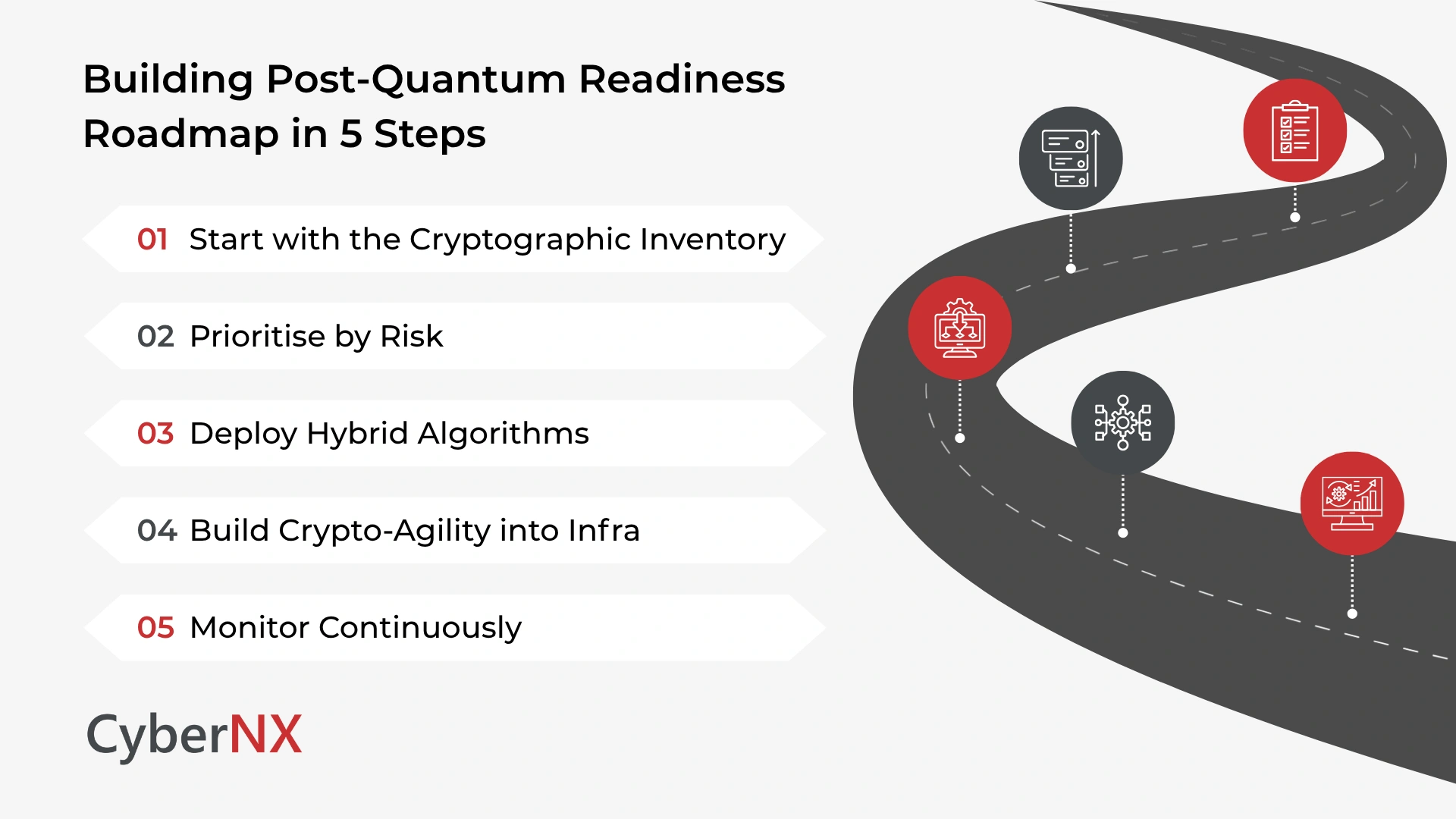
- Start with the cryptographic inventory. Build the CBOM across applications, infrastructure, certificates and third-party dependencies before setting any migration timeline.
- Prioritise by risk. Rank systems by the sensitivity and confidentiality lifespan of the data they protect, moving long-lived, high-value data to the front of the queue.
- Deploy hybrid algorithms where classical and post-quantum cryptography run together, maintaining compatibility with systems and partners still on classical algorithms.
- Build crypto-agility into infrastructure so that future algorithm updates are configuration changes rather than re-architecture projects.
- Monitor continuously. Post quantum readiness is not a single project with an end date. Standards, vendor support and threat timelines will keep shifting, and the CBOM needs to stay current as systems change.
Conclusion
Post quantum readiness is a sequenced programme that starts with visibility and ends with crypto-agile infrastructure that can absorb whatever comes next. If you treat cryptographic inventory as step zero, you will move through PQC migration on your own timeline rather than a regulator’s. CyberNX helps organisations build that inventory and sequence the migration through CBOM solutions and PQC capabilities. Get in touch with our team to scope your post-quantum readiness roadmap.
Post Quantum Readiness FAQs
How long does a post-quantum readiness migration take?
Timelines vary with organisational size and infrastructure complexity, but multi-year programmes are the norm rather than the exception, particularly for organisations with legacy systems or hardware-embedded cryptography.
Is hybrid post-quantum cryptography secure enough for production use?
Yes. Hybrid deployment is the widely recommended transitional approach, since it requires both the classical and post-quantum algorithm to fail before security is compromised.
Does PCI DSS 4.0 require post-quantum cryptography immediately?
PCI DSS 4.0 has extended cryptographic requirements in anticipation of quantum risk, but organisations should treat this as a signal to begin planning now rather than a single immediate deadline.
What happens to symmetric encryption like AES in a post-quantum world?
Symmetric algorithms such as AES remain comparatively resilient against quantum attacks. Increasing key lengths is generally sufficient, which is why PQC efforts focus on public-key algorithms instead.