Choose Language
Google Translate
Skip to content
Facebook X-twitter Instagram Linkedin Youtube
  • sales@cybernx.com
  • +91 90823 52813
CyberNX Logo
  • Home
  • About
    • About Us
    • CERT-In Empanelled Cybersecurity Auditor
    • Awards & Recognition
    • Our Customers
  • Services

    Peregrine

    • Managed Detection & Response
    • AI Managed SOC Services
    • Elastic Stack Consulting
    • CrowdStrike Consulting 
    • Threat Hunting Services
    • Digital Risk Protection Services
    • Threat Intelligence Services
    • Digital Forensics Services
    • Brand Risk & Dark Web Monitoring
    • Full Stack Observability

    Pinpoint

    • Red Teaming Services
    • Vulnerability Assessment
    • Penetration Testing Services
    • Secure Code Review Services
    • Cloud Security Assessment
    • Phishing Simulation Services
    • Breach and Attack Simulation Services

    nCompass

    • Cybersecurity Audit Services
    • Virtual CISO Services
    • DPDP Act Consulting
    • ISO 27001 Consulting
    • RBI Master Direction Compliance
    • SEBI CSCRF Framework Consulting
    • SEBI Cloud Framework Consulting
    • Security Awareness Training
    • Cybersecurity Staffing Services

    NXRadar

    • SBOM Solutions
    • CBOM Solutions
    • AIBOM Solutions
  • Industries
    • Banking
    • Financial Services
    • Insurance
  • Resources
    Blogs
    Case Studies
    Downloads
    Whitepapers
    Buyer’s Guide
    Research & Guides
    Data Sheets
  • Careers
  • English (US)
    • English
Contact Us
CyberNX Logo
  • English (US)
    • English
  • Home
  • About
    • About Us
    • CERT-In Empanelled Cybersecurity Auditor
    • Awards & Recognition
    • Our Customers
  • Services

    Peregrine

    • Managed Detection & Response
    • AI Managed SOC Services
    • Elastic Stack Consulting
    • CrowdStrike Consulting
    • Threat Hunting Services
    • Digital Risk Protection Services
    • Threat Intelligence Services
    • Digital Forensics Services
    • Brand Risk & Dark Web Monitoring
    • Full Stack Observability

    Pinpoint

    • Red Teaming Services
    • Vulnerability Assessment
    • Penetration Testing Services 
    • Secure Code Review Services
    • Cloud Security Assessment
    • Phishing Simulation Services
    • Breach and Attack Simulation Services

    nCompass

    • Cybersecurity Audit Services
    • Virtual CISO Services
    • DPDP Act Consulting
    • ISO 27001 Consulting
    • RBI Master Direction Compliance
    • SEBI CSCRF Framework Consulting
    • SEBI Cloud Framework Consulting
    • Security Awareness Training
    • Cybersecurity Staffing Services

    NXRadar

    • SBOM Solutions
    • CBOM Solutions
    • AIBOM Solutions
  • Industries
    • Banking
    • Financial Services
    • Insurance
  • Resources
    Blogs
    Case Studies
    Downloads
    Whitepapers
    Buyer’s Guide
    Research & Guides
    Data Sheets
  • Careers
  • Contact

Post-Quantum Readiness Concerns: Why Waiting is the Costliest Move for Indian BFSI

3 min read
5 Views
  • CBOM

Somewhere inside your core banking stack exists a certificate, a key or an encryption library that nobody has touched in years. It still works, so nobody questions it. That exact quiet assumption is what a quantum-capable attacker is counting on. Data that is encrypted today with RSA or ECC can be captured now and decrypted later, once quantum computers catch up – a tactic security teams call harvest now, decrypt later.

That single risk is behind most of the post-quantum readiness concerns security leaders raise today. India’s Department of Science and Technology released its National Quantum Mission task force report in Feb 2026, recommending that critical and financial infrastructure begin formal post-quantum cryptography (PQC) implementation by 2027. This blog walks through what is driving these concerns and a structured way to work through them.

Table of Contents

What is driving concern around post-quantum readiness right now?

Quantum computing has not yet broken today’s encryption but attackers do not need a working quantum computer today. They only need to store encrypted data now and wait.

For Indian BFSI, the exposure runs deep. Core banking systems, KYC archives, interbank settlement and SWIFT messaging all depend on RSA or ECC at multiple layers, often across decades-old infrastructure. A 2026 Hybrid Cloud Security Survey by Gigamon found that 88 percent of financial services organisations already cite harvest now, decrypt later as a major problem, with 93 percent saying visibility into encrypted traffic is critical to post-quantum readiness.

5 concerns slowing post-quantum readiness in Indian BFSI

Most of these concerns fall into a handful of recurring patterns. Naming them clearly is the first step toward a plan.
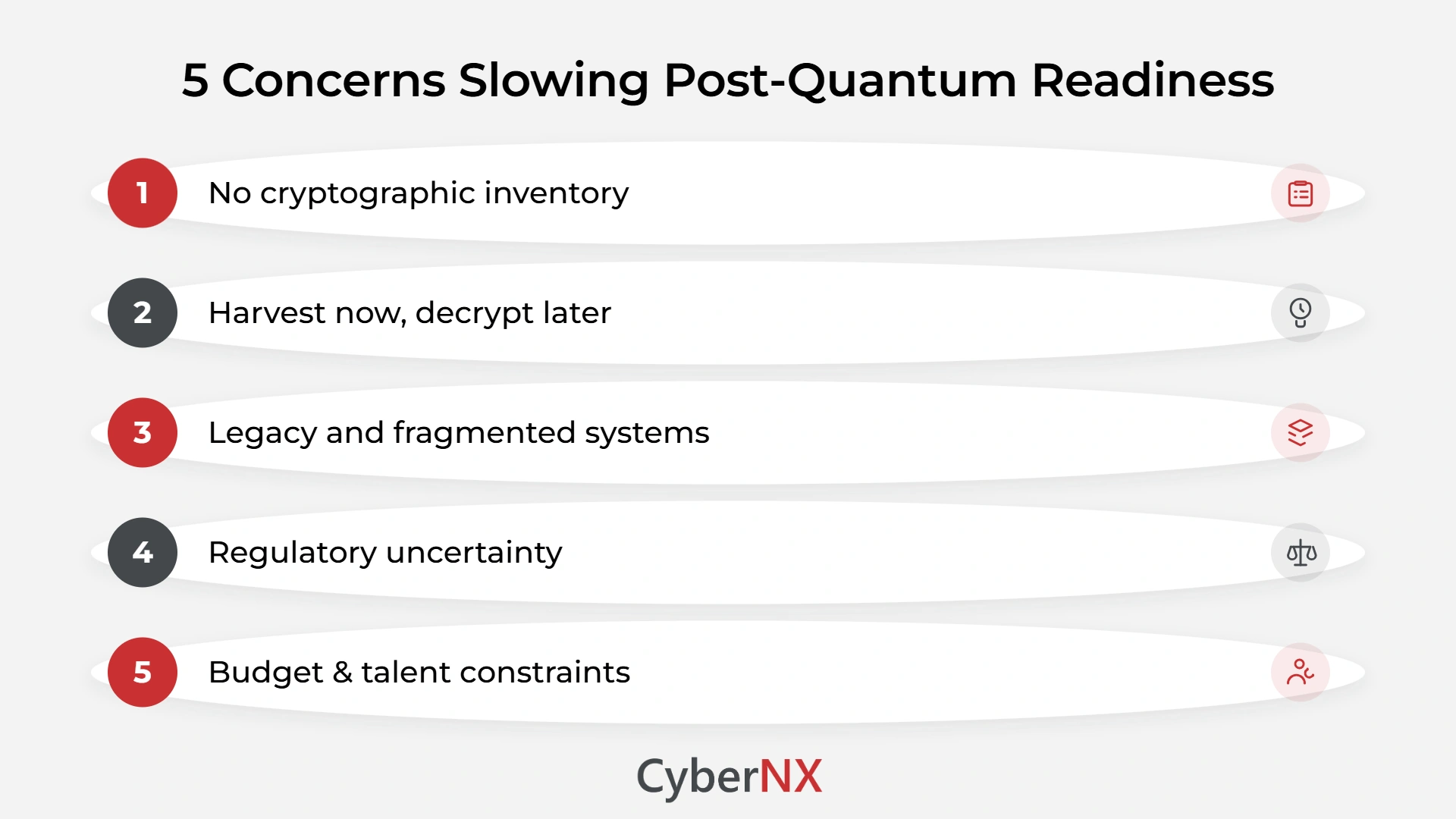
5 Concerns Slowing Post-Quantum Readiness

  • No cryptographic inventory: Security teams cannot say with confidence where every key, certificate and algorithm lives across code, cloud and hardware security modules.
  • Harvest now, decrypt later exposure: Long-lived data such as KYC records, contracts and payment history stays valuable to attackers for years after it is stolen.
  • Legacy and fragmented systems: Public sector banks and large enterprises run core systems built over decades, often with multiple hardware security modules and key stores across business units.
  • Regulatory uncertainty: RBI has not yet issued an explicit PQC migration mandate, even as SEBI’s CSCRF and the DST Task Force move toward firmer timelines and CBOM requirements.
  • Budget & talent constraints: Companies focus more on immediate cyber threats over long-term quantum preparation. When this is combined with limited in-house expertise, it leads to delays in planning and adoption of quantum-resistant cryptography.

Why these concerns are sharper for Indian BFSI

India’s regulatory picture is moving fast, even without a single unified deadline yet. SEBI’s CSCRF already encourages regulated entities to inventory cryptographic assets and prioritise post-quantum migration by risk. The DST Task Force report recommends introducing PQC readiness requirements in procurement, including phased adoption of CBOMs and vendor CBOM submissions beginning from FY 2027–28.

RBI-regulated institutions should plan on two assumptions: supervisory expectations will tighten within the next few regulatory cycles, and institutions that show early, structured progress will fare better at examination than those waiting for an explicit mandate.

How to build post-quantum readiness with a structured plan

A defensible plan does not require solving everything at once. It requires sequencing the work correctly.
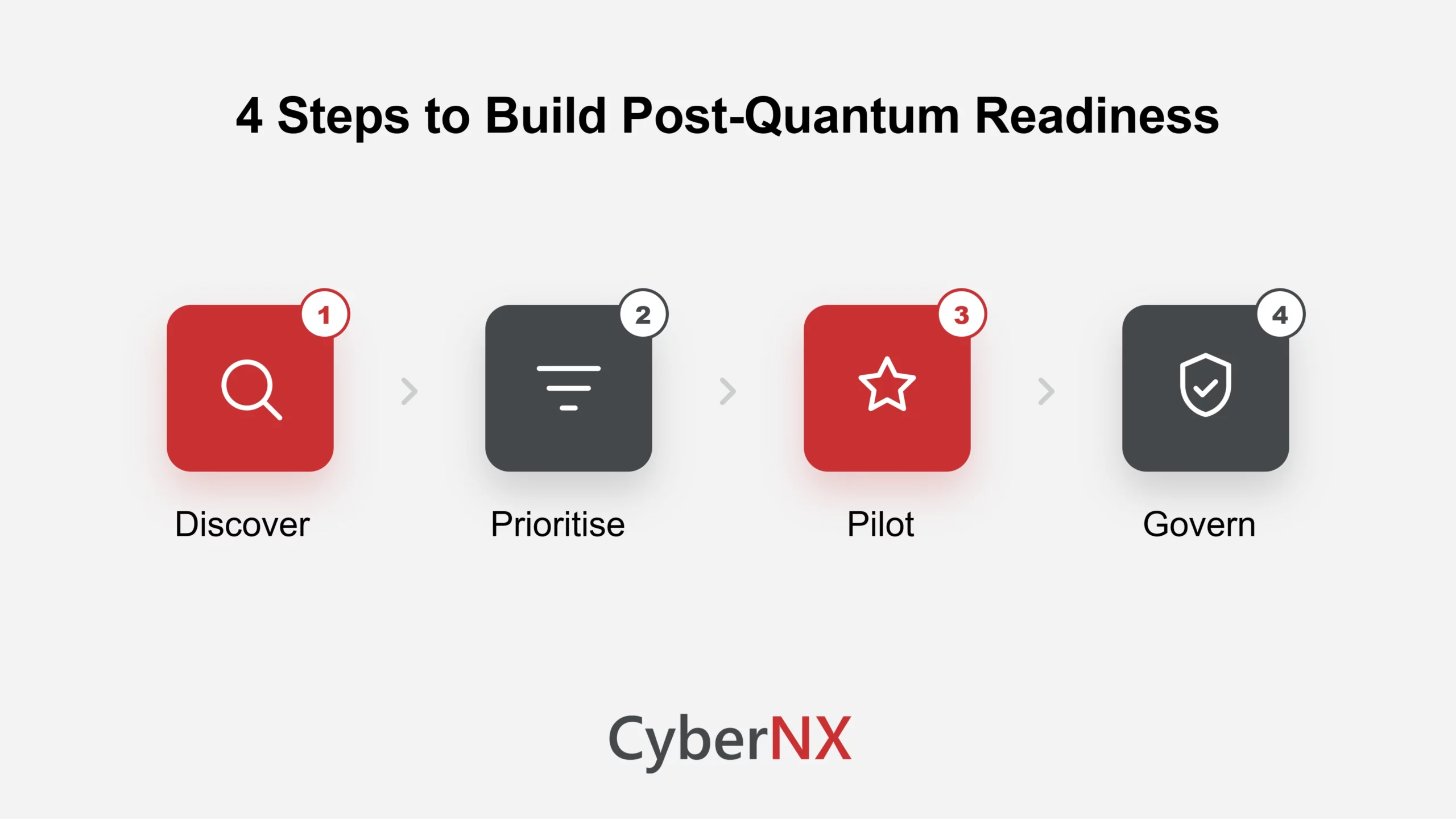
4 Steps to Build Post-Quantum Readiness

  • Discover: Build a complete cryptographic inventory across applications, cloud, HSMs and third-party integrations.
  • Prioritise: Rank systems by data sensitivity and harvest now, decrypt later exposure, not just technical complexity.
  • Pilot: Test hybrid PQC and classical cryptography in non-production environments before wider rollout.
  • Govern: Build crypto-agility into procurement and architecture so algorithms can be swapped without rebuilding systems.

Conclusion

These concerns are not a future problem for Indian BFSI. Broken systems, harvest now decrypt later exposure and tightening frameworks from SEBI, RBI and the DST Task Force all point the same way: institutions that build a cryptographic inventory now will migrate on their own timeline, not a regulator’s.

CyberNX’s NXRADAR platform helps you address post-quantum readiness concerns with continuous cryptographic discovery across code, cloud and HSMs, mapped to India’s growing compliance requirements. Connect with our experts to check out our CBOM solutions and see where your institution stands today.

Post-Quantum Readiness Concerns FAQs

What are the biggest concerns for post-quantum readiness at Indian banks?

Fragmented legacy systems, unclear regulatory timelines and limited visibility into where cryptography lives across the estate are the concerns raised most often by Indian BFSI security teams.

Has RBI mandated post-quantum cryptography migration?

Not yet as an explicit standalone mandate, though RBI’s existing cybersecurity frameworks and India’s DST Task Force roadmap both point toward tightening supervisory expectations within the next few regulatory cycles.

What is harvest now, decrypt later?

It is a tactic where attackers collect encrypted data today and store it, planning to decrypt it once quantum computers become capable enough. Long-lived records such as KYC data are more exposed.

Where should organisations start with post-quantum readiness?

Start with a complete cryptographic inventory. You cannot prioritise or migrate what you have not first discovered and mapped to business risk.

Gopakumar Panicker

Author
Gopakumar Panicker
LinkedIn

An accomplished security professional with extensive experience in Digital Security, Cloud Security, Cloud Architecture, Security Operations, and BFSI Compliance, Gopa has contributed to designing and strengthening enterprise-grade security environments, ensuring alignment with both technical and regulatory requirements. His work focuses on building resilient, scalable architectures and guiding organisations in elevating their operational maturity while meeting the stringent expectations of modern BFSI and cloud-driven ecosystems.

Share on

WhatsApp
LinkedIn
Facebook
X
Pinterest

For Customized Plans Tailored to Your Needs, Get in Touch Today!

Connect with us

RESOURCES

Related Blogs

Explore our resources section for insightful blogs, articles, infographics and case studies, covering everything in Cyber Security.
CBOM Vendor Selection Guide 2026

CBOM Vendor Selection: A 2026 Buyer’s Guide for BFSI Compliance

CERT-In’s Technical Guidelines v2.0 have already put the cryptographic bill of materials on the compliance map for Indian entities, introducing

CBOM vs PQC Readiness Assessment: Where to Start

CBOM vs PQC Readiness Assessment: Where Should Your Team Start?

A board asks a simple question: Are we ready for quantum? The CISO’s team comes back with two different answers

Bills of Materials for Quantum Readiness: A CISO's Guide

Bills of Materials for Quantum Readiness: A CISO’s Guide

Every application that your bank or insurer runs – depends on some sort of cryptography that actually spreads faster than

RESOURCES

Cyber Security Knowledge Hub

Explore our resources section for insightful blogs, articles, infographics and case studies, covering everything in Cyber Security.

BLOGS

Stay informed with the latest cybersecurity trends, insights, and expert tips to keep your organization protected.

CASE STUDIES

Explore real-world examples of how CyberNX has successfully defended businesses and delivered measurable security improvements.

DOWNLOADS

Learn about our wide range of cybersecurity solutions designed to safeguard your business against evolving threats.
CyberNX Footer Logo
Book a Free Call

Peregrine

  • Managed Detection & Response
  • AI Managed SOC Services
  • Elastic Stack Consulting
  • CrowdStrike Consulting
  • Threat Hunting Services
  • Digital Risk Protection Services
  • Threat Intelligence Services
  • Digital Forensics Services
  • Brand Risk & Dark Web Monitoring
  • Full Stack Observability

Pinpoint

  • Red Teaming Services
  • Vulnerability Assessment
  • Penetration Testing Services
  • Secure Code Review Services
  • Cloud Security Assessment
  • Phishing Simulation Services
  • Breach and Attack Simulation Services

nCompass

  • Cybersecurity Audit Services
  • Virtual CISO Services
  • DPDP Act Consulting
  • ISO 27001 Consulting
  • RBI Master Direction Compliance
  • SEBI CSCRF Framework Consulting
  • SEBI Cloud Framework Consulting
  • Security Awareness Training
  • Cybersecurity Staffing Services

NXRadar

  • SBOM Solutions
  • CBOM Solutions
  • AIBOM Solutions
  • About
  • CERT-In
  • Awards
  • Careers
  • Sitemap
Facebook Twitter Instagram Youtube

Copyright © 2026 CyberNX | All Rights Reserved | Terms and Conditions | Privacy Policy

  • English (US)
    • English
Copyright © 2026 CyberNX | All Rights Reserved | Terms and Conditions | Privacy Policy
Scroll to Top

WhatsApp us

Not Sure Where to Start with Cybersecurity?

We value your privacy. Your personal information is collected and used only for legitimate business purposes in accordance with our Privacy Policy.