Ask two people what AI security code review means and you will probably get two different answers. One is talking about artificial intelligence (AI) reviewing code. The other is talking about reviewing the code what AI wrote. And a closer look will reveal that the former is a capability you choose to deploy while the other is a risk that arrived whether you planned for it or not.
Interestingly, both landed in your engineering workflow inside the past eighteen months. But they need different controls, budgets and evidence. Plus, teams that blur them often buy a tool that solves the wrong half.
In this blog, we separate the two. You will see what AI security code review genuinely catches, where it struggles by design and what your audit file needs to contain before the next inspection.
Are they two different things wearing the same name?
The phrase covers a control and a risk. Naming them separately is the first step to governing them properly.
AI-powered secure code review: A capability you deploy
This is the product category. Tools read every pull request and flag security issues before the code merges. Experts describe its approach as a system of agents reasoning as developer, architect and security engineer across a single change.
The pitch is scale. Manual review cannot keep pace with modern release cycles. AI powered secure code review promises coverage on every change instead of a sample.
One is a risk you inherit
This is the demand driver. Coding assistants now write a large share of new code, and the security results have not improved.
- Veracode’s 2026 research found roughly 44% of AI code generation tasks introduced a risky vulnerability. Their Spring 2026 update across more than 150 models showed the pass rate sitting near 55 percent, essentially flat over two years of releases.
- Cloud Security Alliance research found AI-assisted developers commit three to four times faster while introducing security findings at ten times the rate.
Why the difference changes what you buy
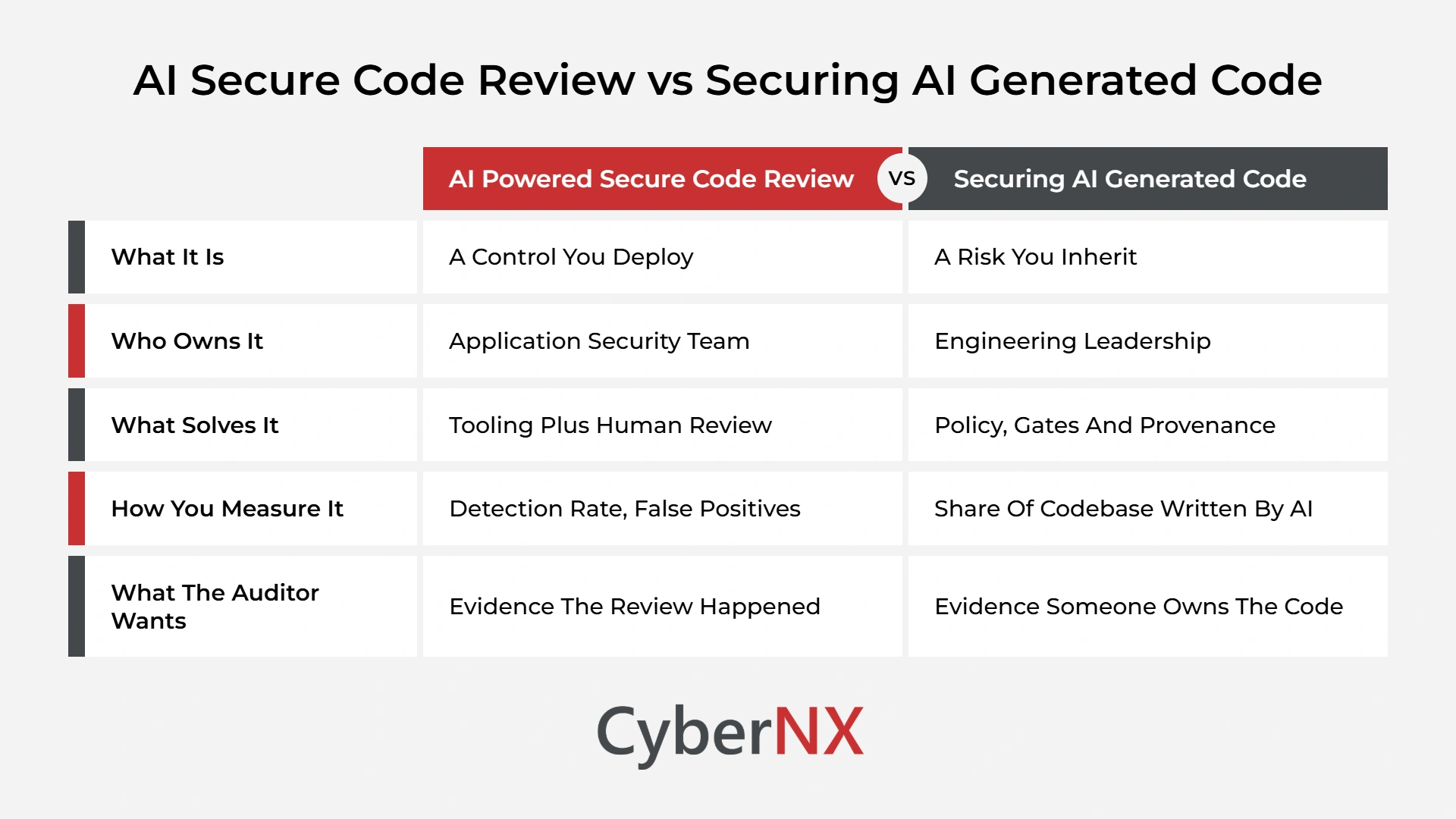
Buying a review tool does not answer the second column. That is the gap most teams have not closed.
What AI security code review catches and what it misses
Understanding the boundary keeps you from over-trusting the output.
Where the technology performs well
AI review is strong on the mechanical layer. It reliably surfaces known vulnerability patterns, insecure functions, hardcoded secrets and dependency risks. It also explains findings in plain language, which shortens the gap between detection and fix.
Where it struggles by design
The weakness is context. AI reviews a diff, not your business rules. Authorisation bypass through parameter manipulation, insecure direct object references and broken workflow logic all look like ordinary code.
Testing and evaluations from trusted bodies have found it frequently failed to detect critical flaws including SQL injection and cross-site scripting. Also, missing rules in authorisation and business logic, and code-only analysis could not confirm what worked against a running system.
There is a recursion problem too. The models reviewing your code were trained on the same public repositories as the models writing it. Shared training data tends to produce shared blind spots.
The complacency trap
The second-order risk is behavioural. When an automated check passes, human reviewers look less hard at everything else. Analysis of AI review workflows describes exactly this pattern: shorter review sessions, fewer substantive comments and less scrutiny of architectural decisions.
You have not removed risk. Instead, you have moved it from code nobody wrote carefully to code nobody read carefully.
How to build an auditable AI powered secure code review process
You do not need to ban the tooling. You need to wrap it in a record. Four practices close most of the gap.
- Pair deterministic scanning with AI reasoning: Run static analysis first so you have a repeatable baseline, then let AI add context on top.
- Name a human owner for every merge: Tools do not hold accountability. A named engineer signing off on a change is what an auditor can trace.
- Record provenance for AI-authored code: Track which commits came from an assistant. You cannot scope your testing effort without knowing this.
- Validate against a running system: Logic and authorisation flaws surface under adversarial testing, not static review. This is where VAPT earns its place.
For a practical comparison of the tooling layer, our guide to the top secure code review tools in 2026 covers what each engine detects and where it falls short.
Bringing the two halves together
Three things are worth carrying forward. AI security code review is a capability you deploy, while insecure AI generated code is a risk you inherit, and each needs its own controls. AI review is a layer in your process, not a verdict on your risk. And in a regulated environment, the evidence you can produce matters as much as the vulnerability you found.
We help teams close both halves. Our Secure Code Review service pairs automated scanning with expert manual review of your security-critical modules, backed by CERT-In empanelled testing that stands up to SEBI and RBI scrutiny.
Not sure whether your current review process would survive an audit? Talk to our team and we will walk through it with you.
AI Security Code Review FAQs
Is AI security code review enough for SEBI CSCRF compliance?
No. CSCRF expects documented evidence, defined remediation windows and demonstrable reviewer competency. An AI tool contributes findings but does not by itself satisfy those requirements. You still need human sign-off, a repeatable baseline and an audit trail that survives inspection.
Who is accountable when AI reviews the code?
The engineer who approves the merge. Tools do not hold accountability, names do. Regulators assess the competency of people, not agents, so every AI-assisted review still needs a human owner on record.
What is the difference between AI security code review and secure code review?
Secure code review is the practice. AI security code review is one way of performing it, using models to analyse every pull request instead of sampling manually. The practice still needs expert manual review for business logic flaws.