Ask any engineering team how they know the last release was secure. Most will point to a scanner report that came back clean.
Now ask a harder question. Did anything confirm that the new API endpoint checks whether the logged in user actually owns the account it returns? That question cannot be answered by tools alone.
This is exactly where a secure code review checklist earns its place. Scanners are very good at pattern matching. They flag unsafe functions, outdated libraries and missing headers. What they cannot do – is reason about business logic, or about the shortcuts a developer took, on a late release night.
This guide covers what belongs on a practical secure code review checklist, why it matters for RBI and CERT-In expectations, and how to run it without slowing your release cycle.
What is a secure code review checklist?
A secure code review checklist is a structured set of security questions applied to source code before it reaches production. It helps reviewers with what to look for, in what order and what evidence to capture along the way.
CERT-In’s Guidelines for Secure Application Design, Development, Implementation and Operations make a useful distinction here. Source code review covers both manual and automated work. Manual review is what evaluates the logic and design of the code, catching issues that automated tools overlook.
That gives the checklist two clear jobs:
- Scope the tools: define what automated scanning must cover so results stay consistent across releases
- Guide the humans: give reviewers a repeatable path through the riskiest parts of the codebase
Without it, review quality depends on whoever happens to be free that week.
Why Indian regulators now expect code-level assurance
Source code has quietly become a compliance artefact. The RBI Master Direction on Information Technology Governance, Risk, Controls and Assurance Practices, in force since Apr 1, 2024, requires regulated entities to obtain source code for all critical applications from their vendors, or to set up a source code escrow arrangement instead. It also requires a written confirmation from the developer or vendor stating the application is free of known vulnerabilities, malware and covert channels in the code. That confirmation must be refreshed whenever material changes or upgrades occur.
CERT-In’s Comprehensive Cyber Security Audit Policy Guidelines, issued on Jul 25, 2025, go further. They list source code review as an audit category in its own right, separate from VAPT, and expect secure by design practices to be built in before an application is accepted for audit at all.
For SEBI-regulated entities, the CSCRF adds similar pressure through its application security and vulnerability management standards, where source code review evidence supports the same controls.
Read together, the direction is clear. A clean penetration test report no longer answers the question of what is actually inside your code.
The secure code review checklist: 8 checks before you ship
These checks align with several risk categories in the OWASP Top 10:2025, including Broken Access Control, Security Misconfiguration, Software Supply Chain Failures, Cryptographic Failures, Injection and Mishandling of Exceptional Conditions. OWASP’s methodology incorporated data from nearly 220,000 extracted CVEs. Two categories are new in this edition: software supply chain failures and mishandling of exceptional conditions. Both belong on a modern secure code review checklist.
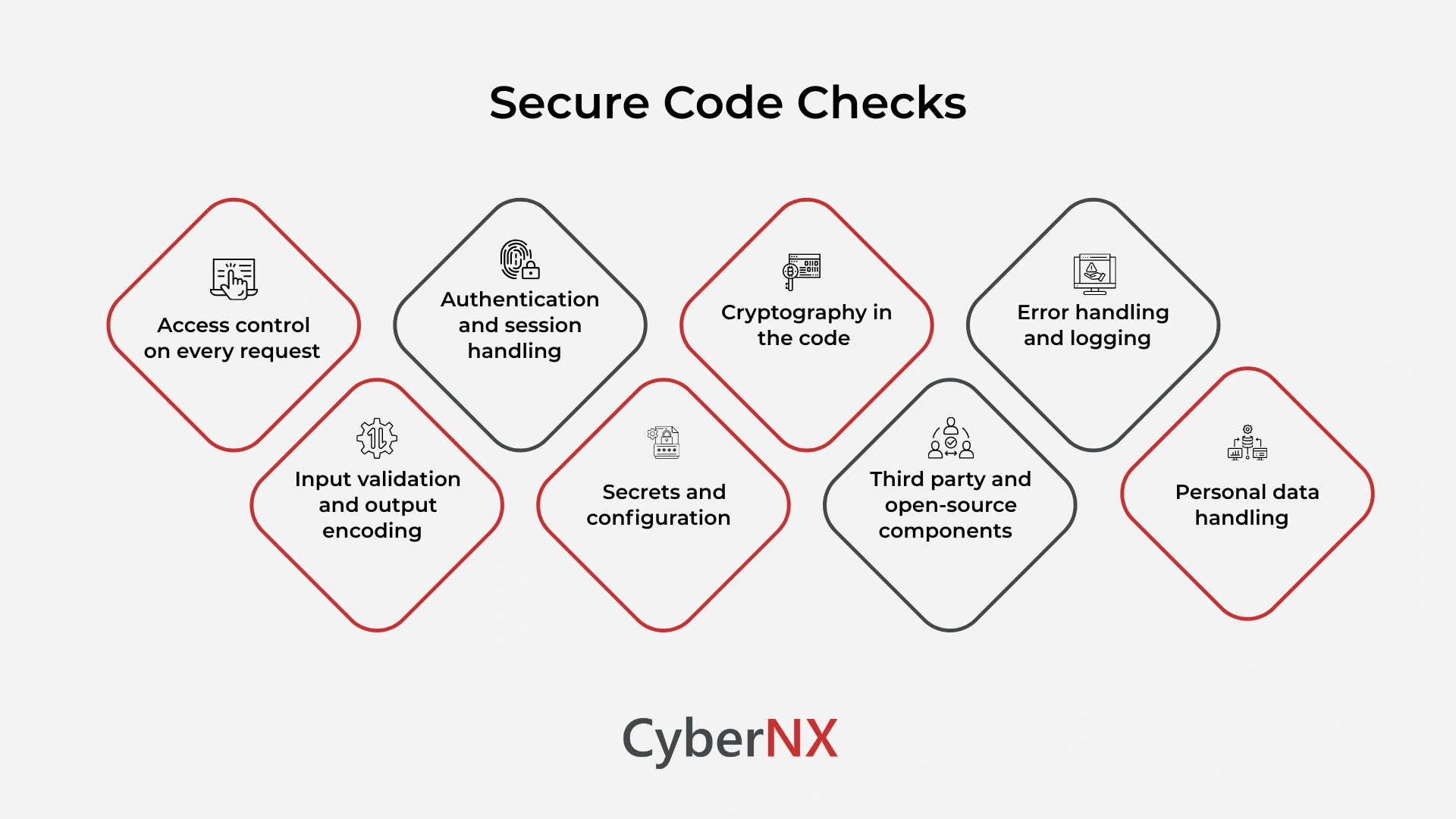
Access control on every request
Confirm that authorisation is checked server side for every object and action, not just at the login screen. Broken access control has topped the OWASP list for four editions running.
Input validation and output encoding
Look for user input reaching queries, commands or templates without validation or parameterisation. This is where injection flaws still hide.
Authentication and session handling
Check password storage, token expiry, session invalidation on logout and multi-factor enforcement for privileged actions.
Secrets and configuration
Search the repository and its history for hardcoded credentials, API keys and connection strings. Verify that debug modes and verbose settings are off in production builds.
Cryptography in the code
Flag deprecated algorithms, custom crypto and weak key lengths. Confirm that encryption is applied to data at rest as well as in transit.
Third party and open-source components
Review direct and transitive dependencies for known vulnerabilities and licence risk. An SBOM makes this check repeatable.
Error handling and logging
Check that failures close safely instead of failing open, that stack traces never reach the user and that security events are logged without capturing sensitive data.
Personal data handling
Trace where personal data is collected, stored and shared in the code. Under the DPDP Act, that trail matters as much as the control itself.
How to run a secure code review checklist without slowing delivery
Review depth should follow risk, not calendar dates. A few practical rules keep the secure code review process sustainable:
- Prioritise by blast radius: Review code paths touching money, identity or personal data first
- Split the work: Automated scanning inside the CI/CD pipeline, manual review reserved for logic and design
- Fix at the pull request stage: Findings raised before merge cost a fraction of findings raised after release
- Capture evidence: Record who reviewed what, findings raised and the date each one was closed
- Re-review after change: Re-review after material changes or upgrades to ensure the security assurance remains current.
Conclusion
Application security now gets judged on what auditors can see inside your codebase, not only on what a scanner reports. A secure code review checklist turns that expectation into a repeatable process your engineering and compliance teams can both stand behind. Start with the eight checks above. Keep evidence of every review. Refresh the review whenever critical code changes.
At CyberNX, our CERT-In empanelled team combines manual and automated analysis through our secure code review checklist driven assessments, aligned to RBI, SEBI and CERT-In expectations. If you are preparing for an audit or shipping a critical application, talk to our experts and find out what your code is really carrying.
Secure code review checklist FAQs
What is a secure code review checklist?
It is a structured list of security checks applied to source code before release. It covers access control, input handling, authentication, secrets, cryptography, dependencies, error handling and personal data flows. The checklist keeps reviews consistent and produces the evidence auditors ask for.
How often should a secure code review be performed?
Run automated checks on every build and a deeper manual review for every major release or material change to critical applications. RBI expects fresh vendor confirmation after material code changes or upgrades, so tying reviews to change events works better than a fixed annual cycle.
Is secure code review the same as penetration testing?
No. Penetration testing attacks a running application from the outside. A source code review inspects the code itself, so it finds flaws that never surface during a test window, including logic errors, hardcoded secrets and unsafe patterns in code paths that are hard to reach externally. Depending on the applicable regulatory, contractual and risk requirements, an organisation may need both.
Can automated tools replace manual review in a secure code review checklist?
No. Automated scanning is fast and consistent, so it should run on every build. CERT-In guidance is clear that manual review is what evaluates the logic and design of the code, which is where authorisation gaps and business logic flaws live. The two work together, not as alternatives.