Generic secure code review best practices checklists don’t satisfy compliance auditors. What they look for is documented, traceable, role-defined review processes tied to specific control requirements. What may look like a mature practice often turns out to be an informal habit and informal habits don’t satisfy regulators.
This post maps secure code review best practices to what RBI, ISO 27001 and PCI DSS specifically require so your programme holds up in an audit and not just in a sprint review.
What is secure code review and why compliance teams care?
Two things are often conflated here:
Code quality review & security code review differs
A standard code review checks whether code is readable, maintainable and functionally correct. A secure code review looks at the same code through an adversarial lens, asking how an attacker could exploit it.
Security-focused reviewers look for injection vulnerabilities, insecure authentication logic, hardcoded credentials, improper error handling and broken access controls. These require a different mindset and, often, different expertise from standard quality review. Read our blog Secure Code Review Guide to learn more.
Why auditors ask for secure code review evidence
Compliance frameworks treat application security as a measurable control and not a development preference. RBI, ISO 27001 and PCI DSS each specify requirements around how software is developed, reviewed and validated. Without documented evidence that secure code review is happening systematically, your organisation is exposed, regardless of how good your developers are.
Best practices for the compliance-mapped foundation
Three foundational practices apply across all three frameworks and satisfy overlapping requirements simultaneously.
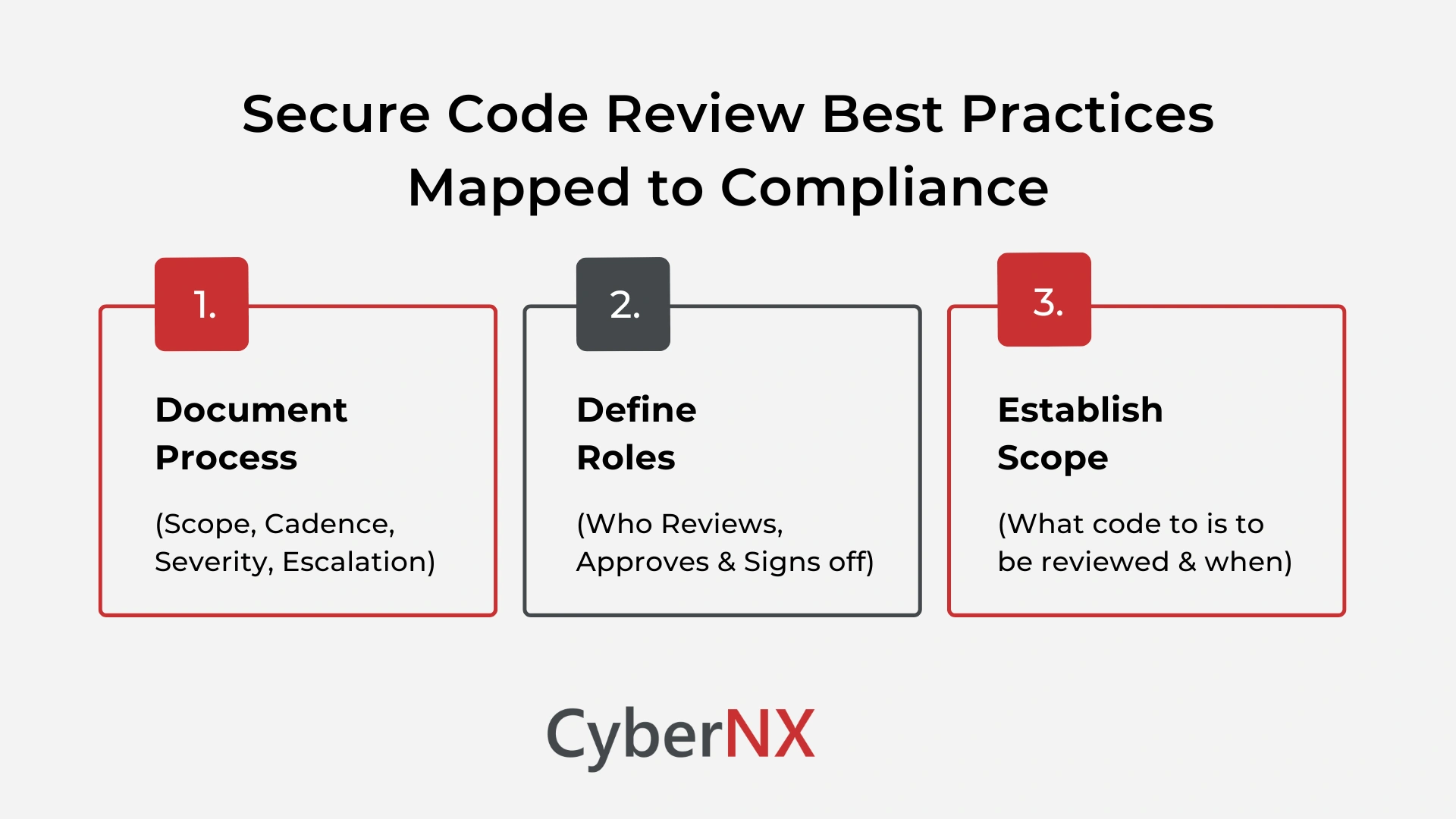
Document your process before you review a single line
A secure code review programme that exists only in developers’ heads is not a programme but a habit. Auditors require written procedures that define what triggers a review, what the review covers, how findings are recorded and what happens when a critical issue is found. Your documented process should cover review scope, cadence, severity classification and escalation paths, this becomes the foundation of your audit evidence.
Define roles: who reviews, approves & signs off
Role ambiguity is one of the most common audit failures. If anyone can approve any code for any reason, there’s no meaningful control in place. Your programme needs defined reviewer qualifications, separation of duties between code author and reviewer and a documented sign-off process. For regulated industries, this is a direct requirement under all three frameworks.
Establish scope: what code must be reviewed and when
Not all code carries equal risk. Payment processing logic, authentication modules, data export functions and customer-facing API endpoints carry significantly higher risk than internal utilities.
A compliance-ready programme defines which components require mandatory security review, which trigger review based on change type and what constitutes a material change. Risk-based scoping is more defensible in an audit than blanket policies that teams quietly ignore under deadline pressure.
How RBI, ISO 27001 & PCI DSS define secure code review
Find out what regulators like RBI and other certification experts want from secure code review:
RBI cybersecurity framework, controls & audit evidence
The Reserve Bank of India’s cybersecurity framework for banks and Non-Banking Financial Companies (NBFCs) requires financial institutions to establish a Secure Software Development Lifecycle (SSDLC) covering design, development, testing and deployment.
Relevant controls require security testing before deployment, records of vulnerabilities identified and remediated and a defined change management and security review process for all application changes.
What RBI auditors look for as evidence includes your written SSDLC policy, review records for code changes, vulnerability tracking logs with remediation status and evidence that security testing occurred before go-live.
ISO 27001 Annex A, relevant controls & documentation expectations
ISO 27001:2022 addresses secure development within Annex A controls A.8.25 through A.8.29, covering system acquisition, development and maintenance. These controls require organisations to establish secure development policies, apply security engineering principles throughout the lifecycle and review custom software before deployment, including software developed by third-party or offshore vendors, which many organisations overlook.
ISO 27001 auditors expect a documented secure development policy, evidence that reviewers have appropriate competence, records linking review activities to your risk treatment plan and a statement of applicability mapping these controls to your development context.
PCI DSS Requirement 6.3: what it mandates and how to evidence it
PCI DSS v4.0 Requirement 6.3 explicitly requires that all bespoke and custom software is reviewed for vulnerabilities before production release – by individuals other than the developer who wrote the code. It also requires that code review procedures address common vulnerabilities for the technology in use, that findings are corrected before release and that management approves all code changes. For web-facing applications, Requirement 6.3 mandates alignment with a recognised standard such as OWASP.
Your PCI DSS evidence checklist should include written review procedures, reviewer independence records, documented findings with remediation notes, management approval records and evidence that your methodology addresses the OWASP Top 10 or an equivalent classification.
Code review programme to satisfy all three frameworks
The three frameworks overlap significantly. A programme satisfying PCI DSS Requirement 6.3 will meet most requirements under ISO 27001 Annex A and RBI. Document what you do, do what you document and keep records that prove it.
The overlapping controls – do once, satisfy many
The core overlapping requirements are written procedures, reviewer independence, findings documentation and remediation tracking. Build your programme around these four pillars and you address the shared requirements of all three frameworks in a single effort. PCI DSS is the most prescriptive – a programme that satisfies Requirement 6.3 in full will exceed the documentation requirements of RBI and ISO 27001 in most areas.
Tooling and documentation your programme needs
A compliance-ready programme needs a code review policy document, a review tracking system with defined fields, a vulnerability classification scheme and a remediation workflow with sign-off records.
Static Application Security Testing (SAST) tools automate detection of known vulnerability patterns – but the human review component remains a requirement under all three frameworks. Automated scanning satisfies the “testing” requirement; it does not satisfy the “review” requirement that calls for expert judgement on application logic and design.
Conclusion
Generic secure code review best practices help developers write better code. Compliance-mapped best practices get your organisation through an audit.
The difference is structure: documented procedures, defined roles, risk-based scope and traceable evidence. RBI, ISO 27001 and PCI DSS each require this in slightly different ways, but the foundation is the same: security review must be a repeatable, governed process, not a habit that happens when time allows.
At CyberNX, our Secure Code Review service is built for regulated industries. We review your application code against your compliance framework’s specific requirements and deliver findings with the documentation your auditors need. Ready to make your code review programme audit-ready? Talk to our team to get started.
Secure code review best practices FAQs
What is the minimum code review frequency required by PCI DSS?
PCI DSS v4.0 requires review before every production release – there is no scheduled frequency. Every production-bound code change must pass through the review process. Organisations using continuous deployment should embed a review gate in their pipeline.
Does ISO 27001 require automated or manual code review?
ISO 27001 does not prescribe the method – it requires that vulnerabilities be identified before deployment. Auditors accept a combination of automated scanning and manual review. The standard’s emphasis on competence means reviewers must demonstrate the skill to find what tools miss, particularly logic flaws and design vulnerabilities.
How should secure code review findings be documented for an RBI audit?
RBI auditors expect a traceable record of each vulnerability identified, its severity, the remediation taken and sign-off evidence before deployment. A ticketing system with mandatory fields for vulnerability type, severity, responsible developer and reviewer approval is sufficient. Consistency matters – every review should produce a record in the same format.