With fast tech advancements and constant pressure to deliver applications to clients faster, your engineering teams are now shipping more code than before. AI coding agents complete in minutes what once took days. But your security testing still relies largely on pattern matching built for human-paced development. This is where agentic AI SAST comes in.
The numbers show how quickly things have changed. Endor Labs’ research reports that almost half of companies now have codebases that are at least 50% AI-generated. In the same benchmark, only 10.5% of one coding agent’s solutions were secure. Traditional static application security testing (SAST) was simply not built for this volume or this type of risk.
In this blog, we explain why conventional SAST struggles with AI-written code and how agentic AI SAST solves the problem. You will also learn which vulnerabilities it detects, where its limitations lie and how to adopt it with confidence.
Why traditional SAST struggles with AI-written code
Before looking at the solution, it helps to understand the problem clearly. Three pressures are stretching conventional SAST beyond its design limits.
Code volume has outpaced review capacity
The Veracode 2026 GenAI Code Security Report found that roughly 44% of AI code generation tasks introduced a risky vulnerability. Models now write syntactically correct code nearly every time. Secure code has not improved at the same pace.
High false positive rates impact developer trust
Pattern-based scanners compare code against known signatures of insecure behaviour. This approach is fast and repeatable. However, it lacks context about how data actually moves through your application. When too many alerts lead nowhere, developers stop trusting scan results and acting on them.
Context-dependent vulnerabilities remain out of reach
Some of the most damaging weaknesses have no recognisable signature. Consider these common examples:
- Broken access control: An API endpoint returns customer records without checking who owns them. The code looks valid. The missing check is the problem.
- Business logic weaknesses: A refund workflow allows the same transaction to be processed twice.
- Insecure design: An application trusts client-side input to set a product price or loan limit.
Pattern matching identifies what is present in code. It struggles to identify what is absent. That limitation is the core problem agentic AI SAST sets out to solve.
What is Agentic AI SAST?
Agentic AI SAST is static application security testing in which AI agents analyse code the way an experienced security engineer would. Instead of matching patterns line by line, the agents investigate how code behaves, what it is meant to do and whether a weakness is truly exploitable.
How agentic AI SAST differs from AI-assisted SAST
Many SAST tools now use a large language model (LLM) to summarise results or suggest fixes. That is AI-assisted SAST. Agentic AI SAST goes a step further.
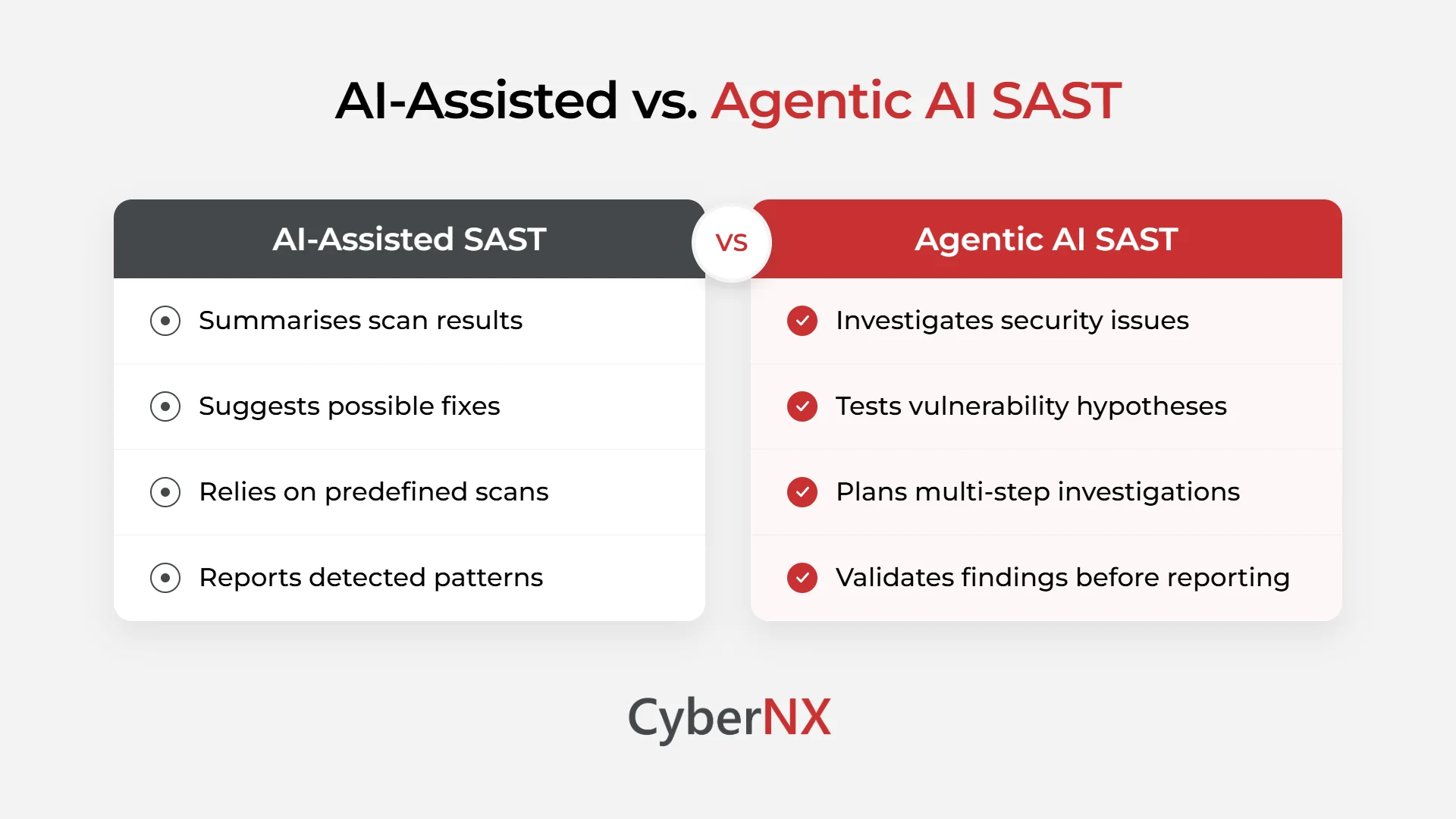
Agentic AI SAST uses multiple specialised agents to understand developer intent, examine application architecture and logic, and assess the security impact of code changes.
How agentic AI SAST works in practice
Most agentic AI SAST platforms follow a similar four-stage pipeline:
- Code graph construction: Program analysis maps functions, data flows and dependencies into a structured model. Agents query this map rather than reading raw text.
- Detection: Agents trace whether untrusted input reaches sensitive operations across the complete call chain.
- Triage: Agents attempt to disprove each candidate finding by checking sanitisation and input constraints.
- Remediation: Agents propose a context-aware fix for developer review.

Looking to compare different AI-powered SAST solutions? Explore our guide to AI SAST tools to find out what different tools offer.
Agentic AI SAST vulnerabilities: What it detects beyond pattern matching
The term “agentic AI SAST vulnerabilities” covers two ideas. The first is the vulnerability classes these tools detect. The second is the weaknesses within the tools themselves. This section covers the first, and the next section covers the second.
Broken access control and authorization gaps
Broken access control consistently ranks at the top of the OWASP Top 10. Yet it is one of the hardest categories for pattern-based scanners to identify.
Cycode’s agentic code scanning benchmark illustrates this well. Two authorization CVEs went undetected by Semgrep OSS, CodeQL and Cycode’s own deterministic engine. Its agentic scanning identified both, running on an affordable open-weights model.
Business logic and insecure design weaknesses
Agentic AI SAST compares what code does with what it is intended to do. For banks, NBFCs and fintechs, this protects high-value workflows such as:
- Payment workflows where amounts or limits can be altered
- Loan approval logic where eligibility checks can be bypassed
- KYC steps that can be skipped through a direct API call
Low-severity findings that combine into critical exploit paths
A verbose error message, a predictable record ID and a missing rate limit may each look minor. Together, they can enable account takeover. Agentic AI SAST connects these signals into one exploit path, so your team can prioritise fixes by business impact.
The limitations of Agentic AI SAST
No security technology is complete on its own. Knowing these limitations helps you adopt agentic AI SAST responsibly.
Non-deterministic results complicate audits
LLMs are probabilistic. The same code scanned twice may return different findings, and results can shift with prompt phrasing. Regulated organisations need reproducible evidence, so ask vendors how they keep findings stable.
Prompt injection inside the code being scanned
An agentic scanner reads code it did not write. Comments, strings or configuration files can carry hidden instructions aimed at the agent itself. Choose platforms that treat scanned code as untrusted and restrict agents to read-only access.
Cost and maturity trade-offs
Running advanced AI models on every commit is expensive at scale. Research also shows that general-purpose AI agents are not yet reliable as standalone SAST tools. Agentic analysis works best as one part of a broader system.
How to build a secure hybrid scanning model
The answer to these limitations is not to choose between deterministic and agentic scanning. It is to assign each approach the work it does best. Here is a practical four-layer model.
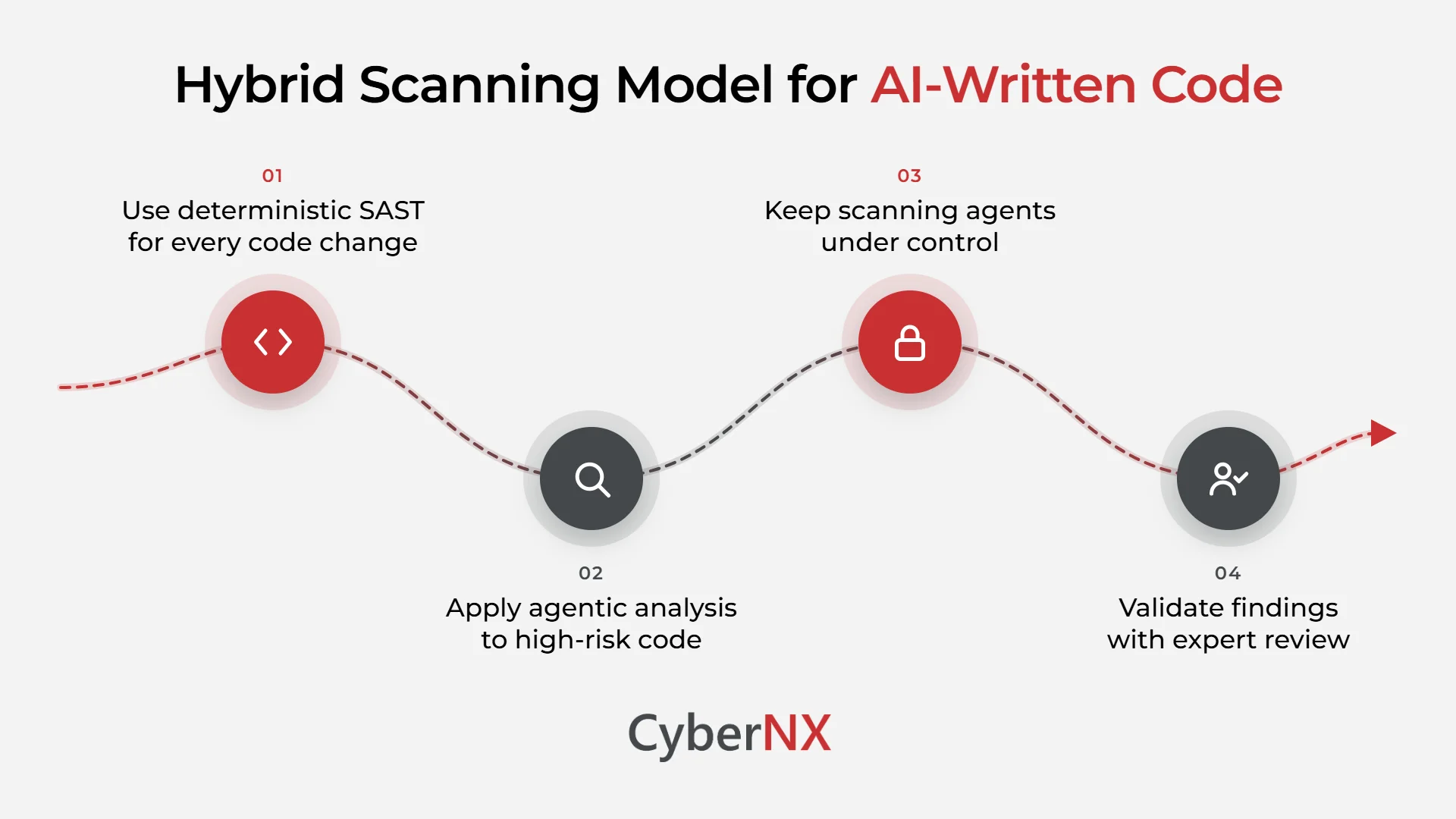
1. Keep deterministic SAST as your merge gate
Deterministic SAST runs in seconds and produces identical results on every run. That makes it the right control to block a pull request. Use it to stop known vulnerability patterns such as SQL injection and hardcoded secrets before code is merged.
2. Apply agentic analysis to high-risk code paths
Reserve agentic reasoning for code where context matters most. Prioritise these areas first:
- Authentication and authorization logic
- Payment, transfer and refund workflows
- APIs that expose customer or financial data
- Code that processes personal data under Digital Personal Data Protection (DPDP) Act obligations
Run broader agentic scans nightly or before major releases. This balances depth of analysis with cost control.
3. Govern the agents that scan your code
Treat your scanning agents like any other privileged system. Confirm they have read-only access and cannot act on instructions embedded in code. Make sure every scan records the model, scope and time it ran. This audit trail supports both internal governance and regulatory reviews.
4. Validate findings with expert human review
Automated tools provide coverage and speed. Experienced security professionals provide business context and judgement. A manual expert review confirms whether an agentic finding is exploitable in your environment. It also identifies design-level risks that no automated tool can fully assess.
Static analysis is only one side of application security. Explore AI DAST to see how AI is changing security testing for running applications.
Conclusion
AI coding agents have changed how fast software is built. Security verification now needs to change at the same pace. Agentic AI SAST closes an important gap by detecting access control, business logic and chained vulnerabilities that pattern matching cannot reach.
It is not a complete answer on its own, though. Non-deterministic results, prompt injection risk and cost all call for a hybrid approach. Combine deterministic scanning, targeted agentic analysis and expert human validation for the strongest outcome.
That final layer is where we can help. CyberNX’s secure code review services pair automated analysis with experienced security professionals. We validate findings, uncover design-level risks and give your developers clear, prioritised remediation guidance.
Ready to strengthen your AI-written code? Talk to our team about a secure code review today.
Agentic AI SAST FAQs
Is it safe to share proprietary source code with an agentic AI SAST tool?
It can be, provided you verify how the vendor handles your code. Check where code is processed and stored, whether it is retained after a scan and whether it is ever used to train models. For Indian BFSI organisations, data residency and DPDP obligations should also shape this decision. Many vendors now offer self-hosted deployments or bring-your-own-model options for sensitive codebases.
Should you allow agentic AI SAST to fix vulnerabilities automatically?
Some platforms, such as Checkmarx with its agentic remediation, can plan, apply and validate fixes autonomously. This saves developer time. However, keep a human approval step before any fix reaches production, especially in authentication or payment code.
How should you evaluate an agentic AI SAST vendor?
Start with a proof of concept on your own code, not only the vendor’s benchmark. Then assess these factors:
- Accuracy: True positive rate on known vulnerabilities in your applications
- Consistency: Whether repeat scans of the same code return the same findings
- Language coverage: Support for every language and framework in your estate
- Agent safeguards: Read-only access and protection against prompt injection
- Audit evidence: Logs that record the model, scope and reasoning behind each finding
Finally, ask for customer references in your own industry.
Does agentic AI SAST work on legacy code written by humans?
Yes. The analysis focuses on how code behaves, not on who or what wrote it.
Which metrics show whether agentic AI SAST is delivering value?
Track the false positive rate, mean time to remediate and the share of findings developers actually fix. Also monitor how many critical vulnerabilities are detected before release rather than during penetration testing. Compare these numbers against your baseline from the previous quarter.