Your Dynamic Application Security Testing (DAST) scan shows no critical findings. That looks like good news. But attackers may still be targeting your APIs through normal workflows.
Akamai’s Apps, APIs and DDoS 2026 report shows how fast this risk is growing. In 2025, 61% of API attacks involved unauthorized workflows. That is double the 30% recorded a year earlier.
Traditional DAST scanners struggle here because these attacks use valid requests. They match no known attack pattern, so the scanner sees nothing wrong. This is exactly the gap AI DAST aims to close.
So, can AI DAST really find what traditional scanners miss? Yes, for certain types of vulnerabilities. In this blog, we explain where those gaps exist and how AI DAST closes them.
Where traditional DAST scanners fall short
Traditional DAST scanners test a running application from the outside, without access to code. They remain useful for detecting common injection and configuration issues. However, their design limits what they can see in modern applications.
Signature matching only detects known patterns
Legacy scanners crawl an application, inject predefined payloads and compare responses against known signatures. A response that matches a SQL injection signature produces a finding. No match means no finding, even when real risk exists.
This approach struggles with vulnerabilities that use valid requests. Changing an order ID in an API call creates a perfectly valid request. The scanner sees nothing unusual because no known payload is involved.
Modern application architecture outpaces legacy crawlers
Legacy crawlers were designed for server-rendered pages with predictable links and forms. Today’s applications work very differently. Common blind spots include:
- Single-page applications (SPAs): Routes render through JavaScript, so link-following crawlers miss entire screens.
- Multi-step authentication: Multi-factor authentication (MFA) and token-based sessions often break scripted scanner logins.
- Undocumented APIs: Shadow endpoints never appear in a crawl, so they remain untested.
- Stateful workflows: Payment, approval and onboarding flows depend on actions taken in a specific sequence.
When a scanner cannot reach these areas, it cannot report on them. A clean report then reflects limited coverage, not a secure application.

Explore our guide to DAST testing best practices to understand how to improve scan coverage and avoid common testing gaps.
How AI DAST tests a running application differently
AI DAST replaces fixed payload matching with reasoning about application state and intent. It still tests from the outside. The real difference lies in how it explores and what it attempts.
Context-aware navigation of authenticated sessions
An AI-powered DAST engine renders the application the way a browser does. It reads the live Document Object Model (DOM) and follows client-side routes. It also maintains authenticated sessions across complex login flows.
This gives the engine access to the post-login attack surface. That is where most access control and privilege issues reside.
Goal-driven testing with exploit validation
AI DAST engines pursue testing goals instead of firing isolated payloads. For example, an engine may notice an API returning user-specific object IDs. It then swaps those IDs and confirms whether another user’s data comes back.
Capable tools also validate exploitability before reporting a result. This reduces false positives and saves your team hours of manual triage.
Vulnerabilities AI DAST can detect that legacy scanners miss
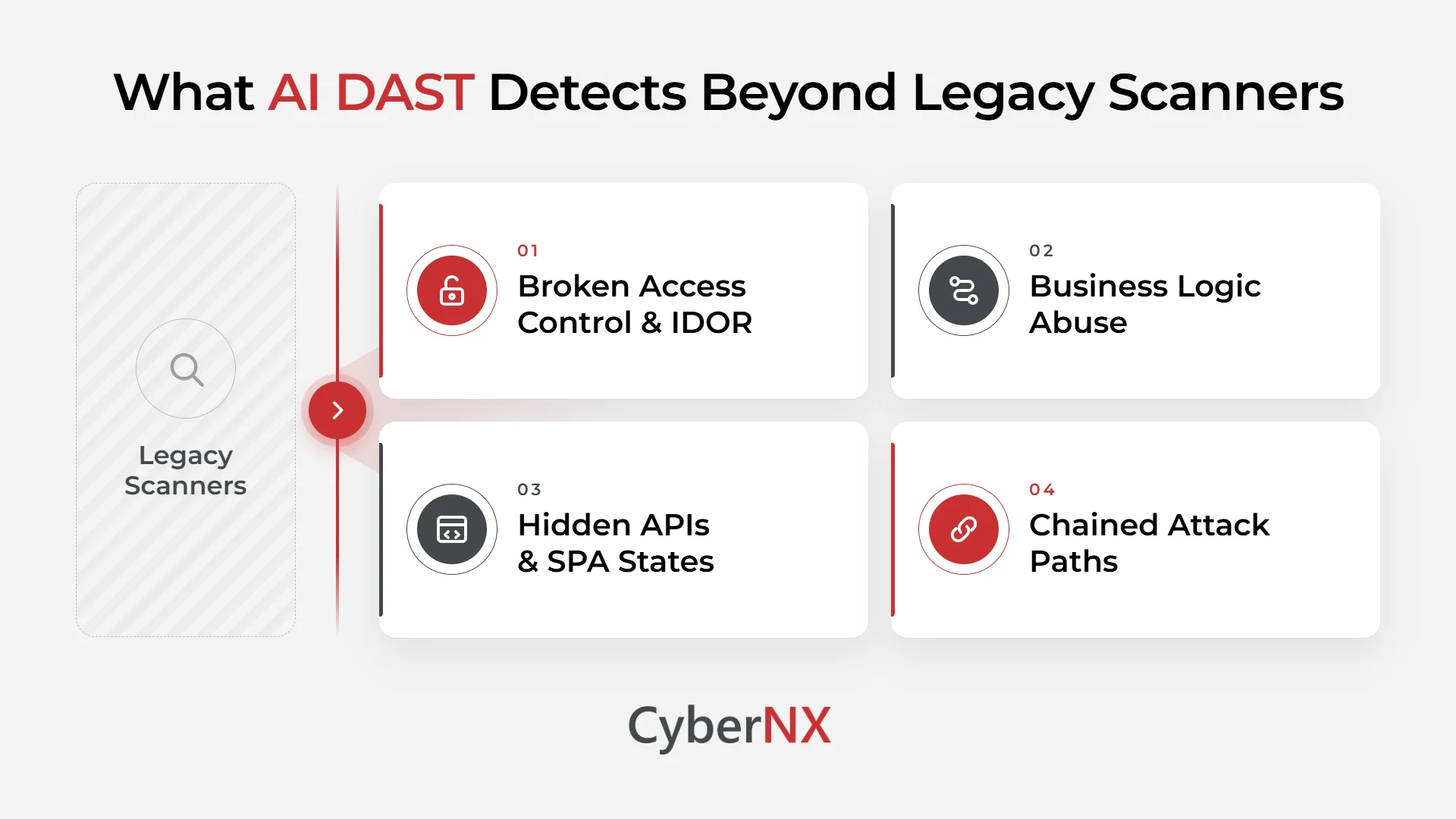
AI DAST adds the most value in vulnerability classes without a fixed signature. Here are four areas where the difference is most visible.
Broken access control and IDOR issues
Broken access control holds the top position in the OWASP Top 10:2025. The category now maps to 40 Common Weakness Enumerations (CWEs), the most of any category.
Insecure Direct Object Reference (IDOR) issues fall within this category. These requests look legitimate, so signature scanners rarely flag them. AI DAST tests them by switching user roles and object references across sessions.
Business logic abuse in multi-step workflows
Business logic vulnerabilities exploit application features in ways developers never intended.
Typical scenarios include skipping a payment verification step or replaying a refund request. Another is raising a fund transfer limit by altering request parameters. AI DAST attempts step-skipping, parameter tampering and request replay within real workflows.
Hidden API endpoints and single-page application states
AI DAST discovers APIs by observing the traffic your front end generates. This exposes undocumented endpoints missing from your API specifications. It also reaches SPA states that appear only after specific user actions.
Chained attack paths
Attackers rarely rely on a single weakness to breach an application. A verbose error message may leak a token that unlocks an admin endpoint. Legacy tools report each issue separately, often at low severity. AI DAST can connect them into one exploitable path with clear business impact.
AI DAST vs traditional DAST
This comparison shows how both approaches perform across the testing dimensions that matter most.
| Dimension | Traditional DAST | AI DAST |
| Crawling | Follows links in static HTML | Renders SPAs and client-side routes |
| Authentication | Fails on MFA and multi-step logins | Maintains authenticated sessions |
| Access control testing | Limited to known payload patterns | Switches roles and object references |
| Business logic | No signature to match | Tests workflow sequence and intent |
| Findings | Unconfirmed signature matches | Validated, exploit-proven results |
| False positives | High, with heavy manual triage | Lower, validated before reporting |
| Attack chains | Isolated findings | Linked exploit paths |
| Remediation output | Generic advice per issue | Endpoint, parameter and reproduction steps |
For a broader comparison of application security testing approaches, read our guide to SAST vs DAST vs SCA.
Where AI DAST still needs support
AI DAST closes real gaps, but it is not a complete application security program. Three limitations deserve your attention.
Coverage depends on scope, credentials and environment
An engine can only test what it can reach and log into. Missing test accounts, restricted roles or unstable staging environments reduce coverage. Your setup decisions still shape the quality of results.
Runtime testing cannot trace root causes in source code
AI DAST proves that a vulnerability is exploitable at runtime. It cannot point to the exact line of code responsible.
Consider an IDOR finding on a reporting API. The root cause might be missing authorization logic in a shared service layer. Fixing only the reported endpoint leaves sibling endpoints exposed.
Secure code review traces the issue to its origin and finds similar patterns elsewhere. It also uncovers hardcoded secrets and weak cryptography that never surface at runtime.
How to evaluate vendor AI claims
Some tools labelled AI-powered DAST are legacy crawlers with new branding. Before you invest, ask these questions:
- Can it complete authenticated, multi-step workflows without custom scripts?
- Does it validate exploitability before reporting a finding?
- Can it test role-based and object-level authorization across user accounts?
- Does it link related findings into complete attack paths?
Conclusion
So, can AI DAST find vulnerabilities that traditional DAST scanners miss? Yes, especially in access control, business logic and authenticated workflows. It reasons about application state instead of matching fixed signatures. Validated findings also mean less triage and faster action for your team.
Yet runtime testing only shows where an application breaks. It does not explain why your code allows it. That is where our Secure Code Review service fits in. Our experts examine your source code to trace each vulnerability to its root cause. We help you fix issues at the source, not just at the endpoint.
Looking to improve your application security? Reach out to our experts for guidance on securing your code.
AI DAST FAQs
Is AI DAST safe to run against production applications?
It can be, with the right controls in place. Most AI DAST platforms offer production-safe modes that avoid destructive payloads. Still, we recommend validating scan behaviour in staging first. Use dedicated test accounts and agree on scan windows with your operations team.
Can AI DAST be integrated into CI/CD pipelines?
Yes. Most platforms connect with continuous integration and continuous delivery (CI/CD) tools through APIs or plugins. Teams usually run quick scans on each build and full authenticated scans before release.
Does AI DAST help meet PCI DSS 4.0 requirements?
It supports compliance but does not satisfy PCI DSS 4.0 on its own. Validated findings with reproduction evidence strengthen your vulnerability management records. Auditors will still expect penetration testing and secure development practices. Map each tool output to specific requirements with your Qualified Security Assessor (QSA).
Can AI DAST test LLM-powered features for prompt injection?
Some newer platforms are adding this capability, but coverage is still maturing. Prompt injection testing needs payloads designed for language models, not web signatures. Treat large language model (LLM) features as a separate testing scope. The OWASP Top 10 for LLM Applications is a good starting framework.