Your latest release passed every functional test and shipped on schedule. But does that mean its code is secure against potential attacks?
Functional testing confirms that an application behaves as expected. It does not necessarily reveal vulnerabilities in the underlying source code. Security code review addresses this gap by examining how attackers could exploit weaknesses in the code.
In this blog, we explain what a professional application security code review covers and why it matters. We also discuss when to engage an external partner and how to choose one.
What an application security code review covers
An application security code review is a structured examination of source code for exploitable weaknesses. Reviewers trace how data enters, moves through and leaves your application.
How it differs from a functional code review
A functional review tests whether code is readable, correct and aligned with standards. A security review checks: how could an attacker misuse this code?
Reviewers focus on the areas attackers target most often:
- Authentication and session handling: How login, token management and password reset processes are secured.
- Authorisation logic: Whether users can access only the records and resources they are permitted to view.
- Input validation: Whether form fields, API parameters and file uploads are properly validated.
- Hardcoded secrets: Whether API keys, tokens or database credentials are exposed in the source code.
- Error handling and logging: Whether error messages or logs reveal sensitive internal system details.
Where it fits in your secure SDLC
The review belongs inside your secure Software Development Life Cycle (SDLC), not after it. It works best at the pull request stage and before major releases. Weaknesses fixed during development cost far less than those patched after an incident. For a deeper look at methodology, read: Secure code review methodology.
Why application security code review is now a business priority
Three trends make code-level security harder for leadership teams to defer.
Sensitive credentials hide inside internal code
Many teams assume private repositories are safe, but recent data suggests otherwise. According to GitGuardian’s State of Secrets Sprawl 2026, 32% of internal repositories contain hardcoded secrets. One leaked database credential can give an attacker direct access to customer data. A manual review traces these secrets across code, configuration files and commit history.
Unresolved security debt keeps growing
Vulnerabilities left unfixed over time become long-term security debt. As development continues, unresolved issues accumulate and become harder to manage. A risk-rated code review helps teams prioritise critical issues and prevent backlogs from growing.
AI-assisted development multiplies code risk
AI coding assistants speed up development but can introduce security issues. These may include flawed business logic, improper access controls, and insecure data handling. Expert code reviewers identify these gaps before the code reaches production.
Inside a professional application security code review engagement
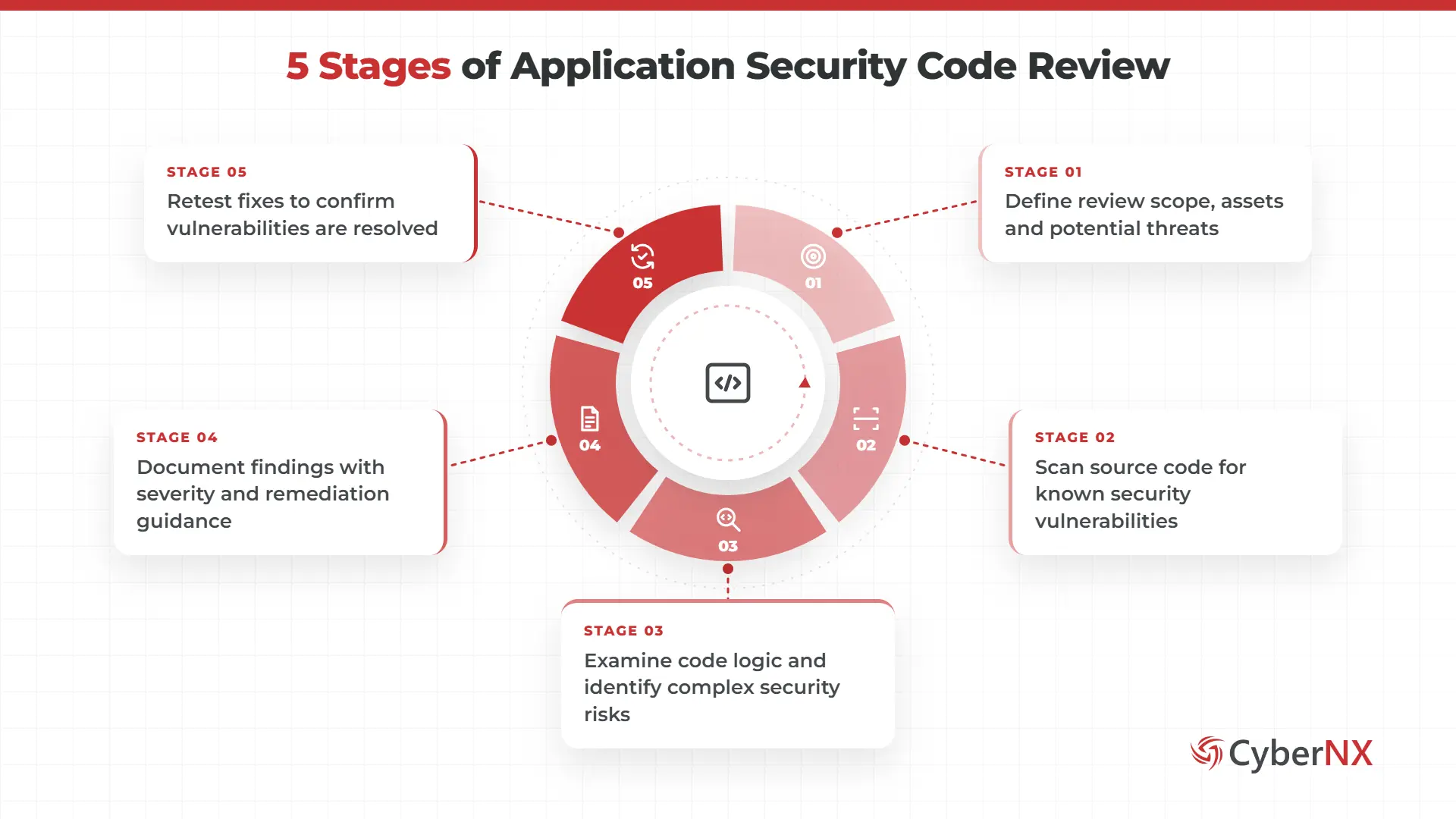
A professional engagement follows a defined sequence, not an informal read-through. Here is what you can expect at each stage.
Scoping around business-critical components
We start by mapping your architecture, data flows and technology stack. Payment modules, authentication services and public APIs receive the deepest attention. Clear scoping keeps effort focused where a breach would hurt most.
Automated analysis combined with manual expert review
Static Application Security Testing (SAST) tools scan the full codebase quickly. They surface known vulnerability patterns and point to the exact files and lines. Our analysts then manually review high-risk logic that tools cannot interpret.
This covers broken authorisation paths, workflow manipulation and insecure cryptographic implementation. We also validate tool output to remove false positives from your report. Our comparison of secure code review tools explains where scanners fall short.
Risk-rated reporting and remediation verification
Every confirmed finding receives a severity rating based on real-world exploitability. Each one includes the affected code, business impact and practical fix guidance. Once your developers remediate, we re-review the code to confirm each fix holds.
Manual vs automated code review
The strongest programmes combine both approaches, because each one covers what the other misses.
| Factor | Automated review (SAST) | Manual expert review |
| Speed | Scans large codebases in minutes | Takes days, depending on scope |
| Coverage | Every line, consistently | Focused on high-risk components |
| Business logic gaps | Rarely detected | A core strength |
| False positives | Common and need triage | Low, as findings are validated |
| Best suited for | Every commit and pull request | Major releases and critical modules |
Signs you need an external code review partner
In-house reviews work well for routine pull requests. However, certain situations call for independent expertise and a fresh perspective.
You should consider an external partner when any of these situations apply:
- A major release is approaching: New payment flows, public APIs or authentication systems carry outsized risk.
- An audit or regulatory deadline is near: Indian regulators increasingly expect documented evidence of secure development practices.
- A recent incident exposed gaps: An independent review confirms the root cause is fully closed.
- In-house application security skills are limited: Developers rarely have time to study attacker techniques in depth.
- You are acquiring or integrating third-party code: Due diligence reveals inherited risk before it becomes yours.
An independent reviewer also faces no pressure to approve code for a deadline.
How to evaluate an application security code review provider
Not every provider delivers the same depth. These criteria help you compare options with confidence.
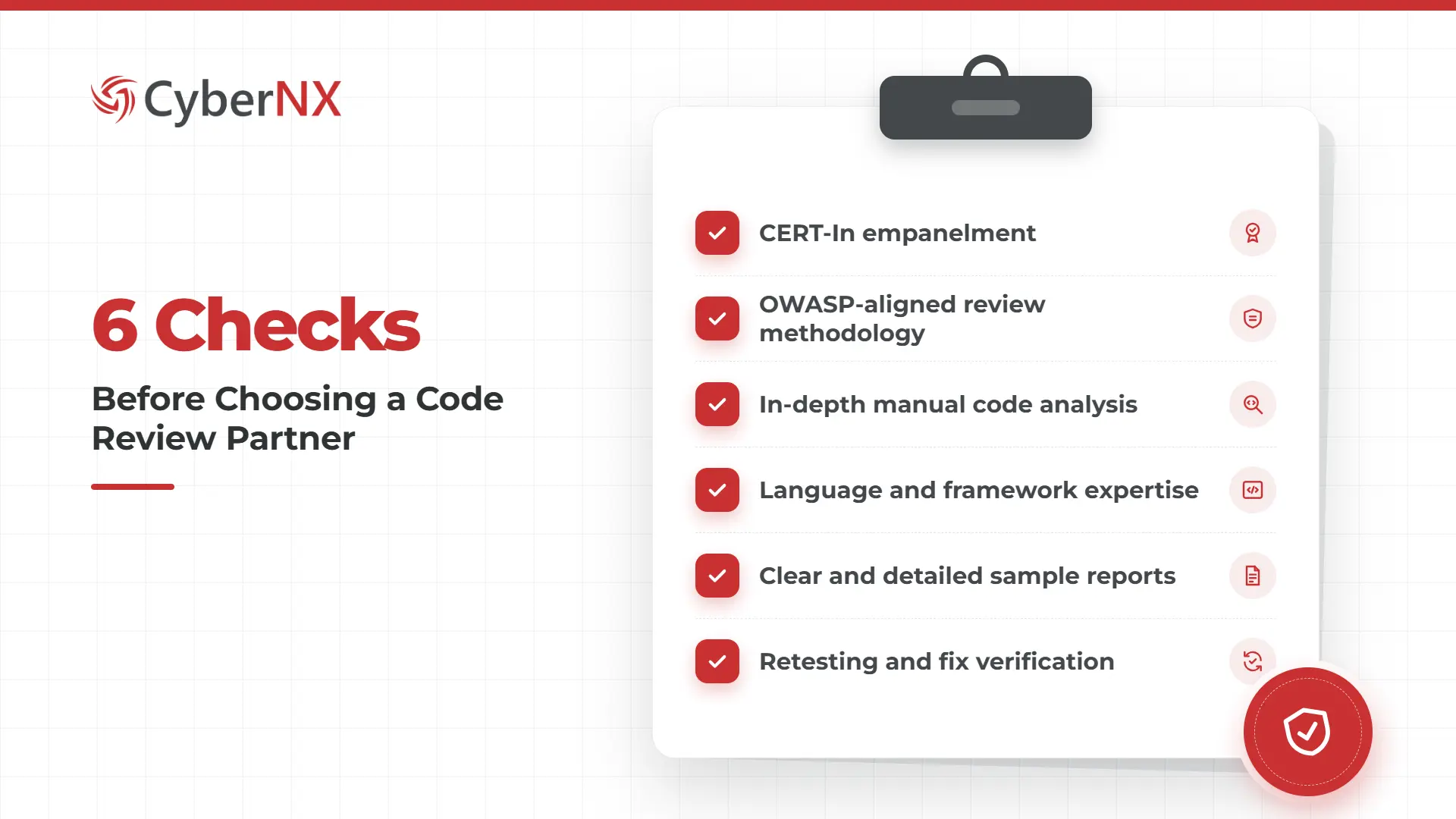
Accreditation and recognised methodology
Look for empanelment with the Indian Computer Emergency Response Team (CERT-In). Empanelment shows the provider has met government-defined audit capability criteria. Also ask whether reviews follow a recognised framework for consistent coverage.
Manual depth and technology stack coverage
Ask how much of the engagement is manual analysis versus tool output. Confirm the team has hands-on experience with your languages and frameworks. A Java microservices backend needs different expertise than a React Native mobile app.
Actionable reporting and retest support
Request a sample report before you sign any agreement. Strong reports include code snippets, exploit scenarios and developer-friendly remediation steps. Confirm that fix verification is part of the scope, not an afterthought.
Conclusion
Functional testing tells you whether code works. An application security code review tells you whether it holds up against attackers. Hidden secrets, growing security debt and AI-generated code all raise the stakes for every release. The best results come from combining automated scanning with expert manual analysis.
At CyberNX, our CERT-In empanelled Secure Code Review service does exactly that. We work alongside your developers to find, prioritise and verify fixes for exploitable weaknesses. Our reports give your team clear, code-level guidance it can act on immediately.
Ready to see what your scanners are missing? Talk to our experts today about your next review.
Application security code review FAQs
How long does an application security code review take?
Timelines depend on codebase size, language complexity and agreed scope. A focused review of one critical module may take a few days. A full application review can run between one and three weeks.
How is our source code kept confidential during the review?
A reputable provider signs a non-disclosure agreement (NDA) before any code changes hands. Reviews can also run inside your environment through access-controlled sessions. When code is shared externally, it should travel through encrypted channels only. Access should stay limited to the assigned analysts throughout the project. Ask your provider to confirm secure deletion of all copies at project close.
What drives the cost of a code review engagement?
Cost mainly depends on lines of code, the number of languages and manual analysis depth. Retest cycles and compliance reporting requirements also shape the final quote.
Can you review legacy or third-party code?
Yes, and legacy or third-party code often carries the highest inherited risk. Experienced reviewers adapt to older frameworks and limited documentation.