A single feed subscription covers one slice of your exposure and attackers do not limit themselves to one slice.
A phishing domain impersonating your brand, a leaked employee credential and an active ransomware group targeting your sector each require different intelligence sources to detect. No single threat intelligence feed provider covers all three.
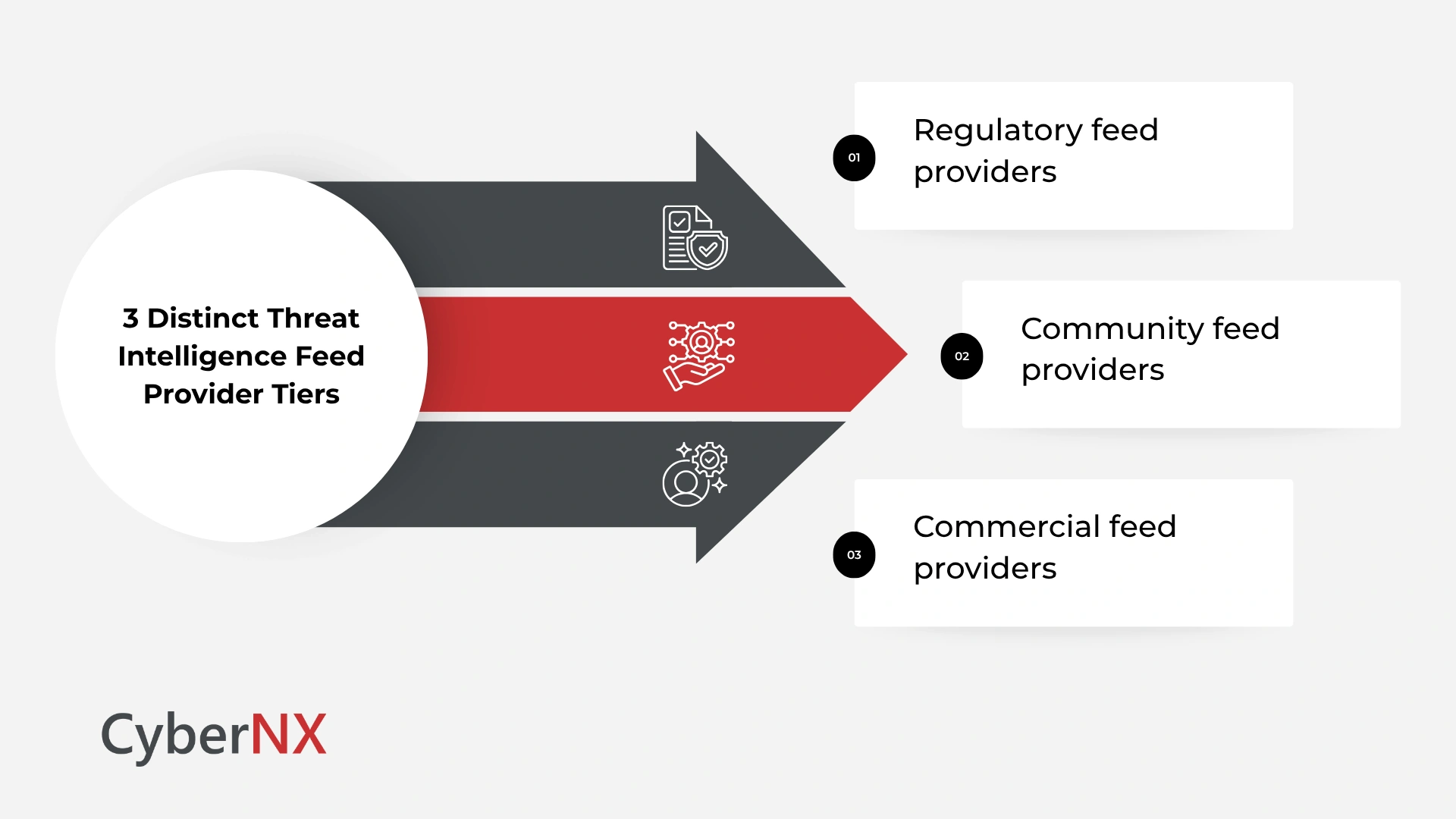
Threat intelligence feeds sit across three distinct provider tiers: government and regulatory sources, community and open-source threat intelligence feeds, and commercial platforms. Each tier answers different questions, covers different threat surfaces and serves a different function in your security programme.
This blog lists nine providers across all three tiers and explains how to combine them into a stack that closes the coverage gaps most organisations leave open.
Why one tier is never enough
Many organisations either subscribe to one commercial threat intelligence feed or assemble three free feeds that share the same upstream sources. Neither approach delivers real coverage breadth.
Research on feed quality evaluation shows that a significant proportion of commercial and open-source feeds draw from the same base repositories. Adding a fourth subscription from the same tier often adds duplicate indicators and not new signal.
The diagnostic question for any feed stack is straightforward. What does each provider catch that the others would miss? If the answer is unclear, the stack has duplication, not depth.
A balanced stack pulls from all three tiers: government feeds for regulatory intelligence and compliance evidence, community feeds for broad coverage and cost efficiency, and commercial threat intelligence feeds for attribution depth and real-time enrichment. The tiers are designed to complement each other, and they do not usually overlap.
Tier 1 – Government and regulatory feed providers
Government feeds are the most trusted and compliance-relevant tier. They are also the most underused.
1. CERT-In advisories and alerts
India’s Computer Emergency Response Team (CERT-In) is the primary government intelligence source for Indian enterprises. With organisations facing an average of 1,847 weekly cyberattacks, CERT-In advisories provide timely alerts on active threats, exploited vulnerabilities and attack campaigns targeting Indian infrastructure.
CERT-In also operates MISP (Malware Information Sharing Platform) instances for critical infrastructure sectors, enabling structured, machine-readable threat sharing across energy, finance and telecommunications. For India’s regulated enterprises, CERT-In feeds serve a dual function: threat detection and compliance evidence under SEBI CSCRF and RBI patching requirements.
2. CSIRT-Fin
The Computer Security Incident Response Team for the Financial Sector (CSIRT-Fin) functions under CERT-In specifically for India’s Banking, Financial Services and Insurance (BFSI) sector. Its bulletins track ransomware groups, phishing campaigns and fraud infrastructure actively targeting Indian financial institutions.
In 2024, CERT-In, CSIRT-Fin and SISA jointly published India’s first BFSI Digital Threat Report. A structured, sector-specific intelligence product covering key attack vectors, adversarial tactics and BFSI-specific threat actor activity. For BFSI security teams, CSIRT-Fin feeds are not optional. They are the regulatory layer of your intelligence stack.
3. CISA Automated Indicator Sharing (AIS)
The US Cybersecurity and Infrastructure Security Agency’s (CISA) AIS programme provides machine-readable indicators from federal investigations in STIX/TAXII format at no cost. Although it is US-centric in origin, CISA indicators are widely adopted by global security teams because threat actor infrastructure crosses borders.
Tier 2 – Community and OSINT feed providers
Community feeds provide breadth. They are maintained by researcher communities, non-profits and open-source projects. They are free or low-cost and update frequently but require evaluation before use, as quality varies widely.
4. AlienVault OTX
AlienVault Open Threat Exchange (OTX) is the largest community-driven threat intelligence platform, with more than 19 million indicators contributed by over 100,000 researchers globally. Coverage is broad but variable. OTX performs best as an enrichment layer, validating indicators from other sources rather than serving as a primary detection feed.
5. Abuse.ch
Abuse.ch operates three purpose-built community feeds: URLhaus (malicious URLs used in phishing and malware delivery), MalwareBazaar (malware sample hashes and metadata) and ThreatFox (indicators of compromise linked to known malware families). Each feed is narrow, accurate and updated continuously. For teams monitoring phishing infrastructure or malware campaigns, Abuse.ch delivers high signal-to-noise quality that most free feeds do not.
6. Shadowserver Foundation
Shadowserver provides remediation-focused intelligence derived from daily internet scanning and sinkhole operations. Its feeds surface exposed assets, botnet-infected infrastructure and network abuse patterns. Security teams use Shadowserver to identify what attackers see when they scan your external footprint, making it a practical complement to internal vulnerability management.
Tier 3 – Commercial feed providers
Commercial feeds deliver the deepest intelligence: real-time threat actor attribution, campaign-level context and enriched indicators linked to specific adversary behaviour. They are the highest-cost tier and deliver the most value when your team has the analyst capacity to act on context, not just block indicators.
7. Recorded Future
Recorded Future processes data across the open, deep and dark web to build an intelligence graph linking threat actors, infrastructure and indicators in real time. Its STIX/TAXII compatibility and broad API integrations make it the most widely deployed commercial threat intelligence feed in enterprise environments.
8. CrowdStrike Falcon Intelligence
CrowdStrike tracks more than 265 named threat actor groups, linking dark web activity, adversary tooling and infrastructure patterns to specific campaigns. For organisations already using the CrowdStrike endpoint platform, Falcon Intelligence integrates directly into detection workflows, turning raw IOCs into contextualised, actor-attributed alerts without additional tooling overhead.
9. Mandiant Threat Intelligence
Mandiant’s intelligence is built directly from more than 200,000 annual incident response hours conducted globally. It tracks over 350 threat actors and produces campaign-level assessments that connect technical indicators to geopolitical and financial motivations. For regulated industries that need to justify security investment at board level, Mandiant’s strategic intelligence layer translates technical findings into business risk language.
How to build your three-tier stack without duplication
A common mistake when building a feed stack is to add subscriptions without auditing overlap. Multiple commercial feeds from the same upstream source deliver duplicate indicators, inflating alert volume without improving coverage.
Before adding any new provider, ask: what does this feed catch that my current stack would miss? Test each candidate against your existing sources over 30 days and measure IOC originality. Also, check what percentage of indicators are unique to this provider versus appearing in feeds you already consume.
For India BFSI teams, a practical starting stack combines CERT-In advisories and CSIRT-Fin bulletins as the regulatory tier, Abuse.ch and Shadowserver as a cost-efficient community tier, and one commercial provider chosen for threat actor attribution depth relevant to your sector. That combination covers regulatory compliance evidence, broad indicator coverage and targeted adversary intelligence without the duplication that inflates cost and noise.
As your threat intelligence lifecycle matures, you can extend each tier rather than adding parallel subscriptions within the same tier.
Conclusion
Building an effective threat intelligence feed stack is not about subscribing to more providers. It is about covering all three tiers – government, community and commercial – without duplication between them.
Government feeds give you regulatory intelligence and compliance evidence. Community feeds give you breadth and cost efficiency. Commercial feeds give you attribution depth and real-time context. Each tier covers what the others miss.
CyberNX’s Threat Intelligence service operationalises feeds across all three tiers, curating, enriching and integrating intelligence into your detection workflows so your team responds to real threats, not feed noise. Have questions about building the right feed stack for your environment? Talk to our team.
Threat intelligence feed providers FAQs
What are threat intelligence feed providers?
Threat intelligence feed providers are organisations that supply continuous streams of cyber threat data – malicious IPs, domains, file hashes, phishing URLs and attacker TTPs – via APIs, STIX/TAXII formats or platform integrations. They range from government agencies and non-profit researcher groups to commercial intelligence platforms.
What is the difference between free and commercial threat intelligence feeds?
Free and community feeds such as AlienVault OTX, Abuse.ch and Shadowserver provide broad indicator coverage at no cost but vary in quality and lack actor attribution depth. Commercial providers like Recorded Future and Mandiant add real-time enrichment, threat actor profiling and campaign-level context – capabilities that require analyst capacity to use effectively.
Which threat intelligence feed providers should India BFSI teams prioritise?
India BFSI teams should begin with CERT-In advisories and CSIRT-Fin bulletins as mandatory regulatory-tier feeds, then layer community feeds like Abuse.ch for phishing and malware coverage. A commercial provider with STIX/TAXII compatibility and RBI or SEBI CSCRF reporting alignment adds depth for teams with dedicated analyst capacity.