Your Security Information and Event Management (SIEM) system sees everything happening inside your network. But threat actors do not plan their attacks inside your network. They plan them outside it on dark web forums, across botnet infrastructure, through attacker-controlled domains and inside criminal marketplaces your SIEM cannot reach.
By the time a threat appears in your internal logs, it has often already crossed your perimeter.
SIEM threat intelligence feeds are the bridge between what is happening out there and what your defences can act on. They supply your SIEM with real-time, contextualised data on known malicious actors, indicators of compromise (IOCs) and adversary behaviour, turning reactive log monitoring into proactive, intelligence-led detection.
What are SIEM threat intelligence feeds?
A threat intelligence feed is a continuous stream of data about known threats like malicious IP addresses, suspicious domains, file hashes associated with malware, and indicators linked to threat actor campaigns.
When integrated with your SIEM, these feeds allow it to cross-reference internal security events against a live, global picture of adversary activity.
The distinction between data and intelligence matters. Raw data is an IP address flagging in your logs. Threat intelligence tells you that IP belongs to a known ransomware group, has been used in command-and-control communications targeting Indian financial institutions, and was first observed in active campaigns three weeks ago.
Types of threat intelligence feeds your SIEM needs
Using the right combination of intelligence feeds gives your SIEM genuine external coverage.
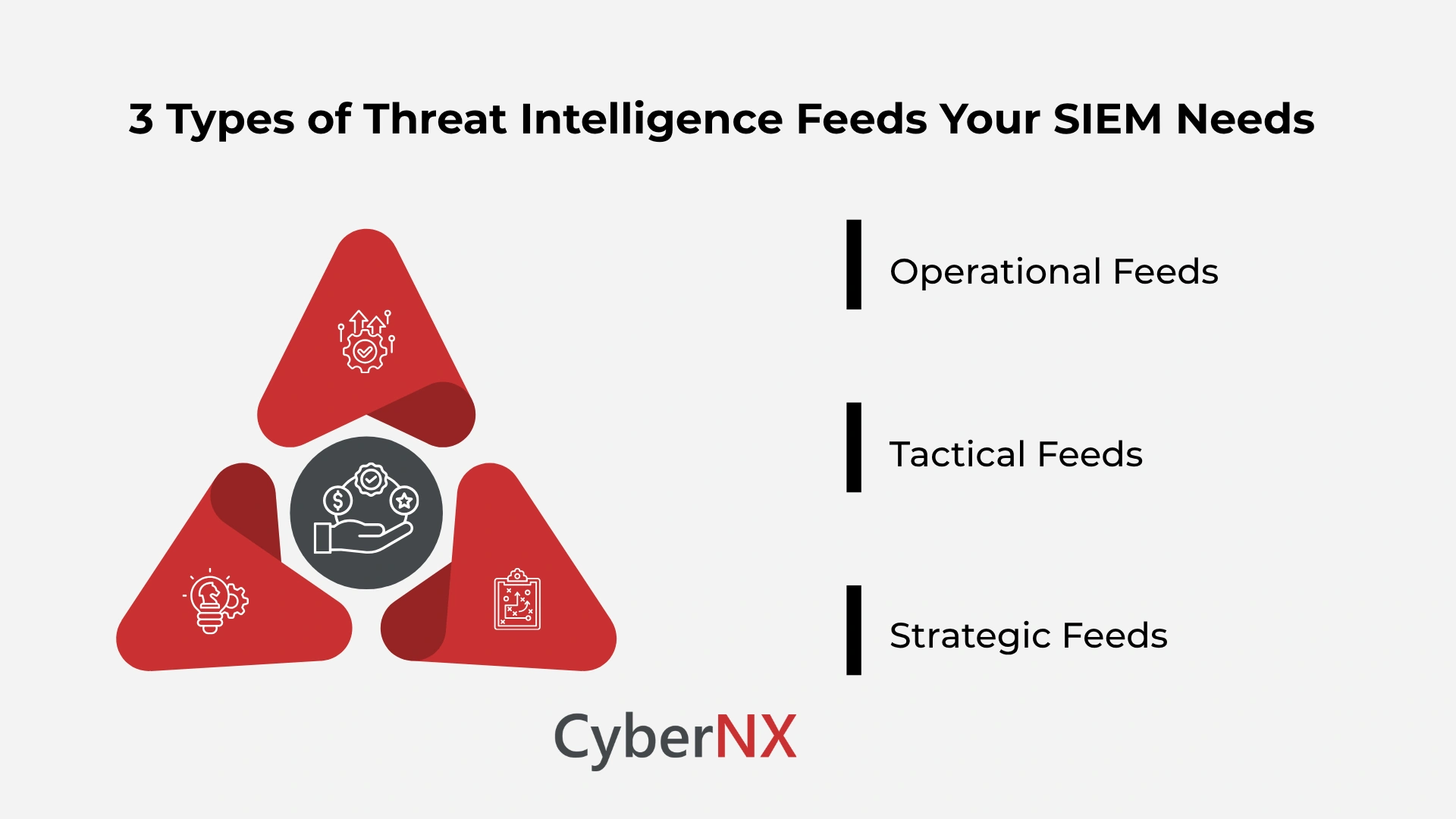
1. Operational feeds – IOCs, IPs, domains and hashes
These are the most common feed type, fast-moving data on active threats. Operational IOC feeds update every five to fifteen minutes to ensure protection against active campaigns. They are high-volume and require careful management. Without confidence scoring and expiry policies, they become a source of false positives rather than actionable detections.
2. Tactical feeds – TTPs and MITRE ATT&CK mapping
Tactical intelligence maps adversary behaviour to the MITRE ATT&CK framework, the techniques, tactics and procedures (TTPs) threat actors use across the attack lifecycle. Updated daily or weekly, these feeds are significantly more durable than IOC lists. An IP address can change overnight. An adversary’s preferred lateral movement technique does not.
3. Strategic and dark web feeds
Strategic intelligence covers threat actor profiles, campaign intentions and sector-specific targeting trends, giving BFSI and healthcare organisations early warning before adversaries reach their perimeter. Dark web feeds add intelligence from criminal forums, Telegram groups and paste sites where threat actors coordinate and sell access. This layer covers compromised credentials, breach data and planned attack campaigns, excellent context no internal log source can provide.
How SIEM threat intelligence integration works
Connecting a feed to a SIEM is the easy part. Making that intelligence flow through to actual detections is where most organisations stall.
The three-tier architecture: ingestion, enrichment, enforcement
Effective integration follows a three-tier model.
- The ingestion layer collects IOCs from multiple feeds via API calls or TAXII subscriptions, normalises them into a common format and deduplicates.
- The enrichment layer cross-references security events against the intelligence store, appending threat actor attribution, campaign association and confidence scores.
- The enforcement layer is where intelligence becomes action – enriched indicators are automatically distributed across SOAR platforms, firewalls and EDR tools, triggering automated blocks or analyst escalations based on confidence thresholds.
STIX and TAXII – the protocols that make it automated
STIX (Structured Threat Information eXpression) is the standardised language for describing threat intelligence. TAXII (Trusted Automated eXchange of Indicator Information) is the transport protocol that moves STIX-formatted data between systems automatically. Together, they allow SIEM platforms to pull IOCs from feeds, cross-check against log data and trigger detections – without manual analyst input. If your feeds do not support STIX/TAXII, you are adding integration overhead every time a new source comes in.
Why your SIEM is blind without external threat context
The most dangerous threats like APTs, nation-state actors and ransomware groups operate outside your network for weeks before touching your systems. In documented incidents, state-sponsored backdoors have maintained access for over a year before detection. The intelligence to identify those actors existed but the detection coverage was not in place.
External threat intelligence feeds close this gap. When your SIEM knows a particular IP is tied to a known APT’s command-and-control infrastructure, a single connection attempt becomes a high-priority incident. Without that context, it gets triaged away.
Best practices for integrating threat intelligence feeds with SIEM
Follow these 3 best practices for threat intelligence to SIEM:
1. Prioritise feed quality over quantity
More feeds mean more normalisation overhead and more false positives without confidence scoring. High-quality feeds tell you not just that an IP is malicious – but why, and which campaign it belongs to. Start with a small, well-curated set and expand from there.
2. Automate IOC expiry and confidence thresholds
IOCs go stale. Confidence decay models that automatically expire indicators based on age and threat type prevent your SIEM from enforcing on dead infrastructure. High-confidence indicators should trigger automated blocking; lower-confidence ones should surface for analyst review.
3. Close the loop from feed to response
The measure of a threat intelligence programme is not how many feeds you ingest – it is what percentage produce detections that lead to contained incidents. Build weekly feed reviews, monthly threat actor assessments and quarterly rule-tuning into your programme.
Conclusion
Your SIEM is a powerful detection engine. But detection without intelligence is always reactive – and reactive is too slow against today’s threat actors. SIEM threat intelligence feeds give your security operations genuine external visibility: context to recognise attacker infrastructure, adversary profiling to understand intent, and automation to act before damage occurs.
At CyberNX, our Threat Intelligence Services combine commercial threat feeds, dark web monitoring and sector-specific IOC research to deliver intelligence your SIEM can operationalise from day one. Our analysts contextualise adversary behaviour, map it to your risk profile and keep your detection rules current as the threat landscape evolves.
Have questions about integrating threat intelligence into your security operations? Talk to our team.
SIEM threat intelligence feeds FAQs
What is a SIEM threat intelligence feed?
A continuous stream of IOCs and adversary data – malicious IPs, domains, file hashes, TTPs, ingested by a SIEM to enrich internal security events with external context.
What is the difference between STIX and TAXII?
STIX is the standardised language for structuring threat intelligence. TAXII is the protocol that transports it between systems. STIX defines the format; TAXII handles the delivery.
How often should threat intelligence feeds update?
Operational IOC feeds every five to fifteen minutes. Tactical TTP feeds daily or weekly. Strategic feeds monthly or quarterly.
Can threat intelligence feeds reduce SIEM false positives?
Yes, when confidence scoring and automated IOC expiry policies are in place. High-confidence indicators trigger blocks; lower-confidence ones surface for analyst review.