In December 2024, the FunkSec ransomware group became the most prolific ransomware actor of the month. They managed to do it through AI-assisted malware development and operated faster than any traditional group could manage. Their code may not be particularly smart, but they wrote it faster. And they iterated on it before defenders could catch up.
This is the new threat reality. Attackers are now using AI to conduct research, analyse large data sets and refine attack paths in real time. Meanwhile, most security teams are still validating their defences through annual penetration tests, static playbooks and manual rule-checks that take weeks to produce results.
The gap between how fast attackers move and how long defenders take to respond is the defining security problem of 2026. And the role of generative AI in BAS is emerging as one of the most effective answers to it.
Why traditional BAS is no longer enough
Breach and attack simulation was built to solve a real problem: security controls often look correct on paper but fail quietly in production. A firewall rule might be misconfigured or a SIEM alert might not trigger. Or perhaps an EDR detection might miss a lateral movement technique that changed three months ago.
Traditional BAS addressed this by automating predefined attack simulations. But predefined means static. And static means yesterday’s threats.
The gap isn’t a shortage of tools, most enterprises already run 20 or more security products. The real problem is that those tools are tested and tuned against known attack patterns. Meanwhile, adversaries are using generative AI to mutate techniques and move faster than any fixed simulation library can track. When attackers operate in minutes and defenders are still running last quarter’s playbook, the simulation layer becomes the weakest link in the security stack.
What generative AI brings to BAS
The role of generative AI in BAS isn’t simply to automate what humans were already doing. It’s to do things that were previously impossible at scale like creating novel attack scenarios on demand, adapting to your specific environment and delivering findings in minutes rather than weeks.
Here are the six core capabilities that define how generative AI is reshaping BAS:
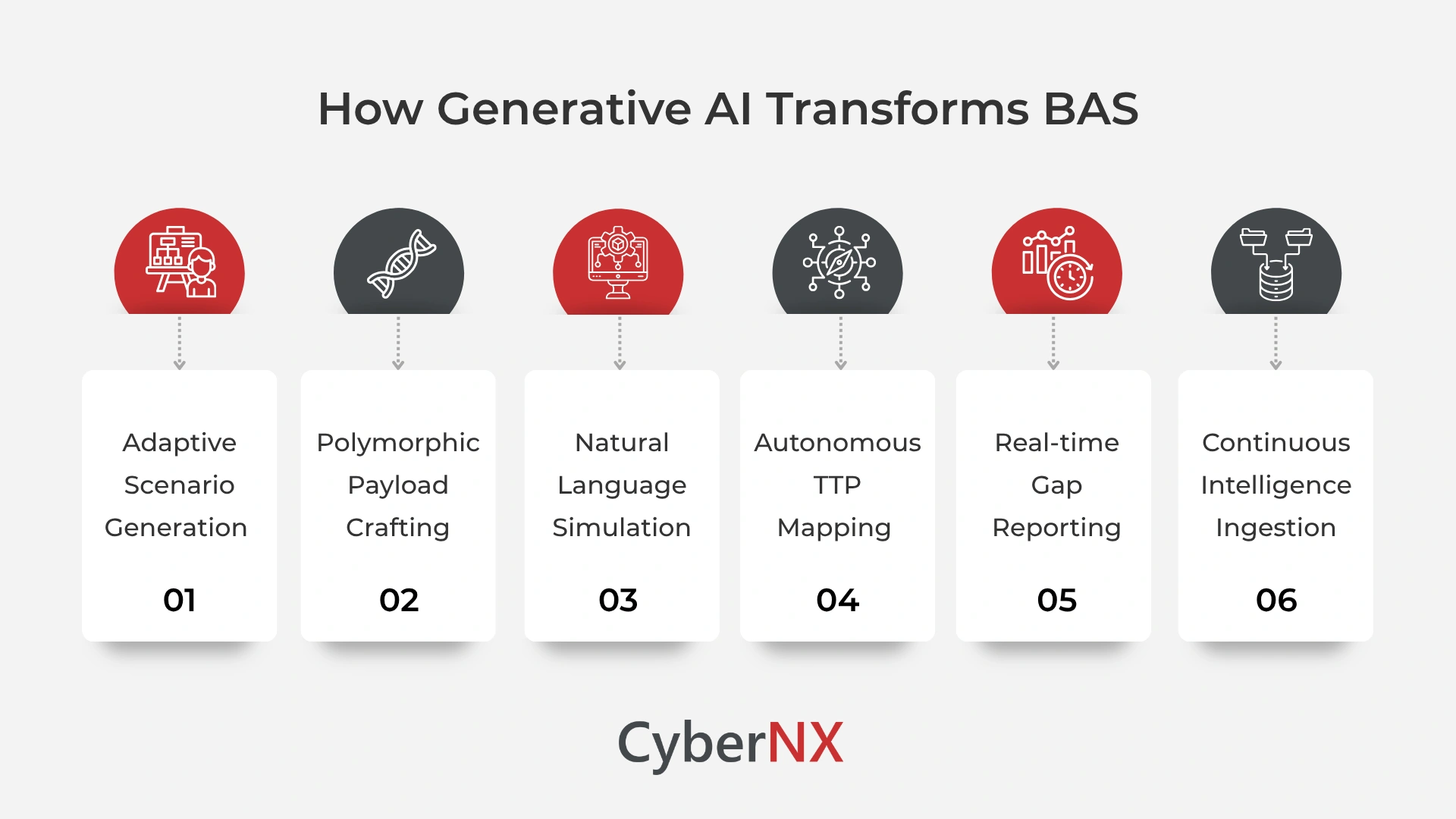
Adaptive scenario generation
Traditional BAS relies on a fixed library of attack simulations. Generative AI builds scenarios dynamically from live threat intelligence feeds, constructing attack chains that reflect what active threat groups are actually doing, not what they were doing six months ago.
Polymorphic payload crafting
One of the most dangerous shifts in the threat landscape is the rise of polymorphic malware, which rewrites itself to evade detection. Generative AI can rewrite a malware’s codebase continuously and adapt it to escape defences. AI-powered BAS replicates this behaviour in a safe environment, and tests if your controls catch payloads that mutate – the same challenge your team faces from real adversaries.
Natural language simulation control
Legacy BAS platforms need security engineers to configure simulations manually. With gen AI, analysts can describe an attack scenario in plain language. For example, “simulate a credential theft and lateral movement attack targeting our Active Directory environment”, and the platform translates it into a structured, easy simulation.
Autonomous TTP mapping
Every simulation automatically maps findings to MITRE ATT&CK, identifying which adversary techniques succeeded, which controls failed and in what sequence. This removes a major manual burden from analysts and makes sure that remediation priorities reflect the actual tactics of threat actors targeting your industry.
Real-time gap reporting
Gen AI reduces the time between running a simulation and understanding its implications. Reports are generated in real time, structured for different stakeholders – technical detail for the SOC, executive summary for the CISO, evidence trail for auditors etc. – without requiring manual post-processing.
Continuous threat intelligence ingestion
AI-powered BAS platforms gather new threat feeds daily, automatically adding emerging TTPs to the simulation library. BAS offers a continuously updated library of attacks, including zero-day exploits within 24 hours if a proof-of-concept exists. This means your simulation library evolves as fast as the threat landscape.
The attacker-defender asymmetry generative AI must close
AllAboutAI’s analysis of recent threat intelligence found that:
- AI- cyberattacks have increased 72% year-over-year
- Automated scanning has jumped to 36,000 attack probes per second
- 87% of global organisations now report AI-driven incidents
Threat actors use these capabilities to compress what used to take days – reconnaissance, initial access, lateral movement, data exfiltration – into operations that complete in under an hour.
In addition, according to a 2025 survey done by Programs.com:
- More than 53% of CISOs agree that AI actually benefits attackers more than defenders.
That perception reflects a real asymmetry. Attackers operate without approval processes, change management cycles or tool constraints. They iterate instantly. Defenders, working within enterprise governance structures, cannot match that pace through human effort alone.
Generative AI in BAS addresses this asymmetry directly. When defenders can simulate AI-generated attack chains and receive prioritised remediation guidance within hours of a new threat emerging, the gap narrows. It will do so by automating the validation cycle to the point where it can keep pace.
What this means for your security programme
The practical impact of generative AI in BAS extends beyond faster simulations. It changes how security programmes are structured and justified.
- Continuous validation replaces point-in-time testing: Security posture is assessed daily, not once a year. Each change to your environment can be validated immediately.
- Remediation becomes data-driven: Instead of triaging findings based on CVSS scores and theoretical risk, teams prioritise based on whether an attack actually succeeded against their live controls.
- Compliance evidence is always current: Regulators increasingly expect proof of continuous security validation. AI-powered BAS generates structured, audit-ready reports automatically, and reduce the burden of compliance documentation.
- Security ROI becomes measurable: Organisations that adopted security AI and automation save a significant amount of capital compared to those that did not deploy these technologies. Continuous BAS directly contributes to faster detection and containment.
Conclusion
Generative AI has changed both sides of the security equation. Attackers are using it to move faster and operate at a scale that human-led campaigns could never achieve. The role of generative AI in BAS is to give defenders an equal capability – the ability to simulate, validate and remediate at machine speed, not human speed.
At CyberNX, our breach and attack simulation services are built to help you stay ahead of an evolving threat landscape. To continuously test security controls, map findings to real adversary TTPs and deliver the intelligence – your team needs to act before attackers. If you’re ready to see what the role of generative AI in BAS looks like in practice for your environment, our experts are here to help. Connect with us and start validating smarter.
The role of generative AI in BAS FAQs
What is the role of generative AI in BAS platforms?
Generative AI allows BAS platforms to move beyond fixed attack libraries. It creates adaptive, novel attack scenarios based on live threat intelligence, generates polymorphic payloads that mimic real adversary evasion techniques and enables security teams to control simulations through plain language instructions.
How is generative AI used by attackers, and why does this make AI-powered BAS necessary?
Threat actors use generative AI to craft personalised phishing content, develop polymorphic malware and scale attacks across thousands of targets simultaneously. Because these attacks are adaptive and fast-moving, static simulation libraries cannot replicate them. AI-powered BAS mirrors the same adaptive behaviour on the defensive side and makes sure your controls are tested against the techniques attackers are actually using today.
Does AI-powered BAS replace penetration testing or red teaming?
No, they serve different purposes. Penetration testing and red teaming validate human strategy, creativity and decision-making in complex scenarios. Generative AI in BAS provides continuous, automated control validation that runs 24/7. The most effective security programmes use both: AI-powered BAS for ongoing validation and red teaming for deep, scenario-based adversary emulation.
How quickly does an AI-powered BAS platform incorporate new threats?
Leading platforms ingest threat intelligence continuously, with new TTPs and zero-day exploits with available proof-of-concepts added to the simulation library within 24 hours of public disclosure. This means your validation remains current even as the threat landscape changes week to week.