Your firewall flagged zero alerts last quarter and your EDR hasn’t triggered in weeks. Does that mean you’re secure? Or are you just unaware of what’s getting through?
This is the question that breach and attack simulation (BAS) and automated pentesting were both built to answer. But they answer it very differently. And choosing the wrong tool for the wrong job can give you a false sense of security that’s actually more dangerous than no testing at all.
The BAS vs automated pentesting debate has intensified as security teams face more and more pressure to validate defences continuously. Companies are lately combining both these services to build stronger, evidence-based security programs. Read on to understand how to make the right call.
What is breach and attack simulation (BAS)?
BAS is an automated technology that continuously simulates attacker behaviour across your environment. It tests how well your security controls detect, prevent and respond. It runs pre-built and customizable attack scenarios mapped to the MITRE ATT&CK framework, safely inside live production environments. The core question BAS answers is: Are my controls actually working right now?
BAS platforms use lightweight agents across your network and simulate the full attack kill chain – from initial access and lateral movement to data exfiltration – without the disruptive footprint of a real intrusion. The result is a continuous, quantifiable score of your security posture, updated in real time as your environment changes.
BAS is particularly powerful for:
- Ongoing detection gap analysis against the latest threat actor techniques
- Configuration drift detection i.e. finding when a control that worked last month no longer does
- Security control validation across SIEM, EDR, firewall, and email gateway layers
What is automated pentesting?
Automated penetration testing uses intelligent tooling to simulate an attacker probing your environment for exploitable weaknesses, autonomously chaining vulnerabilities, escalating privileges and mapping realistic attack paths to high-value assets.
Where BAS focuses on breadth – testing whether controls catch known techniques – automated pentesting focuses on depth. It asks: given what’s in my environment right now, how far can an attacker actually get?
Unlike manual penetration testing, automated pentesting can operate continuously or on-demand without needing a team of specialist testers for every engagement. It is, however, best deployed by skilled security professionals who can interpret findings and scope tests appropriately.
Automated pentesting is most effective for:
- Pre-deployment security validation for new systems or major infrastructure changes.
- Compliance-driven assessments that require proof of exploitability.
- Understanding real attack paths from external or internal attacker perspectives.
BAS vs automated pentesting: A side-by-side comparison
To understand what is the difference between pen test and BAS, refer the table below:
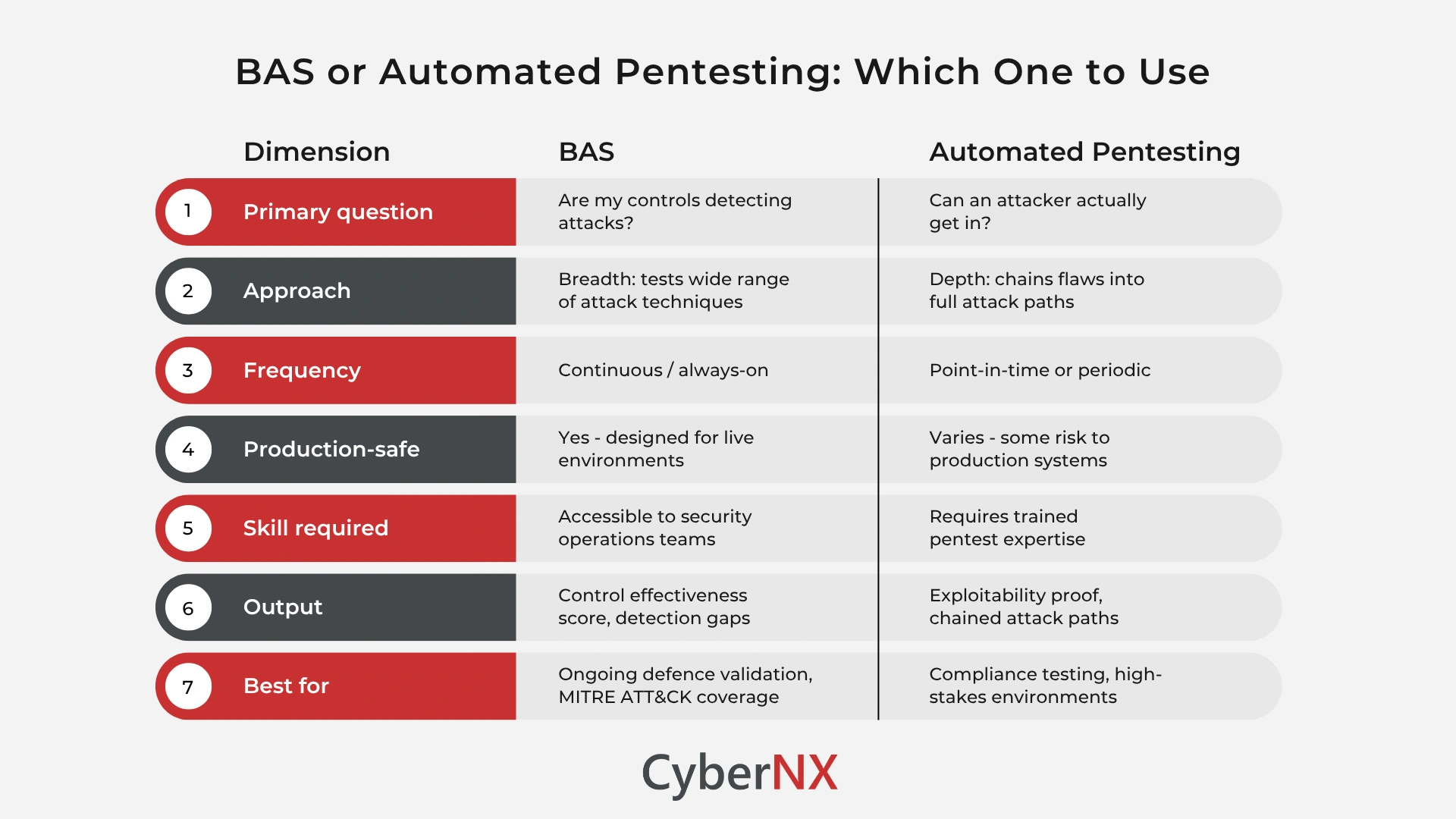
The simplest way to frame it: BAS tells you if your defences are working. Automated pentesting tells you if an attacker can get through. Both questions matter but they need different tools.
When to use BAS, automated pentesting, or both
Now that you have clarity about what is the difference between BAS and automated pentest, you need to have a simple understanding: neither tool replaces the other. The choice depends on your security maturity, operational context, and what question you’re trying to answer.
Use BAS when you need continuous validation
If your environment changes frequently – new tools, policy updates, personnel changes – BAS gives you a live readout of control effectiveness. It is the right fit for mature SOCs that need ongoing visibility without scheduling dedicated test windows.
Use automated pentesting for depth proof
When you need to demonstrate to the board, an auditor, or a regulator that a vulnerability is actually exploitable (not just theoretically possible), automated pentesting delivers that evidence. It is also critical before major releases, cloud migrations or third-party integrations.
Use both together within a CTEM program
Continuous Threat Exposure Management (CTEM) is most effective when BAS and automated pentesting work in parallel. BAS maintains a continuously scored baseline. Automated pentesting digs into the highest-risk exposures that baseline surfaces.
Default to automated pentesting for compliance mandates
Regulatory frameworks including RBI cybersecurity guidelines, SEBI CSCRF, and India’s DPDP Act expectations, typically need evidence of vulnerability exploitation testing. Automated pentesting fulfills this requirement in a way that BAS alone does not.
Conclusion
BAS and automated pentesting are complementary layers of a mature defence program. BAS keeps a constant pulse on whether your controls are working day-to-day. Automated pentesting goes deeper, proving what an attacker could actually do if they got in. Together, they answer the questions that vulnerability scanners and compliance checklists never could.
The organisations getting this right aren’t just choosing between the two. They’re also building programs where both work in parallel, and feed into a broader CTEM strategy.
Our organisation CyberNX is a CERT-In empanelled cybersecurity firm that offers dedicated breach and attack simulation services as well as automated pentesting services. We help organisations in banking, financial services and insurance continuously validate their defences against real-world attack techniques. Whether you need to have BAS vs automated pentesting clarity, a one-time assessment or even an ongoing validation program aligned to RBI, SEBI CSCRF, or DPDP Act requirements, we bring the expertise to deliver it. Connect with us today.
BAS vs automated pentesting FAQs
What is the difference between BAS and automated pentest?
BAS constantly tests whether your security controls detect and block known attack techniques. Automated pentesting probes your environment to find exploitable vulnerabilities and map real attack paths to critical assets. BAS focuses on breadth and ongoing control validation; automated pentesting focuses on depth and proof of exploitability.
Can BAS replace penetration testing?
No. BAS and penetration testing answer different questions and serve different purposes. BAS cannot replicate the creative, human-driven exploitation that skilled pentesters bring, nor does it produce the kind of exploitability evidence that regulatory frameworks typically require. Most mature security programs use both.
How often should BAS and automated pentesting be run?
BAS is designed to run continuously, it is always-on by nature. Automated pentesting is typically triggered by major infrastructure changes, pre-deployment testing, compliance cycles, or when BAS surfaces a high-risk exposure that warrants deeper investigation.
Is automated pentesting safe to run in production?
It depends on the platform and how it’s configured. BAS platforms are explicitly designed for safe production use. Automated pentesting tools vary – some are production-safe, others may carry risk of service disruption and should be run in staging environments or with carefully scoped parameters. Always validate with your provider.