Most organisations fail to recognise that their security controls have been compromised. Instead, they directly realise that an attacker has already been inside for weeks.
The problem is validation – the gap between assuming controls work and actually proving it. Breach and Attack Simulation (BAS) exists to close that very gap. And as the market matures, the differences between breach attack simulation vendors have become sharper, more consequential and much harder to navigate without a clear framework.
With dozens of vendors now competing in this space, choosing the right one needs a lot more than reading feature lists. It requires you to know exactly what to look for.
How to choose a breach attack simulation vendor
Before reviewing individual vendors, it helps to understand what actually matters when checking out breach attack simulation vendors. The five criteria below form the foundation of any serious vendor assessment.
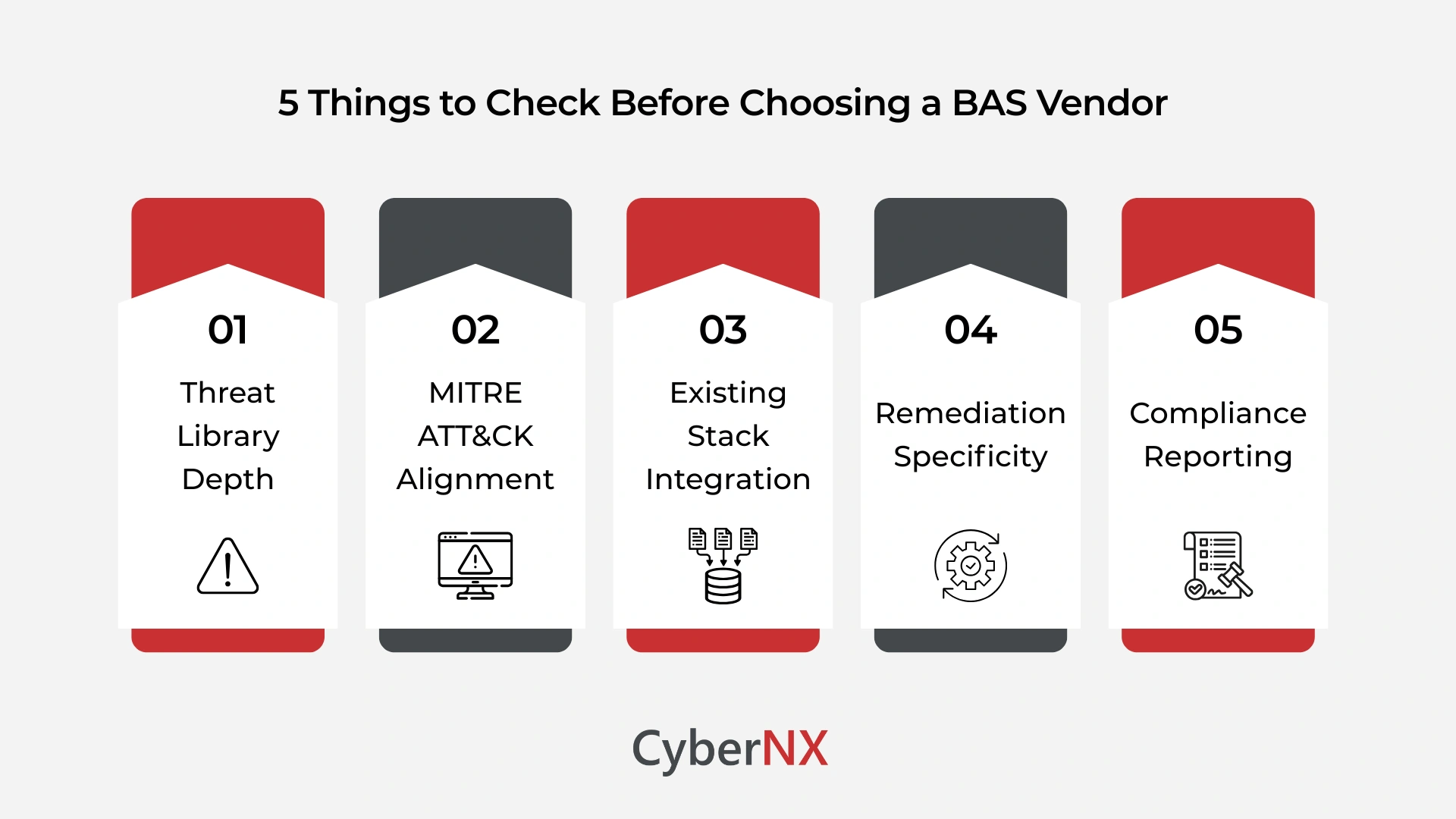
Threat library depth
The volume and freshness of attack content determines how realistic your simulations are. Look for vendors that cover the full kill chain – from initial access and lateral movement to data exfiltration – and update their libraries continuously as new TTPs emerge.
MITRE ATT&CK alignment
Vendors that map every simulation to specific MITRE ATT&CK techniques allow security teams to understand exactly which adversary behaviours their controls detect and which they miss – and prioritise solution based on real threat actor behaviour, not generic risk scores.
Existing stack integration
A BAS platform that cannot communicate with your SIEM, EDR, firewall or SOAR tools creates more work, not less. Check the depth of integration – not just whether the API exists, but whether simulation findings automatically surface as actionable data inside the tools your analysts already use daily.
Remediation specificity
There is a major difference between a vendor that identifies a control gap and one that tells you precisely how to fix it within your existing toolset. Vendor-specific tuning instructions reduce the time between finding and resolution.
Compliance reporting
BAS findings need to reach different audiences – technical detail for the SOC, posture trends for the CISO, structured evidence for auditors. Vendors that automate stakeholder-appropriate reporting across frameworks like SEBI CSCRF, RBI Master Direction and ISO 27001 reduce a large chunk of operational burden.
Leading breach attack simulation vendors to consider in 2026
The following list covers the most consistently recognised vendors:
1. CyberNX
CyberNX is a CERT-In empanelled cybersecurity firm with 100+ security experts, delivering end-to-end BAS services across India, UAE, the US and Singapore. Unlike the software-only BAS platforms, CyberNX brings a service-led approach. They combine automated attack simulation with expert human analysis to deliver findings that are both technically precise and operationally actionable.
CyberNX’s BAS services cover the full attack surface:
- Servers, endpoints, APIs, cloud and applications: Vulnerabilities identified and validated across every layer of your IT environment
- Customised simulation exercises: Initial consultations make sure BAS exercises align with your organisation’s security goals, threat profile and compliance obligations
- Security control fine-tuning: Simulation data is used to tune existing security tools and make your current cybersecurity investments more effective
- Compliance-ready reporting: Structured outputs aligned to SEBI CSCRF, RBI Master Direction and ISO 27001 requirements, suitable for auditors and regulators
2. Picus Security
Picus Security is well known for its prescriptive remediation guidance and a large threat library. It is a strong fit for organisations looking for a software-led, self-managed validation platform with deep MITRE ATT&CK coverage.
3. AttackIQ
AttackIQ is built around deep MITRE ATT&CK integration and is designed for organisations that need a highly customisable, data-driven platform for continuous security control validation. It is widely used by large enterprises and MSSPs operating at scale.
4. SafeBreach
SafeBreach runs continuous simulations using a simulator-based approach across production environments, with a large playbook library and strong executive-level reporting capabilities. It is best suited for organisations that need broad breach simulation coverage with board-level risk communication.
The questions that separate the right vendor from the rest
Even after narrowing down a breach attack simulation vendors list, the final decision comes down to fit. Before committing, ask:
- Does the vendor’s threat library cover the attack vectors most relevant to your industry like ransomware, supply chain, identity abuse?
- Can simulations run safely in your production environment without disrupting operations?
- How quickly do they incorporate new threat intelligence after a major adversary campaign or zero-day disclosure?
- Is remediation guidance specific enough for your team to act on without additional investigation?
- How does the vendor handle multi-cloud or hybrid environments if that matches your architecture?
- What does compliance reporting look like for the frameworks your regulators require?
The answers usually narrow it down to two or three options that genuinely fit your programme.
Conclusion
The breach and attack simulation vendors market has matured a lot. Almost all of their platforms can simulate attacks. The real differentiators are threat library freshness, integration depth and – for regulated organisations especially – whether the vendor brings both technology and expertise to the table.
At CyberNX, our breach and attack simulation services combine constant automated validation with expert-led analysis, thus helping companies identify control gaps, meet compliance obligations and build a security posture that holds up under real adversary pressure. If you are working through the breach attack simulation vendors decision and want guidance specific to your environment, our team is ready to help. Speak to a CyberNX BAS expert today.
Breach attack simulation vendors FAQs
What are breach attack simulation vendors?
Breach attack simulation vendors are firms that provide platforms or services for constantly simulating real-world cyberattacks against a live security environment. They test whether controls like SIEM, EDR and firewalls actually detect and block attacks – providing ongoing validation rather than relying on periodic manual assessments.
How do I choose the right vendor from the breach attack simulation vendors list?
Start with your environment and obligations: what security tools do you run, which attack vectors are most relevant to your industry and what are your regulatory requirements? Test vendors against threat library coverage, MITRE ATT&CK alignment, integration depth, remediation specificity and compliance reporting quality.
Are the best breach and attack simulation vendors suitable for mid-sized organisations?
Yes. Most vendors offer cloud-based delivery that removes infrastructure overhead. Mid-sized organisations should weight ease of deployment, time-to-value and the availability of expert support more heavily than large enterprises since they usually have smaller security teams to manage and act on simulation output independently.
How frequently should BAS simulations run?
Continuously. Leading breach and attack simulation vendors design their platforms for 24/7 automated validation, with new threat scenarios added as they emerge. At minimum, simulations should trigger automatically after any major configuration change to make sure the change has not introduced new gaps.