CrowdStrike’s 2025 Global Threat Report recorded an adversary breakout time – the speed at which an attacker moves from initial access to lateral movement – of just 51 seconds. Yet most organisations still rely on security tests that happen once or twice a year. The math does not work. By the time the next scheduled test arrives, the environment has changed and the gaps that did not exist initially are now quietly harming your systems.
That is the core tension behind the breach and attack simulation vs red teaming debate – and why choosing the right testing approach, at the right frequency, has never mattered more.
Both approaches simulate adversary behaviour. Both expose weaknesses before real attackers find out. But they answer fundamentally different questions and serve different purposes. Treating them as interchangeable is one of the most common and costly mistakes security leaders can make.
This guide breaks down exactly what separates the two, when each is the right call and why the strongest security programmes do not choose between them.
What is breach and attack simulation?
Breach and attack simulation (BAS) is an automated, continuous approach to security testing. It replicates real-world attacker tactics, techniques and procedures (TTPs) against your live environment. It tests whether your SIEM alert fires for a specific lateral movement technique, whether your EDR blocks a known payload variant or if your firewall rules hold against a tested exploit pattern.
Unlike a point-in-time test, BAS runs around the clock. Every configuration change, every newly deployed rule and every system addition gets validated – automatically. The output is specific: here is the control that failed, here is where it maps in the MITRE ATT&CK framework and here’s how to fix it. BAS is all about coverage, consistency and speed of validation.
What is red teaming?
Red teaming is a human-led adversarial exercise where a team of skilled ethical hackers simulates a real-world attack campaign against your organisation. It targets not only the technology, but people and processes as well.
A red team engagement usually runs for weeks or months. The team crafts custom attack chains, tests social engineering susceptibility and adapt their approach based on what they discover in your specific environment. The goal is to answer one question: could a determined, skilled hacker achieve a meaningful business impact against us – and would we know?
Breach and attack simulation vs red teaming: The core differences
The core differences with breach and attack simulation vs red teaming are explained below:
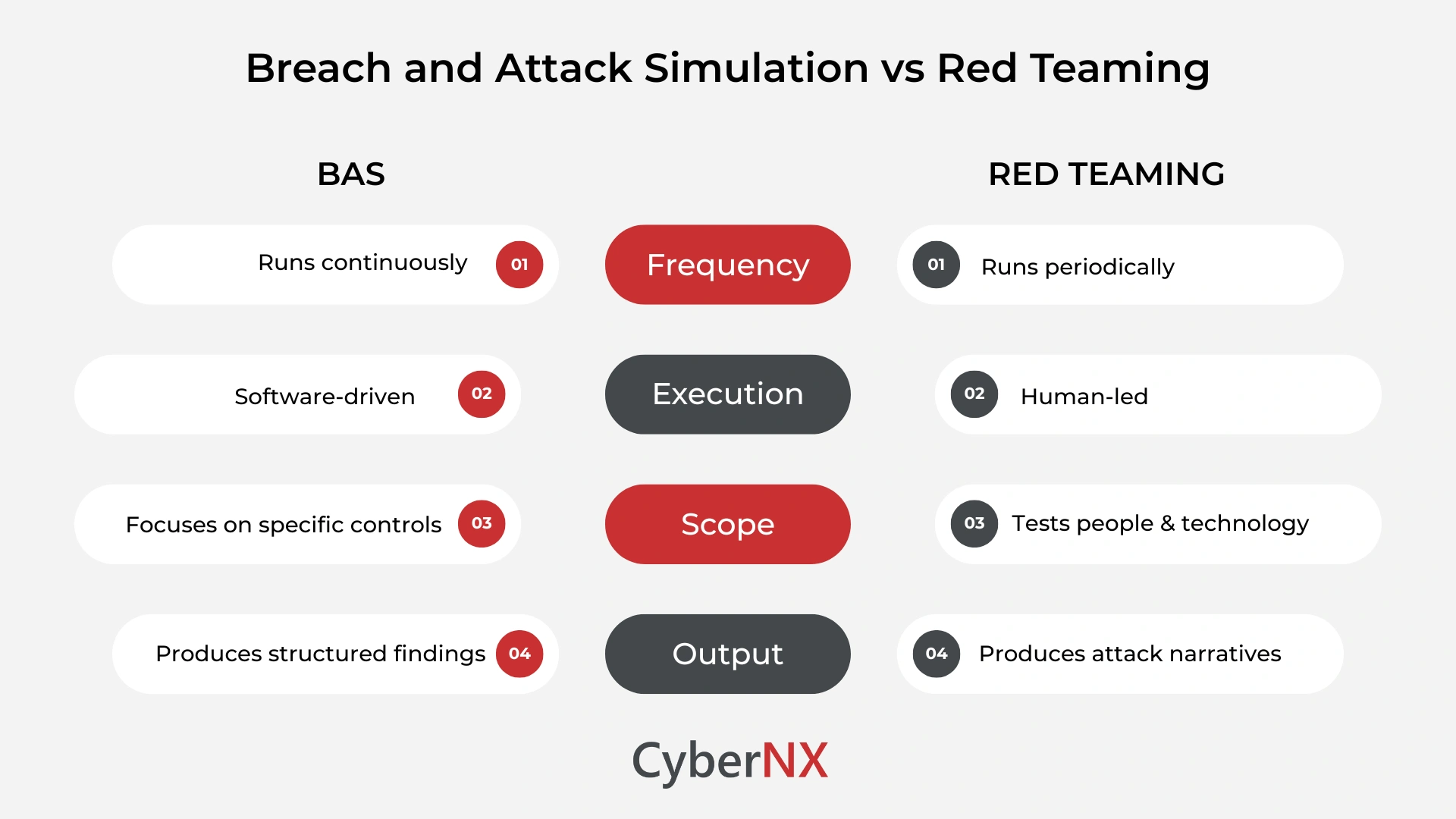
Frequency and rhythm
BAS runs continuously whereas red teaming is periodic. This is not a limitation of red teaming, it is by design. A red team engagement needs time to authentically simulate the full adversary lifecycle. BAS fills the gaps between those engagements with daily validation.
Execution model
BAS is software-driven and requires minimal analyst effort per cycle. Red teaming is human-led, requiring specialised expertise that cannot be fully automated. This difference in execution directly shapes what each approach is suited for.
Scope
BAS focuses on specific security controls: does your SIEM alert fire? Does your EDR quarantine this payload? Red teaming takes a wider lens. It tests how people and technology interact under a realistic, adaptive attack that no predefined simulation library can fully replicate.
(BAS focuses on specific security controls: SIEM, EDR etc.
Red teaming tests how people & technology interact under attacks)
Output type
BAS produces structured, technical findings with clear remediation steps and MITRE ATT&CK mappings. Red teaming produces attack narratives – accounts of how a real adversary moved through your environment – that inform strategic decisions at the CISO and board level.
When to use each approach
The breach and attack simulation vs red teaming question is not always binary. The right answer depends on your security maturity and what question you most urgently need answered.
Use BAS when you need to:
- Maintain continuous visibility into whether controls are working between red team engagements
- Get fast feedback after configuration changes, patches or new tool deployments
- Produce compliance evidence that security controls were regularly tested and validated
- Tune SIEM alert rules and reduce false positive rates without waiting for a scheduled assessment
Use red teaming when you need to:
- Simulate a full, realistic adversarial campaign that tests your entire security posture
- Validate that your SOC can detect and respond to a sophisticated, multi-stage attack
- Understand business-impacting attack paths, not just individual control gaps
- Confirm that previous remediation findings have been genuinely resolved under pressure
The honest answer for most mature organisations: choose both. BAS keeps defences calibrated daily. Red teaming validates that the overall posture holds against a thinking adversary operating without a script.
The risk of relying on only one
Relying only on red teaming creates long validation gaps. Between engagements – which may be six to twelve months apart – configurations change, new systems go live and threat actor TTPs evolve. Controls that passed a red team assessment in Q1 may silently fail by Q3.
Relying only on BAS creates a different blind spot. BAS simulates known TTPs against defined controls. It cannot mimic the creative, adaptive decision-making of a skilled human attacker who pivots when their first approach fails, exploits trust relationships between systems or chains low-severity findings into a high-impact attack path.
As Picus Security’s analysis highlights, the average malware instance now exhibits 11 different MITRE ATT&CK TTPs. This is a level of complexity that demands both automated continuous control validation and periodic human-led adversarial simulation working together.
Conclusion
There is no winner in the breach and attack simulation vs red teaming debate, because they are not competing. They solve different problems at different layers of your security programme. BAS gives you continuous, automated confidence that your controls work every single day. Red teaming gives you the adversarial perspective that only a skilled human can provide.
The organisations building genuinely resilient security programmes are using both – BAS running continuously in the background and red team engagements validating the overall posture at meaningful intervals.
At CyberNX, our breach and attack simulation services help organisations build the constant validation layer that keeps defences tuned between red team engagements. If you want to decide between breach and attack simulation vs red teaming or if you are looking to run both in a coordinated programme, our team can help you build a strategy that covers every gap. Speak to our experts today.
Breach and attack simulation vs red teaming FAQs
What is the main difference between breach and attack simulation vs red teaming?
BAS is automated and continuous, it tests specific security controls like SIEM, EDR and firewalls 24/7 using known adversary TTPs. Red teaming is a human-led exercise that simulates a full, multi-stage attack campaign against your entire security posture over weeks or months.
Can breach and attack simulation replace red teaming?
No. BAS validates that defined controls work against known TTPs. It cannot replicate the creative, adaptive behaviour of a skilled human attacker who pivots, improvises and chains low-severity weaknesses into high-impact attack paths. Red teaming provides that depth. The two are complementary, not interchangeable.
How often should each approach be used?
BAS should run continuously – daily, or more frequently after configuration changes. Red teaming is usually conducted one to two times per year, or following major infrastructure changes, post-breach remediation or major regulatory audits.
Is red teaming worth the cost for mid-sized organisations?
Yes, when the security foundations are in place. Red team engagements are most valuable after an organisation has addressed penetration testing findings and established baseline security controls. Without those foundations, a red team exercise may surface the same structural gaps a more targeted assessment would have found more cost-effectively. BAS is often the right starting point for building that foundation continuously.