How many open vulnerabilities does a usual enterprise IT environment carry at any given time? Often, hundreds, sometimes thousands. The harder question is not how many exist, but which ones need fixing first, and how fast. That question has taken on new urgency in India.
CERT-In’s 2026 blueprint on AI-assisted attacks now asks organisations to close known exploited vulnerabilities on internet-facing systems within 12 hours of discovery. Vulnerability management best practices exist to answer exactly this challenge. They turn an overwhelming scan report into a clear, risk-based plan for what to fix, in what order and how quickly. This guide walks through what that looks like in practice, the common roadblocks Indian enterprises run into and how to choose an approach that fits your environment.
Why vulnerability management matters for Indian enterprises now
The scale of the problem keeps growing. The CVE Program published 48,185 new vulnerabilities in 2025, a record high, and the Edgescan 2026 Vulnerability Statistics Report found that high and critical application vulnerabilities take an average of 54.81 days to close once discovered. That gap between disclosure and remediation is exactly what regulators are trying to close.
For SEBI-regulated entities, the CSCRF already mandates vulnerability assessment and penetration testing (VAPT) after major system releases, along with periodic vulnerability scanning as part of the framework’s “anticipate” goal. RBI-regulated financial institutions face similar expectations under existing IT risk guidelines. Add CERT-In’s newer AI-driven timelines and the message across regulators is consistent: continuous, risk-based vulnerability management is no longer optional for BFSI and other regulated sectors operating in India.
What are vulnerability management best practices?
A vulnerability management programme is more than just running a scanner every quarter. It is a continuous cycle of finding, prioritising, fixing and verifying weaknesses across your systems. The following practices form the core of a mature programme.
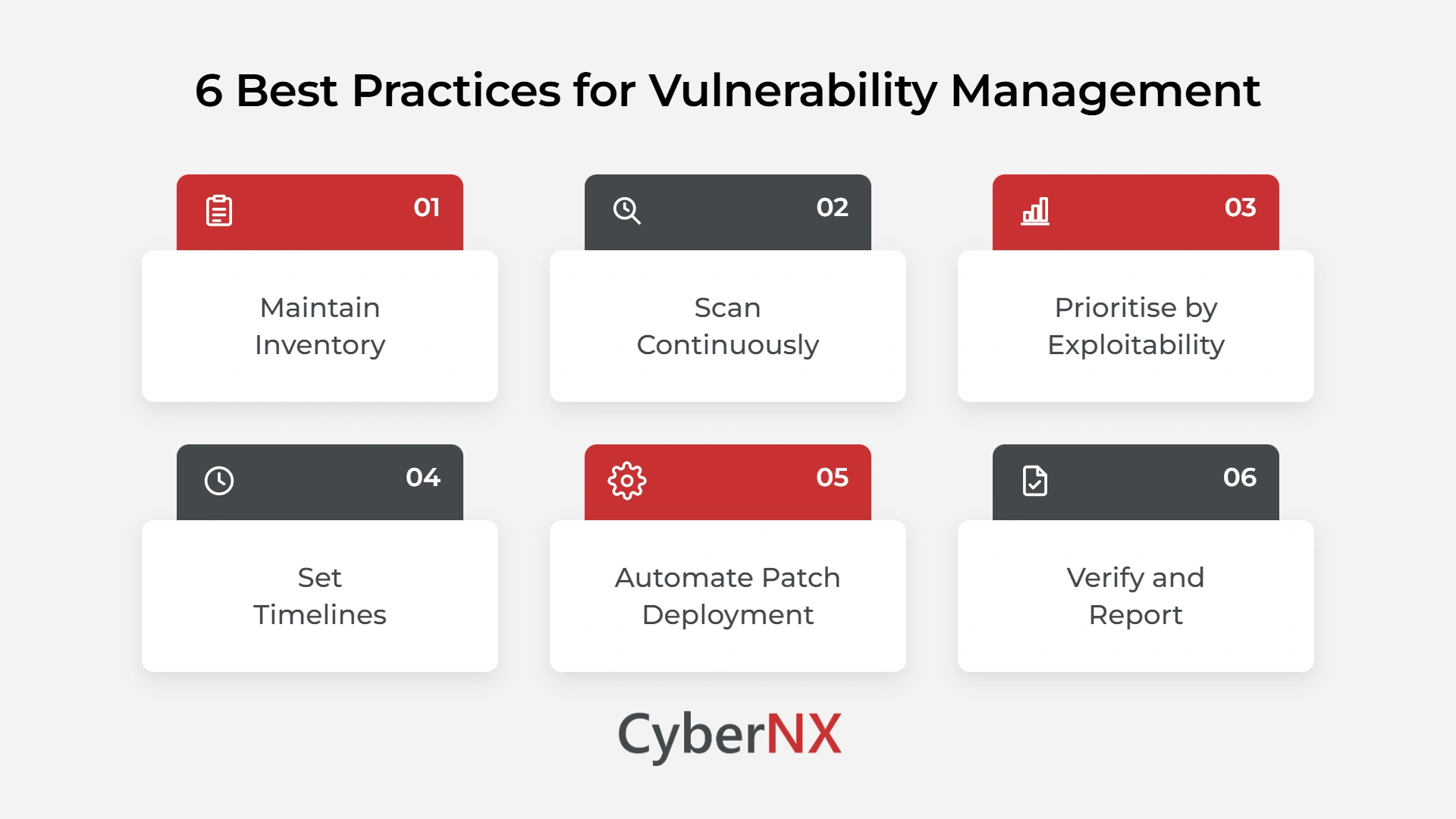
- Maintain a live asset inventory: You cannot secure what you cannot see, so keep an accurate, updated record of servers, applications, cloud workloads and endpoints.
- Scan continuously: Point-in-time scans miss vulnerabilities introduced between cycles. Continuous or near-continuous scanning closes that gap.
- Prioritise by exploitability: A medium-rated flaw with a public exploit can be riskier than an unexploited critical one. Reference sources such as CISA’s Known Exploited Vulnerabilities catalogue and EPSS scores alongside CVSS.
- Set risk-based remediation timelines: Tie patching deadlines to exposure and criticality, similar to the tiered schedule CERT-In has outlined for internet-facing systems.
- Automate patch deployment where possible: Manual patching does not scale against tens of thousands of new CVEs a year.
- Verify and report: Confirm fixes actually worked, and keep documentation ready for VAPT and cyber audit submissions under frameworks like SEBI CSCRF.
Common challenges in building a vulnerability management programme
Most programmes stall at the same few points.
- Alert overload: Scanners often return thousands of findings, and teams without clear prioritisation criteria spend more time triaging than fixing.
- Legacy and shadow IT: Older systems and unmanaged cloud instances are frequently left out of scanning scope entirely.
- Patch testing delays: Production systems need testing before patches roll out, which can stretch remediation windows well past what regulators now expect.
- Limited in-house capacity: Many mid-sized enterprises do not have a dedicated vulnerability management function, so the task competes with other IT priorities.
These challenges are not signs of a poorly run IT function. They reflect how fast the vulnerability landscape itself has changed, with disclosure volumes and exploitation speed both accelerating beyond what manual processes were built to handle.
How to choose the right vulnerability management approach
The right setup depends on scale, regulatory exposure and existing security tooling. Smaller organisations often start with a managed vulnerability scanning service paired with a clear patch management policy. This covers the basics without needing a large internal team.
Mid-sized and regulated enterprises, particularly those under SEBI CSCRF or RBI oversight, need a combination of continuous scanning, VAPT after major releases and integration with a SOC or MDR service so vulnerability data feeds directly into detection and response. This closes the loop between finding a flaw and confirming it cannot be exploited.
Larger enterprises with complex environments benefit from a dedicated vulnerability management platform that correlates asset data, threat intelligence and patch status in one place, supported by a team that can act on CERT-In’s shortened remediation windows without disrupting operations.
Conclusion
Vulnerability disclosures keep climbing and exploitation windows keep shrinking, and regulators in India are responding with sharper expectations around patching speed. Continuous scanning, exploit-based prioritisation and clear remediation timelines give enterprises a way to keep pace without burning out their IT teams.
If your organisation needs help applying these vulnerability management best practices, CyberNX’s vulnerability assessment services can help you build the programme and stay ahead of CERT-In and SEBI CSCRF timelines. Connect with our team to get started.
Vulnerability Management Best Practices FAQs
How often should vulnerability scans run?
Continuous or weekly automated scanning is the current baseline, with a full assessment at least quarterly. Internet-facing and high-value systems warrant more frequent checks given CERT-In’s shortened remediation expectations.
Is vulnerability management the same as penetration testing?
No. Vulnerability management is the ongoing process of finding and fixing weaknesses. Penetration testing is a periodic, deeper exercise that simulates real attacker behaviour to confirm whether those weaknesses are actually exploitable.
What is EPSS and why does it matter for prioritisation?
The Exploit Prediction Scoring System estimates the likelihood a vulnerability will be exploited in the near term. Used alongside CVSS severity, it helps teams fix the flaws attackers are most likely to use first.
Do SEBI or RBI regulated entities need a formal vulnerability management policy?
Yes. SEBI CSCRF requires VAPT after major releases as part of its audit and compliance formats, and RBI-regulated entities are expected to maintain equivalent risk-based vulnerability processes under existing IT governance guidelines.