Many network vulnerability assessments fail not because of bad tools or inexperienced teams, but because of what gets left out. It might be a network segment that was not added to scope, a legacy server nobody thought to include or a finding that got logged but never assigned to anyone.
These are common oversights, and they often show up at the worst possible times like during an audit, after a breach or when a regulator asks for documentation that does not exist.
A structured network vulnerability assessment checklist helps prevent exactly this. It gives security teams a clear, repeatable sequence to follow – from scoping and asset discovery through to remediation verification, so nothing important gets missed and everything is documented. For Indian firms operating under SEBI CSCRF, applicable CERT-In requirements and RBI’s applicable cybersecurity directions, that kind of structure is a compliance requirement. Here is what the checklist looks like in practice.
What is a network vulnerability assessment?
A network vulnerability assessment is a structured process of identifying and prioritising security weaknesses across your network infrastructure – routers, switches, firewalls, servers, endpoints, wireless access points and cloud-connected devices.
The goal is to find weaknesses before an attacker does and produce a prioritised remediation plan. It differs from a penetration test – which actively exploits weaknesses to prove real-world impact. In India, both are bundled as VAPT and required under SEBI CSCRF.
Why this matters more than ever for Indian enterprises
The Indusface State of Application Security 2025 Report found that 33% of critical and high vulnerabilities remained unpatched for over 180 days – more than enough time for attackers to act. Under SEBI CSCRF, vulnerability assessment is an important practice and a recurring requirement, with the frequency depending on the regulated entity and its classification. Regulated entities must retain documented VAPT reports and engage CERT-In empanelled auditors for formal assessments.
A proper network vulnerability assessment checklist makes sure your programme meets that bar.
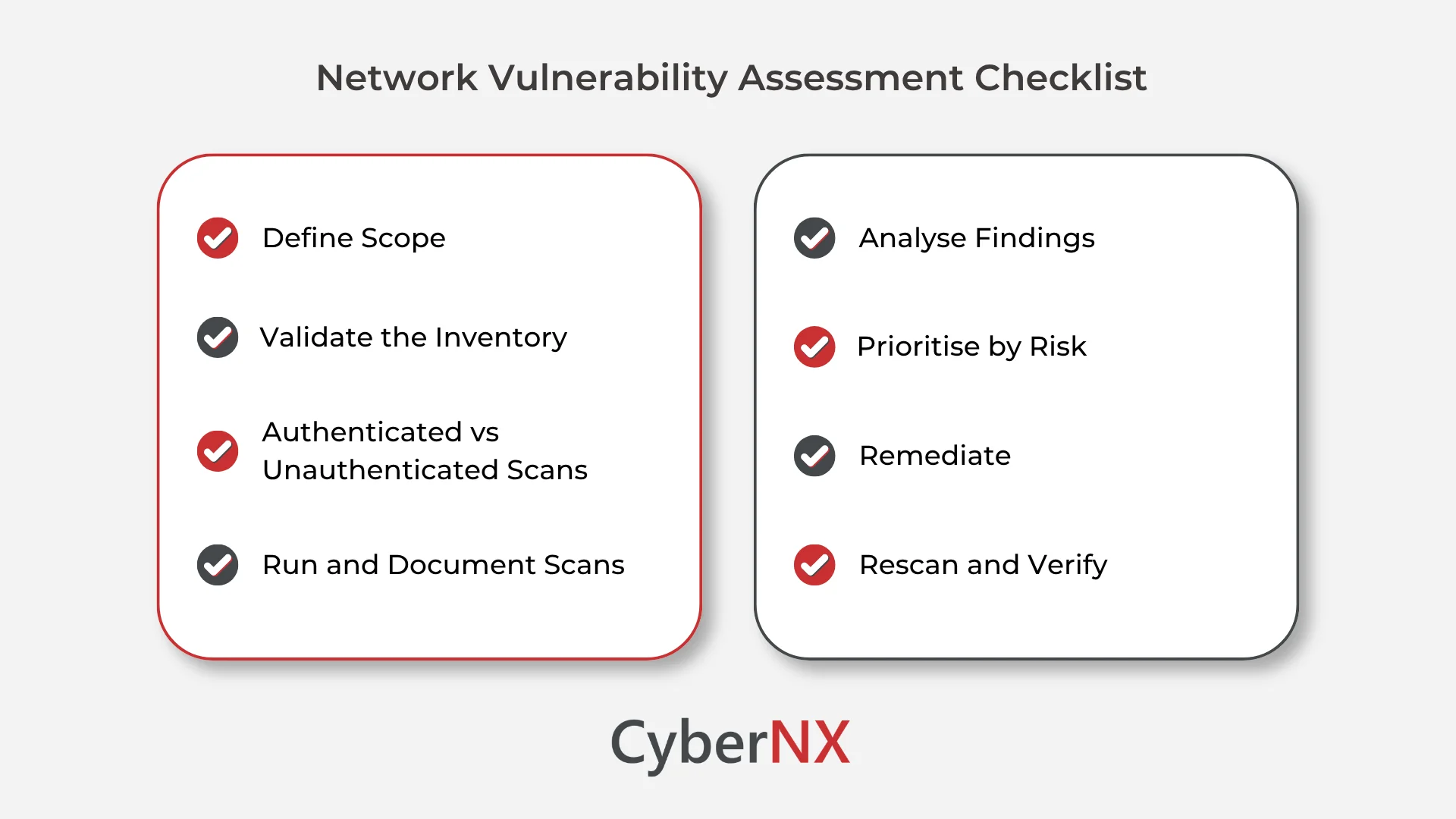
The network vulnerability assessment checklist
Below is a practical vulnerability assessment checklist that can be used:
Step 1: Define scope and objectives
Before running your network vulnerability assessment checklist, decide exactly what is in scope. Vague scope is the most common reason assessments miss critical assets.
Your scope definition should cover:
- All network segments – internal, external, cloud, OT/IoT where applicable
- Internet-facing versus internal-only assets
- Third-party integrations and vendor-managed systems
- Assets excluded from scanning and why (e.g., legacy systems sensitive to aggressive scans)
- Defined roles – who scans, who analyses, who remediates
Step 2: Build and validate the asset inventory
You cannot test what you have not documented.
- Maintain a current register of all networked devices: servers, endpoints, routers, switches, firewalls, wireless APs, cloud instances
- Flag shadow IT – unauthorised devices that may not appear in official records
- Classify each asset by criticality and internet-facing status
- Sync with your CMDB before scanning begins
Asset classification shapes scan frequency and remediation priority directly.
Step 3: Choose between authenticated and unauthenticated scans / Authenticated vs unauthenticated scans
Many programmes take shortcuts here.
- Unauthenticated scans simulate what an external attacker sees – open ports, exposed services and CVEs visible from outside
- Authenticated scans log into systems using valid credentials, surfacing deeper issues – local privilege escalation paths, unpatched internal software, misconfigured services invisible from outside
A complete network vulnerability assessment checklist requires both. External scans alone miss the exposure that matters most for lateral movement inside the network.
Step 4: Configure, run and document scans
Every network vulnerability assessment checklist should specify how scans are configured – not just which tool is used.
- Tune scan intensity, aggressive scanning can disrupt production systems
- Schedule scans during low-traffic windows for sensitive systems
- Ensure scanners have access to all in-scope segments (VLANs, cloud subnets, DMZ)
- Use updated vulnerability databases so recently disclosed CVEs are not missed
- Document scan parameters: start time, duration, tool used
Step 5: Analyse findings and validate
Raw scan output is not a vulnerability report.
- Validate all findings as automated scanners produce false positives, and acting on every output without review wastes remediation effort
- Separate confirmed vulnerabilities from informational findings
- Cross-reference against CISA’s Known Exploited Vulnerabilities (KEV) catalogue to flag what is actively being exploited
- Keep an evidence trail of your analysis – this is what auditors will ask for
Step 6: Prioritise by risk – not CVSS score alone
Not every finding needs the same urgency. Weigh these factors together:
- Severity: CVSS score as a starting point
- Exploitability: is there a known active exploit? Is it in the KEV list?
- Asset criticality: payment server or test workstation?
- Business impact: what breaks if this is compromised?
- Compensating controls: are other defences already in place?
A CVSS 9.5 on an isolated development machine may be lower priority than a CVSS 7.2 on an internet-facing API gateway with no WAF in place.
Step 7: Remediate and track to closure
Assign every finding to a named owner with a deadline based on severity. An example internal remediation targets:
- Critical: Within 24–72 hours
- High: Within 7–14 days
- Medium: Within 30 days
- Low: Next scheduled maintenance window
Log all remediation actions. A finding handed off without tracking is a finding that will most likely reopen.
Step 8: Rescan and verify
The final step in any network vulnerability assessment checklist is confirming if the fixes worked.
- Rescan affected assets after fixes are applied to confirm closure
- Many “patched” vulnerabilities reappear because patches were only partially deployed
- Retain rescan evidence as part of the audit trail required under SEBI CSCRF Annexure-A
What a compliance-ready assessment produces
A credible network vulnerability assessment checklist for SEBI-regulated entities must produce:
- Documented scope covering all critical and core systems
- Evidence of CERT-In empanelled auditor engagement for formal assessments
- VAPT reports retained in the CSCRF Annexure-A format
- Remediation SLAs tracked and evidenced, not just reported
- Records of ongoing vulnerability monitoring, remediation and risk tracking between formal assessment cycles, where applicable
Conclusion
A network vulnerability assessment checklist is only as strong as the discipline behind it. Ineffective scope or temporary fixes can turn a security exercise into paperwork with no real protection behind it.
If you are looking to build or strengthen your network vulnerability assessment programme – one that closes real gaps and holds up under SEBI CSCRF and CERT-In scrutiny – our team is here to help. At CyberNX, we work with BFSI and fintech organisations across India with CERT-In empanelment and compliance-ready assessment experience. Talk to our experts to learn more about our vulnerability assessment services and make your systems audit ready.
Network vulnerability assessment checklist FAQs
What is included in a network vulnerability assessment checklist?
A complete checklist covers scope definition, asset inventory validation, scan type selection (authenticated and unauthenticated), scan configuration and execution, findings analysis, risk-based prioritisation, remediation tracking and post-fix rescanning. Each step produces documentation that supports both security action and audit evidence.
How often should a network vulnerability assessment be done?
Assessment frequency should be based on asset criticality, exposure, risk and applicable regulatory requirements. All assets should be reassessed after major changes or new deployments. For SEBI-regulated entities, CSCRF requires vulnerability assessment to be treated as a continuous activity.
What is the difference between a network vulnerability assessment and a penetration test?
A network vulnerability assessment identifies and prioritises known security weaknesses using automated and manual analysis. A penetration test goes further – ethical hackers actively exploit those weaknesses to demonstrate real-world impact. In India, both are commonly bundled as VAPT and required under SEBI CSCRF, conducted by CERT-In empanelled auditors.
Do Indian enterprises need a CERT-In empanelled auditor for network vulnerability assessments?
For SEBI-regulated entities, formal VAPT and cyber audits covered by CSCRF must be conducted by a CERT-In-empanelled information security auditing organisation, subject to the applicable CSCRF provisions. RBI-regulated entities should follow the auditor and testing requirements applicable to their specific RBI cybersecurity and technology directions. Internal teams may conduct ongoing vulnerability monitoring and scanning where appropriate, but this does not replace any externally required assessment.