Licence data is one of the fields that regulators, including SEBI’s CSCRF, explicitly require an SBOM to capture. That gap matters, because open-source licence violations carry legal and commercial consequences distinct from a security breach, and they surface at inconvenient moments, typically during a funding round, an acquisition due diligence process or a customer’s vendor security review.
Also, licence risk sits at the intersection of security, legal and engineering, and it rarely has a clear owner. This blog sets out what that risk looks like, why it matters at a business level before a technical one, and how SBOM data becomes the practical mechanism for managing it.
Why licence risk is a business risk plus a technical one
An open-source licence violation does not trigger a security incident response. It triggers a legal one, and the exposure is often financial and reputational rather than operational.
What a licence violation costs
Organisations that distribute software containing improperly licensed open-source components face demands for source code disclosure, statutory damages in jurisdictions with active enforcement, and in acquisition scenarios, a reduced valuation or a delayed close while the target remediates its licence posture.
For a software vendor selling into enterprise or government accounts in India, an unresolved licence question surfacing during a customer’s procurement review can stall or kill a deal outright.
Why this differs from vulnerability risk
A vulnerability is patched and the risk closes. A licence obligation persists for as long as the component remains in the codebase. Strong copyleft licences in particular can impose disclosure obligations on the surrounding proprietary code, not just the open-source component itself. This is why the initial licence choice at the point of integration matters more than most engineering teams treat it.
Understanding the licence categories that create exposure
Not all open-source licences carry the same obligations, and CISOs do not need to become licensing lawyers to recognise where the real risk concentrates.
1. Permissive licences carry minimal obligation
Licences such as MIT and Apache 2.0 generally require only attribution and preservation of copyright notices. These rarely create commercial exposure and make up the bulk of low-risk usage across most codebases.
2. Weak copyleft sits in a manageable middle ground
Licences such as LGPL require that modifications to the licensed component itself be shared, but typically do not extend that obligation to the surrounding proprietary application, provided the component is used as intended, such as dynamic linking.
3. Strong copyleft is where exposure concentrates
Licences such as GPL and AGPL can require that an entire combined work be released under the same licence terms if the open-source component is integrated in ways the licence considers derivative. AGPL extends this further to software accessed over a network, which matters directly for SaaS products. This is the category that most often surfaces as a serious finding during due diligence or customer review, and it is also the category most likely to be introduced accidentally, through a transitive dependency nobody on the engineering team explicitly chose.
Where SBOM data closes the visibility gap
Licence risk is fundamentally a visibility problem before it is a legal one. Organisations cannot manage a risk they cannot see, and most teams cannot answer a basic question: which licences exist across their entire dependency tree, including transitive dependencies pulled in indirectly.
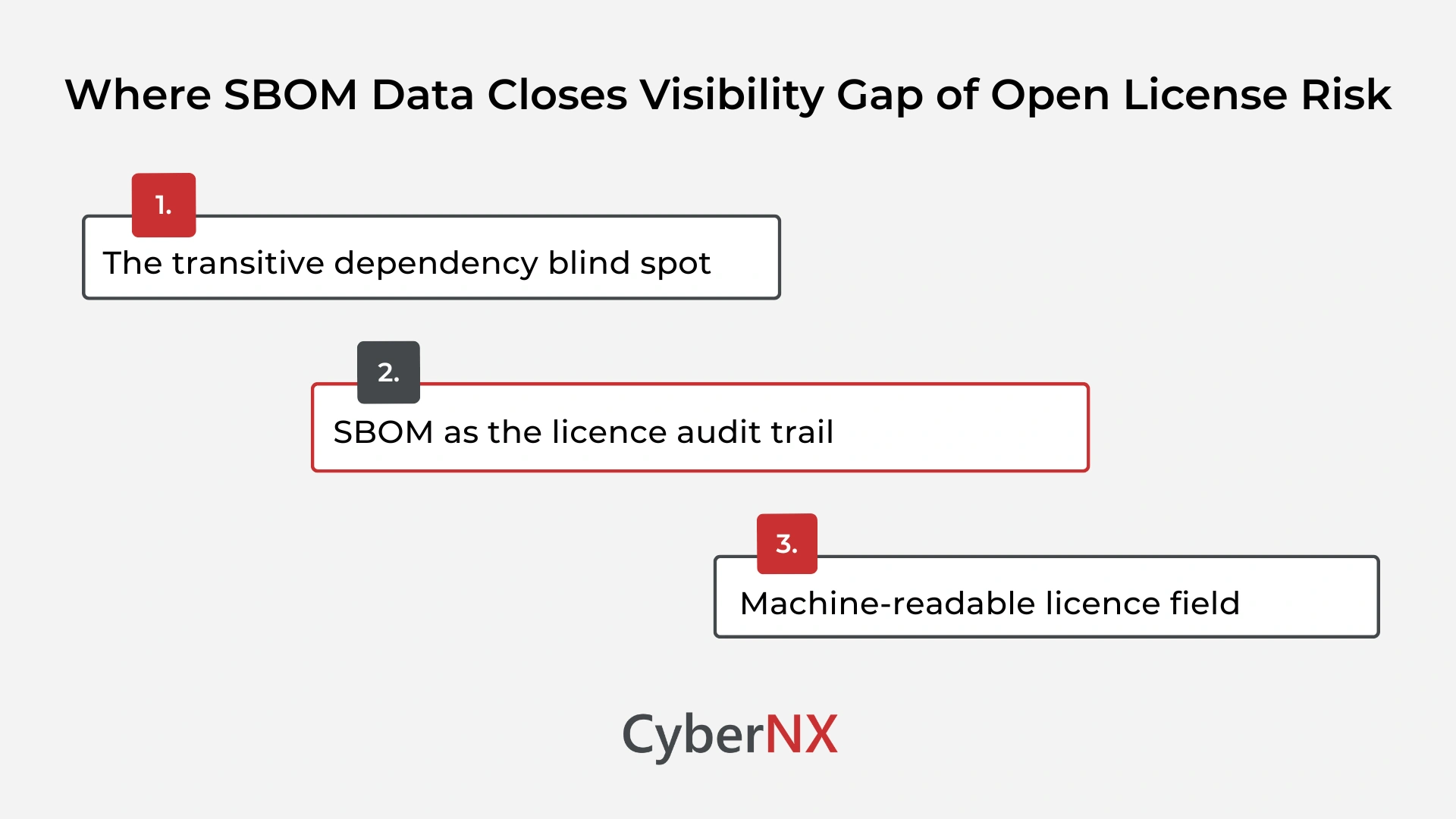
1. The transitive dependency blind spot
A direct dependency chosen under a permissive licence can itself depend on a component under a strong copyleft licence. Engineering teams that review only their direct imports miss this layer entirely, and it is precisely where the highest-risk findings tend to appear.
2. SBOM as the licence audit trail
A properly generated SBOM captures licence type per component across the full dependency tree, not just the top-level imports. This turns a manual, spreadsheet-driven licence audit, which typically only happens once, ahead of a known event like an acquisition, into a continuous, queryable record that legal and security teams can check at any point without a fire drill.
3. Machine-readable licence field
SPDX in particular carries a mature vocabulary specifically for licence expression, which is why organisations with heavy legal or compliance review needs, such as software exporters, often favour it over CycloneDX for this specific purpose. A machine-readable licence field means legal teams can query the SBOM directly rather than relying on engineering to manually trace a dependency chain each time a question arises.
Building a practical licence risk process
Licence risk management does not require a dedicated legal team on day one. It requires a defined process that treats licence data as seriously as vulnerability data.
1. Establish a licence policy before you need one
Define which licence categories are pre-approved for use, which require review before integration, and which are prohibited outright for the organisation’s specific business model, since a SaaS company’s AGPL exposure differs materially from an on-premises software vendor’s.
2. Gate new dependencies at the point of introduction
Reviewing licences after the fact, once dozens of services already depend on a component, is far more expensive than catching the licence category before a developer runs the install command. Integrating licence checks into the CI/CD pipeline, alongside existing security scanning, catches this at the cheapest possible point.
3. Treat the SBOM’s licence field as a living record
An SBOM generated once at release and never refreshed becomes exactly as unreliable for licence purposes as it does for vulnerability purposes. Continuous, auto-regenerating SBOM capability keeps the licence inventory current as dependencies change, rather than accurate only on the day it was generated.
Conclusion
Open-source licence risk sits quietly inside nearly every modern codebase, and it stays invisible until a due diligence process, a customer audit or a legal notice forces the question. SBOM data, when it captures licence type across the full dependency tree and stays current as components change, turns that invisible risk into something legal, security and engineering teams can manage before it becomes a liability.
CyberNX’s SBOM solutions capture licence metadata as part of SBOM generation and enrichment, giving security and legal teams a queryable, continuously updated view of licence exposure across the entire software estate.
If your organisation has never run a full dependency-tree licence review, the findings will surprise you. Talk to our team today and find out what licence risk is sitting quietly in your codebase before a due diligence process or a customer audit surfaces it first.
SBOM and open-source license risk: what CISOs in India must know FAQs
Does SEBI’s CSCRF require licence data in an SBOM?
Yes. Licence information is one of the minimum fields SEBI’s CSCRF requires a compliant SBOM to capture for regulated entities. The August 2025 compliance deadline has passed – this is now an active audit obligation.
Can a licence violation happen without engineering intentionally choosing a risky licence?
Yes, and this is the most common scenario. Transitive dependencies introduce licence obligations that no one on the team explicitly selected or reviewed.
Is open-source licence risk only a concern for software vendors?
No. Any organisation that modifies and distributes software containing open-source components, or exposes it over a network under certain licences, can carry licence obligations, not only companies that sell software as their primary product.