Day one of an ISO 27001 project looks the same almost everywhere. You open a browser, search for ISO 27001 policy templates and ten minutes later have a folder of Word files with the company name swapped in. It feels like progress. Twenty policies drafted before lunch.
But then the audit arrives. The auditor will not necessarily read the access control policy end to end. They might pick one line and ask who signed off the last quarterly access review. Not having an answer at that moment can cost a lot.
That gap between a downloaded document and a working system is where most first-time certifications stall. Templates are not the problem but treating them as the finished product definitely is. This guide covers where to find ISO 27001 policy templates worth using, what they leave out and the edits that turn a generic pack into documentation an Indian auditor will accept.
Where to find ISO 27001 policy templates
Where can I find a template for ISO 27001 policies? There is no official ISO library, because the standard says what to document, not how to lay it out. That leaves four realistic sources:
- Compliance platform vendors: free packs for your contact details. Clean and current, but shaped around their own tooling
- Commercial toolkits: paid bundles of 50 to 130 documents. Widest coverage, heaviest editing load
- Certification bodies and consultants: shared during a gap assessment. Closest fit to your real scope
- Your own existing documents: the HR handbook, IT policy and BCP you already run on. Least glamorous, most accurate
Whatever the source, check its vintage. A pack referring to 114 controls across 14 domains was written for ISO 27001:2013. Certificates against that edition expired on 31 October 2025 under the accreditation transition rules, so plenty of free ISO 27001 policy templates still online are quietly out of date.
What ISO 27001 policy templates actually have to cover
ISO/IEC 27001:2022 specifies requirements for documented information that supports the ISMS, including the ISMS scope, information-security policy, risk-assessment and risk-treatment results, Statement of Applicability, information-security objectives and records demonstrating that required ISMS processes are being carried out.
Notice what is missing: a document count. Nothing says you need 40 policies. A 130-file toolkit is a vendor packaging decision, not a requirement.
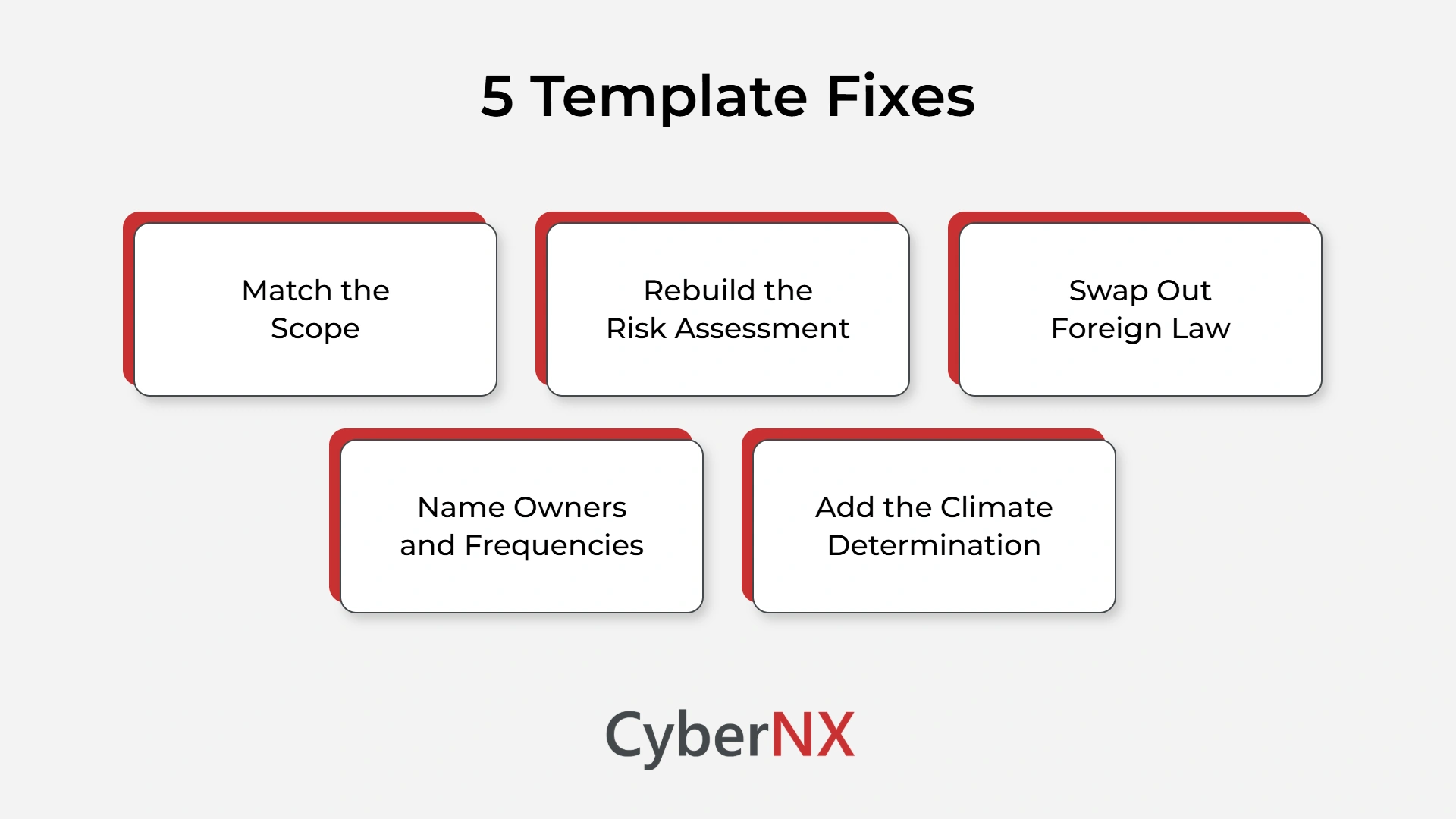
5 fixes every ISO 27001 policy template needs
A good template can save you weeks of drafting:
1. Match the scope
Templates assume a whole-organisation ISMS. Most certifications cover one product, one office or one data centre. Rewrite every “the organisation” reference to name what is in scope.
2. Rebuild the risk assessment
A common source of audit findings is a risk assessment that reads like a generic template. It will not be able to survive one question about how those risks were scored. Run the assessment yourself and let the Statement of Applicability follow from it.
3. Swap out foreign law
Imported packs cite GDPR, HIPAA or SOC 2. For an Indian entity those references belong to the IT Act 2000, the SPDI Rules 2011, CERT-In directions and the DPDP Act.
4. Name owners and frequencies
“Reviews shall be conducted periodically” tells an auditor nothing. Name the role, the cadence and where the evidence lives.
5. Add the climate determination
ISO/IEC 27001:2022/Amd 1:2024 added one requirement to clause 4.1: decide whether climate change is a relevant issue for your ISMS. Deciding it is not fine. Ignoring the question is a nonconformity, and almost no template published before 2024 covers it.
Start with the acceptable use policy
The acceptable use policy template ISO 27001 teams download most often is also the one they edit least. It maps to Annex A control 5.10. Because acceptable-use requirements directly affect day-to-day employee behaviour, organisations should make sure that relevant personnel understand and acknowledge them.
Standard packs cover email, internet and company laptops. What they miss is where the risk sits today:
- Personal devices: what BYOD access is allowed and what is not
- SaaS and AI tools: which platforms staff may paste company data into
- Acknowledgement: a dated record that each person accepted the rules
- Enforcement: the disciplinary route, linked to the HR process
An acceptable use policy with no signed acknowledgements is a document, not a control.
What Indian regulators expect on top of the template
Global ISO 27001 policy templates are written for a Western regulatory backdrop. Indian obligations sit on top and change what several policies must say.
- IT Act 2000: Rule 8 of the SPDI Rules 2011 names IS/ISO/IEC 27001 as reasonable security practices under section 43A
- CERT-In directions: listed cyber incidents must be reported within six hours of noticing, with ICT logs kept 180 days inside India. Imported incident response templates assume 72 hours
- SEBI CSCRF: certification is mandatory for Market Infrastructure Institutions. The August 2025 technical clarifications made it recommended, not mandatory, for Qualified REs
- DPDP Rules 2025: notified in November 2025, with substantive duties phasing in over 18 months. Retention and breach clauses drafted for GDPR will not map cleanly
For BFSI teams, the answer is one document set that satisfies the standard and the regulator together, not two parallel binders.
Conclusion
ISO 27001 policy templates are a genuine head start. They give you structure and the clauses auditors expect. What they cannot give you is scope, risk context or Indian regulatory framing, and those three decide whether certification goes smoothly or drags through corrective actions.
The ISO Survey 2024, published in September 2025, recorded 96,709 valid ISO/IEC 27001 certificates worldwide, with India among the top-ranked countries. Certification is now increasingly used as a security assurance requirement for enterprises.
At CyberNX, our ISO 27001 consulting services help teams turn ISO 27001 policy templates into a certified, audit-ready ISMS, with the risk assessment, Statement of Applicability and regulatory mapping built for India. Talk to our experts and get your documentation audit ready.
ISO 27001 policy templates FAQs
Where can I find a template for ISO 27001 policies?
Compliance platform vendors, commercial toolkits, your certification body or consultant and the documents you already run on. There is no official ISO library. Free ISO 27001 policy templates are fine to start with, not to submit unchanged, because auditors test what you actually do.
How many policies does ISO 27001 require?
There is no fixed number of policies. The amount of documented information depends on the organisation’s size, complexity, scope, risks, processes and applicable requirements.
What goes into an acceptable use policy template ISO 27001 auditors accept?
It maps to Annex A control 5.10 and sets rules for information, devices, email, removable media, SaaS platforms and AI tools. It also needs a personal-device section, a dated acknowledgement record for every user and a clear link to the HR disciplinary process.
Do ISO 27001 policy templates cover DPDP and CERT-In requirements?
Rarely. Most are drafted against GDPR or US frameworks. Indian entities need incident response aligned to CERT-In’s six-hour reporting window and 180-day log retention, plus retention and breach clauses reflecting the DPDP Act and its 2025 Rules. The edits are straightforward but never automatic.