What does a certification auditor ask for first? It’s not your firewall rules or your endpoint dashboard. They usually ask who approved the scope, when the risk register was last reviewed and which record proves it.
That is the silent problem with how most ISO 27001 audit checklists get built. They are assembled around controls, because controls feel like the real security work. Then Stage 2 arrives and the questions turn out to be about decisions, owners and dates. The controls are in place. But often, the trail leading to them is not.
The fix to this problem is not more controls. It is a checklist that mirrors the order an auditor reads your information security management system (ISMS) in, and that carries the Indian regulatory requirements a downloaded template was never built to cover. This guide covers what a good checklist should contain, how to build one that fits your environment, and where these checklists usually break down.
What is the ISO 27001 checklist?
An ISO 27001 checklist is a working list of everything an auditor can ask you to produce, mapped back to the part of the standard that requires it. It has two halves, and they carry different weight.
- Clauses 4 to 10: the management system itself. Context, leadership, risk planning, competence, internal audit, management review and corrective action
- Annex A: the 93 controls, grouped into four themes. Organisational, people, physical and technological
Most teams build the second half first because it feels concrete. Auditors work the other way round. They start at Clause 4, because a control with no risk behind it and no owner in front of it has nothing holding it up.
One clarification worth making early. Your ISO 27001 audit checklist is not your Statement of Applicability (SoA). The SoA is required documented information that records the necessary controls, their inclusion rationale and implementation status. The checklist is an internal working tool used to verify that the ISMS requirements and control evidence are ready for audit.
How to prepare ISO audit checklist in six steps
A useful ISO 27001 audit checklist is built from your own environment, not downloaded. This sequence keeps the work in the order an auditor reads it.
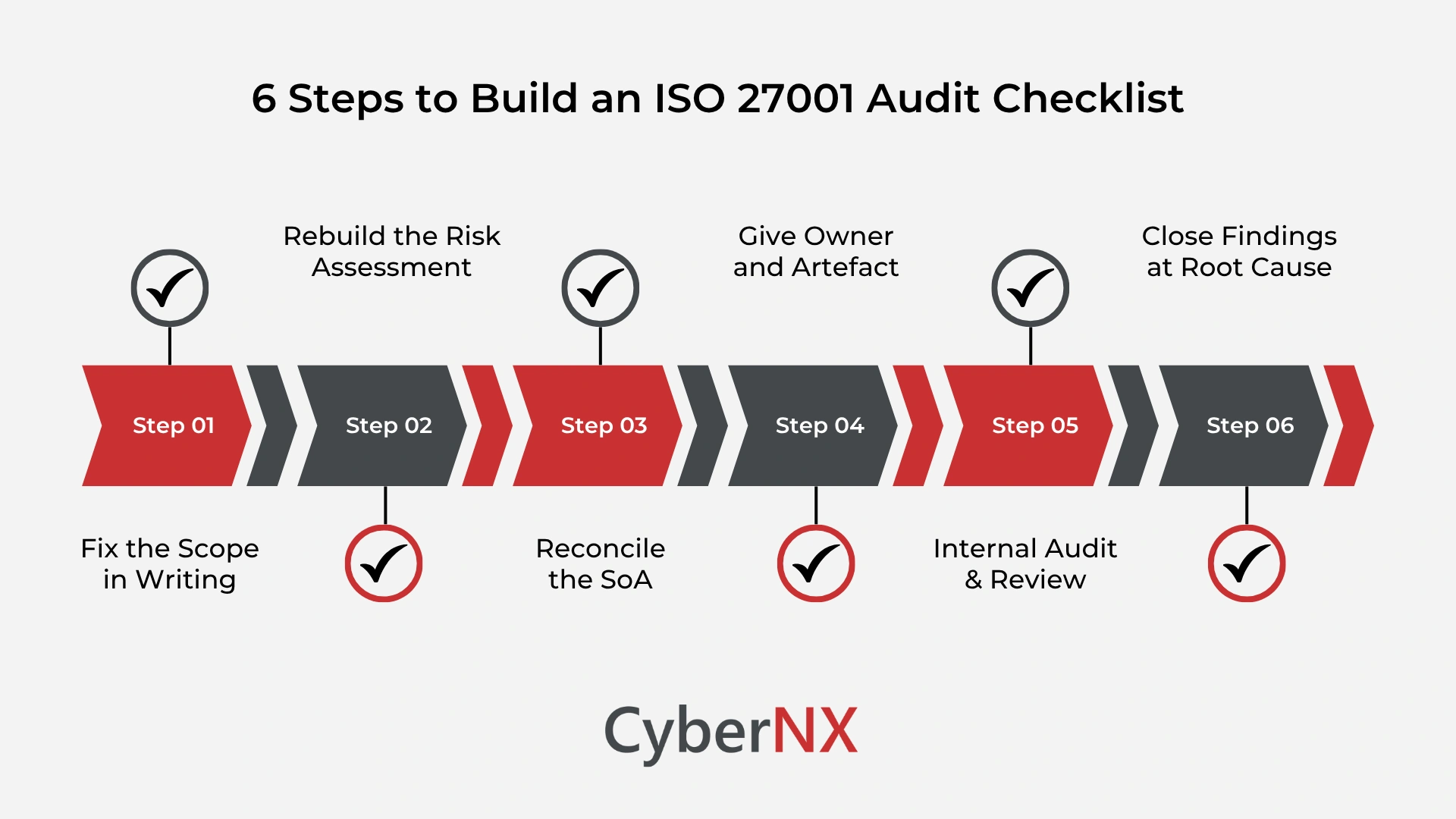
- Fix the scope in writing: Name the entities, locations, systems and cloud services inside the ISMS. Say plainly what sits outside. Vague boundaries create Stage 2 disputes that are expensive to settle mid-audit.
- Rebuild the risk assessment from your own environment: A risk register that reads like a template is a fast route to a finding. Document the methodology, apply it consistently and make sure the risks reflect systems your team runs.
- Reconcile the SoA: Each of the 93 Annex A controls needs a decision, a justification and an implementation status. Inclusions and exclusions both need reasoning.
- Give owner and artefact: For each clause and control, record who owns it and which document, log or ticket proves it. If the artefact does not exist yet, that is a gap, not a to-do.
- Internal audit & review: Clause 9.2 requires the internal audit process to be impartial. Auditors should not audit their own work or activities for which they are directly responsible.
- Close findings at root cause: Fixing the instance without addressing the cause tends to resurface at the next surveillance audit. Track corrective actions through to verified closure.
The India layer most templates leave out
For regulated Indian entities, the standard is only part of the picture. Two Indian requirements sit on top of it.
- Under SEBI’s Cybersecurity and Cyber Resilience Framework (CSCRF), ISO 27001 certification is mandatory for Market Infrastructure Institutions. For Qualified Regulated Entities, SEBI’s technical clarifications dated 28 Aug 2025 confirmed it is recommended, not mandatory. Where it does apply, scope is expected to cover the primary data centre, DR and near-DR sites and the SOC.
- CERT-In’s Comprehensive Cyber Security Audit Policy Guidelines, issued 25 Jul 2025, add expectations for auditees: at least one comprehensive audit of ICT systems a year, an audit program and scope reviewed and approved by top management, and risk treatment decisions authorised by the head of the organisation. SEBI has directed its regulated entities to follow them.
Your ISO 27001 audit checklist should carry both layers, so one evidence set answers the certification body and the regulator.
Where ISO 27001 audit checklists usually break down
Findings cluster in predictable places. Checking these early can save a lot of time for you:
- Unjustified SoA entries: controls recorded with no reasoning
- Internal audit independence: the team running the controls also auditing them
- Incomplete management review: minutes that skip required Clause 9.3 inputs
- Access revocation lag: leavers still holding active accounts weeks later
- Missing vendor assessments: medium and high-risk suppliers with no current review
- Silent Clause 4.1: no documented determination on climate change relevance
Conclusion
A checklist is only as strong as the evidence behind it. Scope defined honestly, risks drawn from your own environment, an SoA that reasons through all 93 controls and clause records carrying dates and names. That combination separates a smooth Stage 2 from a long corrective action list.
For Indian companies, the work doubles as regulatory groundwork. The same evidence feeds into SEBI CSCRF and CERT-In audit obligations. If you want help turning your ISO 27001 audit checklist into an ISMS that holds up under real scrutiny, CyberNX’s ISO 27001 consulting services support implementation, internal audits and certification readiness. Talk to our experts and walk into your next audit with all the evidence already in place.
ISO 27001 audit checklist FAQs
What is the ISO 27001 checklist?
It is an internal working list of every requirement in ISO/IEC 27001:2022, covering Clauses 4 to 10 and the 93 Annex A controls, mapped to an owner and the evidence proving each one. It is a preparation tool, distinct from the Statement of Applicability, which is a formal deliverable you submit.
How to prepare ISO audit checklist for a first certification
Start with scope, then risk assessment, then the Statement of Applicability, in that order. Assign an owner and a named artefact to every clause and control, run an independent internal audit and a documented management review, then close findings before booking Stage 1.
Does an ISO 27001 audit checklist cover Indian regulatory requirements?
Not on its own. Global templates are built around the standard alone. SEBI CSCRF and CERT-In’s 2025 audit policy guidelines add scope, frequency and approval requirements that need mapping alongside the clauses.
How often should an ISO 27001 audit checklist be reviewed?
Treat it as a living document rather than an annual exercise. Refresh it after any change to scope, infrastructure, vendors or regulatory obligation, and always before a surveillance or recertification audit.