Things are moving very fast as we advance through 2026. Every week, there are frontier AI models launched and deployed across business operations. AI is now integrated into critical workflows. But unlike conventional software, AI systems rely on models, training datasets, open-source frameworks, APIs and third party services that change over time.
Without visibility into these components, assessing risk could be a nightmare for security leaders. That’s why the necessity of security guardrails around AI cannot be ignored. And this is where an AIBOM, could be a game changer.
If you are exploring how to build an AIBOM, the goal is not simply to document AI assets. It is to create a trusted inventory that supports security, governance and informed decision making throughout the AI lifecycle.
How to build an AIBOM
Building an AIBOM should be viewed as an ongoing governance process. As AI applications evolve, the inventory must evolve with them.
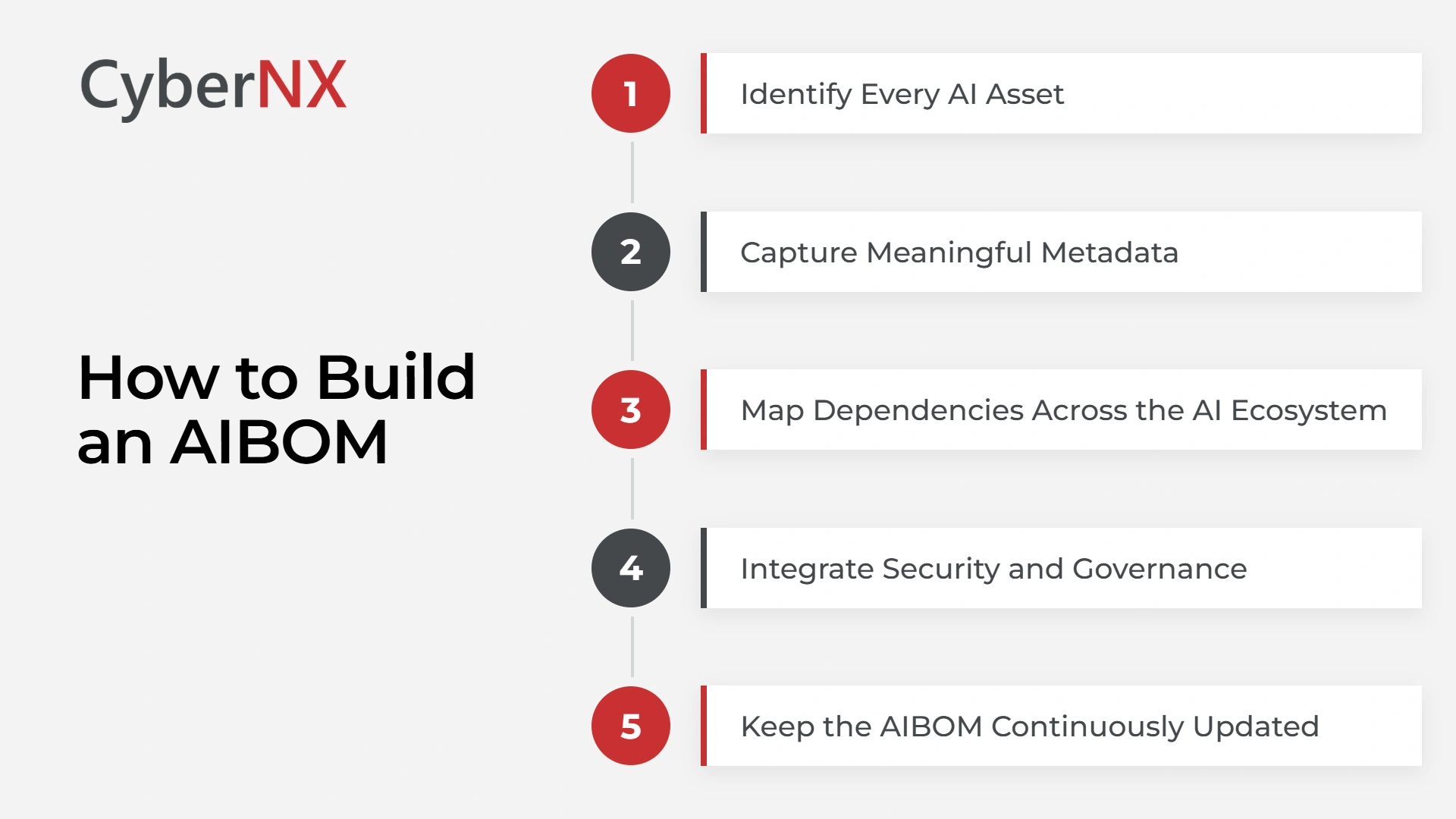
1. Identify every AI asset
The first step in building AIBOM is understanding what already exists within your environment. This often proves more challenging than expected because AI projects frequently span multiple business units, cloud platforms and development teams.
Begin by identifying every model, dataset, framework, API and third-party service that contributes to your AI applications. Do not overlook experimental projects or externally hosted models, as these can introduce the same security and compliance risks as production systems. Creating a complete inventory establishes the foundation for every stage that follows.
2. Capture meaningful metadata
An inventory has limited value if it contains only names and versions. Every AI asset should include contextual information that helps teams understand its origin and purpose.
For example, record who owns the asset, where it was obtained, its licensing terms, the version currently in use and the intended business function. Where possible, document model publishers, training methodologies and validation results. This additional context helps security teams verify authenticity, simplify audits and make informed decisions when updates or vulnerabilities arise.
3. Map dependencies across the AI ecosystem
AI systems rarely operate in isolation. A language model may rely on multiple open-source frameworks, external APIs, retrieval systems and cloud infrastructure before delivering a response.
Mapping these relationships provides valuable visibility into the AI supply chain. If a vulnerability affects one dependency, security teams can quickly identify every application that may also be impacted. This level of traceability significantly improves incident response and reduces the time spent investigating interconnected systems.
Consider an organisation using an open-source embedding model across several customer facing applications. When a critical vulnerability is disclosed, an up-to-date AIBOM enables security teams to identify every affected deployment within minutes rather than days.
4. Integrate security and governance
An effective AIBOM should support more than asset management. It should become part of broader security and governance processes.
As new models or datasets are introduced, organisations should verify their provenance, review licensing obligations and assess potential risks before deployment. Integrating the AIBOM into existing vulnerability management and change management workflows ensures that AI assets receive the same level of scrutiny as traditional software. This approach reduces operational blind spots while supporting compliance with emerging AI regulations.
5. Keep the AIBOM continuously updated
Perhaps the most important aspect of building an AIBOM is recognising that it is never truly complete. AI environments evolve constantly as models are retrained, datasets are refreshed and new integrations are introduced.
For this reason, organisations should automate updates wherever possible. Integrating the AIBOM with development pipelines allows new assets and changes to be recorded automatically, reducing manual effort and improving accuracy. A living inventory provides far greater value than one that is only reviewed during annual audits.
The road ahead for AIBOM
As AI adoption continues to grow, transparency will become just as important as innovation. Organisations are already being asked to demonstrate where their AI models come from, how they were trained and whether the supporting components meet security and compliance requirements. An AIBOM provides a structured way to answer these questions with confidence.
Industry frameworks and regulations are also evolving to encourage stronger governance of AI systems. Organisations that establish an AIBOM today will be better prepared to adapt to future requirements without having to rebuild their processes from scratch. More importantly, they will have greater visibility into their AI ecosystem, making it easier to manage risk as new models, datasets and technologies are introduced.
Conclusion
Understanding how to build an AIBOM is becoming an important capability for organisations adopting AI at scale. By maintaining a clear inventory of models, datasets, frameworks and supporting dependencies, security teams gain the visibility needed to identify risks, respond to vulnerabilities and strengthen governance across the AI lifecycle. Rather than treating an AIBOM as a documentation exercise, organisations should view it as a living asset that supports secure, transparent and responsible AI adoption.
As AI ecosystems become more complex, visibility is essential for managing risk effectively. At CyberNX, we help organisations strengthen AI security through governance assessments, AI supply chain risk reviews and security testing tailored to modern AI environments. Whether you are deploying your first AI application or scaling enterprise-wide initiatives, our experts can help you build an AI security strategy with confidence. Contact us to know more about our AIBOM solutions.
How to build an AIBOM FAQs
Is an AIBOM only relevant for organisations that develop their own AI models?
No. Organisations using third party or commercial AI services can also benefit from an AIBOM. It provides visibility into external models, APIs and supporting components, helping teams manage supply chain and compliance risks more effectively.
How does an AIBOM support AI risk management?
An AIBOM creates a central record of AI assets and their dependencies. This allows organisations to identify affected components when vulnerabilities are disclosed, assess third party risks and improve incident response across the AI lifecycle.
Can an AIBOM work alongside an SBOM?
Yes. An AIBOM complements an SBOM rather than replacing it. While an SBOM focuses on software components, an AIBOM extends visibility to AI specific elements such as models, datasets, prompts and machine learning frameworks.
How often should an AIBOM be reviewed?
An AIBOM should be updated whenever AI assets change. Integrating it with development pipelines and governance processes helps ensure the inventory remains accurate as models, datasets and dependencies evolve.