In Aug 2025, the RBI’s FREE-AI Committee recommended that regulated entities should maintain a proper inventory of AI models, use cases, supporting assets, and associated risks as part of their AI governance framework. That expectation is now showing up in audit rooms as a direct question: where is your AI Bill of Materials, and can you prove it is current?
An AIBOM audit is the review that answers this exact question. It checks whether your AI systems have a documented inventory of models, training data and dependencies. For BFSI organisations already juggling CERT-In, SEBI, and RBI expectations, this is becoming part of the standard compliance calendar.
This guide covers what an AIBOM audit examines, why Indian regulators are asking for it now, and what to have ready before your next review.
What is an AIBOM audit?
An AI Bill of Materials (AIBOM) lists every component behind an AI system. This includes the base model, training and fine-tuning datasets, licenses and the software dependencies running it. An AIBOM audit checks whether that list exists, if it is accurate, and can be traced back to its source.
Think of it as the AI equivalent of an SBOM (Software Bill of Materials). An SBOM tells you what code you shipped. An AIBOM tells you what model you deployed, what data trained it, and whether you are legally allowed to use it.
Why Indian regulators are asking now
Three regulatory systems are meeting at the same question in 2026.
- The RBI’s FREE-AI Committee report recommends that regulated entities build AI inventories covering models, use cases, dependencies, and risks, alongside a board-approved AI governance policy and expanded model risk management.
- SEBI has moved in a similar direction. Its CSCRF audit scope places strong emphasis on software supply chain visibility through SBOM practices. As companies use AI more and more, many firms are extending similar governance principles to AI and ML systems.
- CERT-In’s technical guidelines define detailed metadata requirements for AI bill of materials, so it gives companies a properly structured way to document components, licenses and vulnerabilities.
This matters a lot more beyond compliance optics. Third-party and supply chain involvement in breaches doubled from 15% to 30% year over year, according to the Verizon 2025 Data Breach Investigations Report. AI systems built on external models and datasets sit squarely inside that exposure.
What auditors will ask for
When an AIBOM audit happens, auditors usually tend to work through the same checklist. Here is what to have ready.
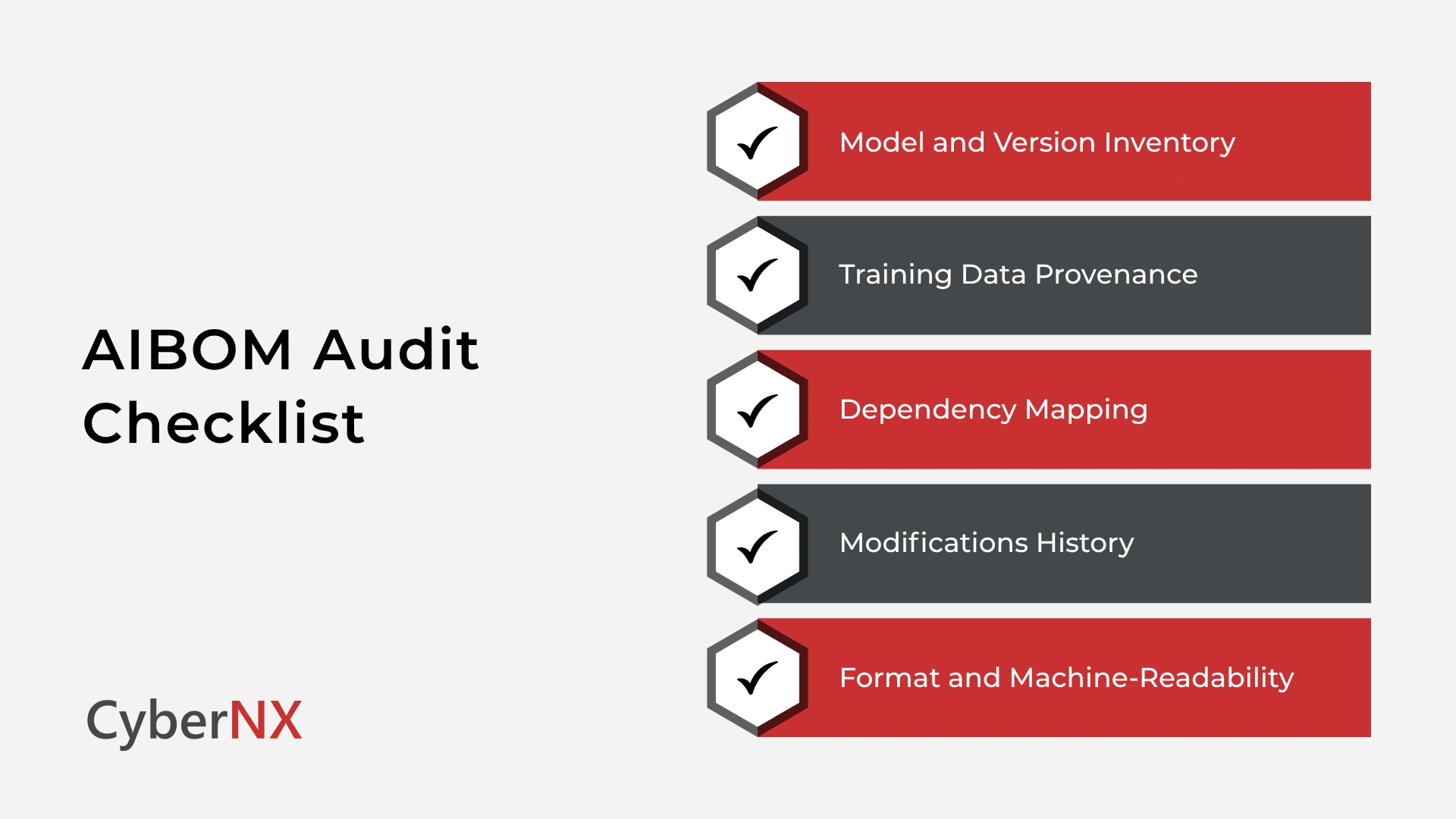
- Model and version inventory: Companies should have a record of every model in production, its version, and the base model it was fine-tuned from.
- Training data provenance: Companies must know where each dataset came from, and whether it carries copyright, PII, or license restrictions.
- Dependency mapping: It’s a good practice to know the libraries, frameworks, and third-party APIs each AI system relies on.
- Modifications history: This includes having a record of when models were retrained or swapped – and why.
- Format and machine-readability: It is important to know whether the AIBOM is exportable in a standard format such as CycloneDX or SPDX, so it can be verified properly.
Conclusion
If your organisation already runs an SBOM program, an AIBOM extends that same infrastructure. You are not building any new discipline. You are adding models and datasets to an inventory process your teams already run for software components.
An AIBOM audit is no longer a hypothetical exercise for Indian BFSI organisations. RBI, SEBI, and CERT-In are each building toward the same expectation – a current, traceable AI inventory that stands up to review. Waiting for a formal mandate before building one leaves you assembling evidence under pressure instead of on your own schedule.
CyberNX provides AIBOM solutions that support this extension directly, mapping component-level data to CERT-In, SEBI, and RBI reporting formats so audit evidence is ready before the auditor asks for it. Connect with our certified experts to learn more and be prepared for AIBOM audits.
AIBOM Audit FAQs
What is an AIBOM audit?
An AIBOM audit reviews if your organisation has an accurate, traceable inventory of the models, datasets, and dependencies behind an AI system, and whether that inventory can be produced on request. Auditors usually check version history, data lineage, and licensing terms alongside the inventory itself. A missing or outdated AIBOM is treated the same way as an incomplete SBOM – a governance gap that needs remediation before the audit closes.
Is AIBOM legally mandatory in India?
Not as a single named mandate yet. RBI’s FREE-AI report, CERT-In’s technical guidance and governance expectations under SEBI’s CSCRF all point toward stronger and better AI inventory practices – even though no single regulation mandates AIBOM by name.
How is an AIBOM different from an SBOM?
An SBOM tracks software code and libraries. An AIBOM adds models, training data, and fine-tuning lineage, since an AI system’s behaviour depends on data as much as code.