Attackers are no longer relying on crude scams. They are building near-perfect replicas of trusted brands across domains, apps, and social platforms. In many cases, these attacks bypass traditional security controls because they target human trust rather than technical flaws. What makes this shift more concerning is the speed. Therefore, understanding how attackers exploit brand trust is the first step. The next is acting early and decisively to stop them.
Why brand trust has become a prime attack surface
Attackers now position themselves between your brand and your users. It is faster, cheaper, and often more effective. This shift is primarily driven by three factors.
- First, users rely heavily on digital touchpoints.
- Second, attackers have access to tools that make imitation easy.
- Third, many organisations lack visibility beyond their internal environment.
The result is a growing ecosystem of brand impersonation attacks that operate in plain sight. Now let’s decode 5 common ways attackers are exploiting brand trust today.
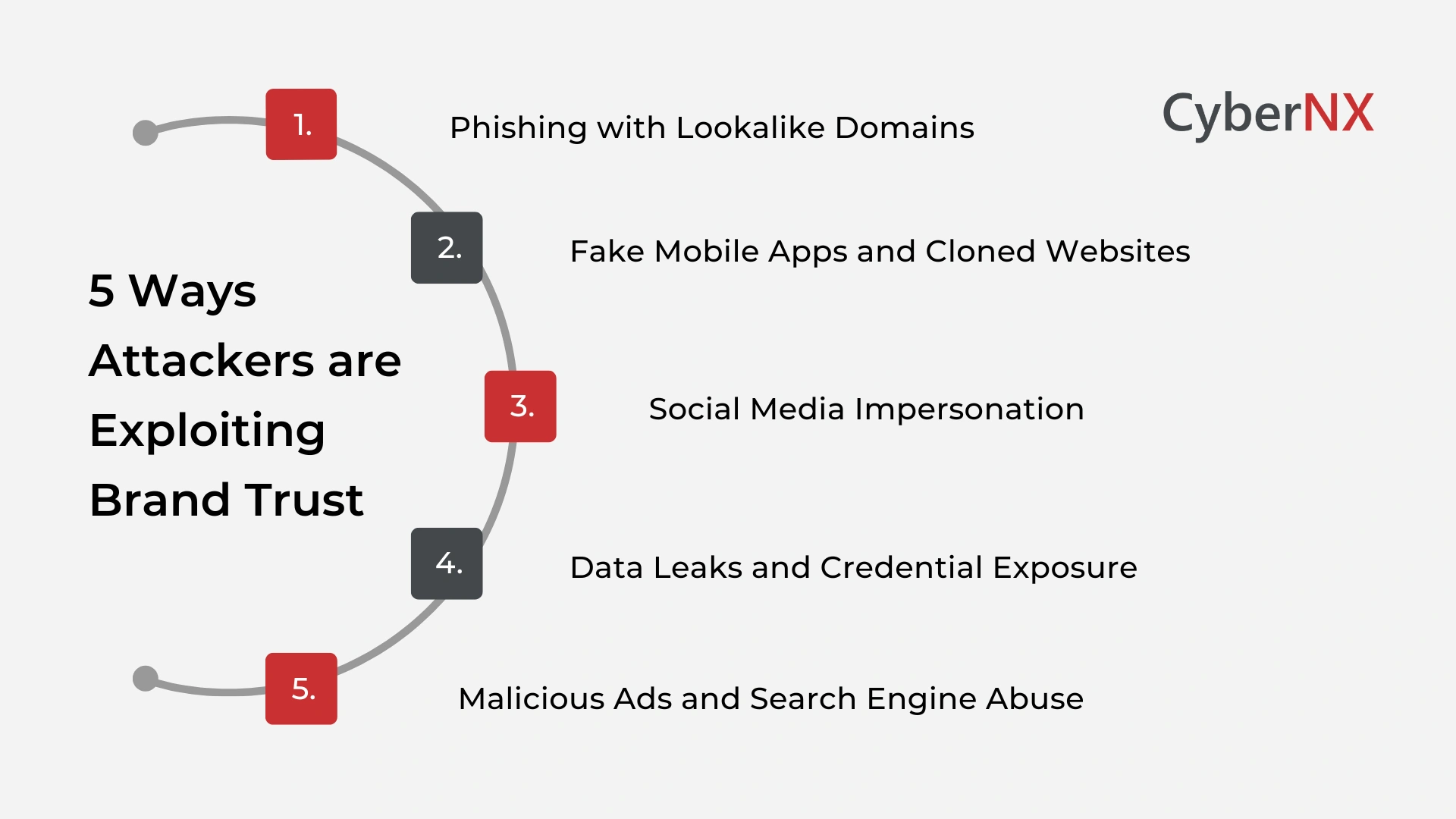
1. Phishing with lookalike domains
Cybercriminals have targeted tech giants like Google, Microsoft and even domestic companies like Amul using lookalike domains. So, what they essentially do is register domains that closely resemble the official website.
For example, googhle.com, microsooft.com, annul.com. Look at those closely and you will find these domains differ only by a single character. Thereafter, they mimic login pages, payment portals and customer dashboards. Carefully crafted emails or messages are sent to users, urging them to log in or verify details. Now this part has become easy with AI tools like ChatGPT. Now, because the site looks legitimate, users end up entering sensitive information and credentials are captured instantly.
Why it is effective
The human eye struggles to detect small domain differences. Combined with urgency-driven messaging, users rarely pause to verify authenticity.
How to stop it
Stopping this requires visibility beyond your owned domains.
- Monitor new domain registrations that resemble your brand
- Use automated tools to detect typo-squatting and homograph attacks
- Act quickly to take down malicious domains
- Educate users to verify URLs before entering credentials
2. Fake mobile apps and cloned websites
Here again, threat actors have mastered the art of creating fake mobile apps and clone websites. Once created, they distribute apps through third-party app stores or malicious links. The apps and sites will have similar branding, interface, and functionality as original. Users do not check or verify and end up interacting with fake apps and websites. So, once these are installed, they collect login credentials, financial data, or personal information.
Why it is effective
Mobile users tend to trust apps more than websites. A familiar logo often overrides caution. Additionally, cloned websites can be nearly indistinguishable from the original.
How to stop it
Defence here requires continuous monitoring and clear communication.
- Scan app stores regularly for impersonating applications
- Take down fraudulent apps quickly through platform reporting
- Promote official download links on your website
- Use digital certificates and app verification mechanisms
You must simplify access to official channels. When users know exactly where to go, risk drops sharply.
3. Social media impersonation
Attackers create fake profiles posing as your brand, executives, or customer support teams. They engage directly with customers. This may involve responding to complaints, offering support, or sharing promotional messages. During these interactions, attackers request sensitive information such as account details or one-time passwords.
Why it is effective
Social platforms encourage real-time interaction. Users expect quick responses, which reduces scepticism. A convincing profile picture and brand name are often enough.
How to stop it
Speed and visibility are critical.
- Monitor social platforms for impersonating accounts
- Verify official brand profiles with platform badges
- Respond quickly to user reports of suspicious accounts
- Educate customers on official communication channels
We recommend maintaining an active presence. A visible and responsive brand makes impersonation harder to sustain.
4. Data leaks and credential exposure
When customer data is leaked, attackers gain access to email addresses, passwords, and personal details. This data is often sold or shared on underground forums. Attackers use this information for targeted attacks. They may attempt credential stuffing or craft highly personalised phishing messages.
Why it is effective
Users tend to reuse passwords. Once credentials are exposed, multiple accounts become vulnerable. Personalised attacks also appear more convincing.
How to stop it
Proactive monitoring is key.
- Monitor dark web sources for leaked credentials
- Alert affected users immediately
- Enforce password resets and encourage strong authentication
- Implement multi-factor authentication across platforms
5. Malicious ads and search engine abuse
Attackers create malicious advertisements or manipulate search results. These ads appear when users search for your brand. When users click on these links, they are redirected to fraudulent websites that mimic your brand.
Why it is effective
Users trust search engines. If a link appears at the top, it is often assumed to be legitimate. Attackers exploit this trust to capture traffic.
How to stop it
This requires coordination with advertising platforms and continuous tracking.
- Monitor paid ads and search results for brand misuse
- Report malicious listings immediately
- Use official ads to dominate search visibility
- Educate users to verify URLs before interacting
We have seen organisations reduce phishing traffic significantly by actively managing their search presence.
Conclusion
Attackers are not just targeting systems anymore. They are targeting trust. And that changes how organisations need to respond. Each technique discussed here operates outside traditional security boundaries. That is why visibility, speed, and user awareness matter just as much as technical controls.
Here at CyberNX, our brand risk monitoring services can help you identify brand abuse early and act quickly. From monitoring domains and apps to tracking impersonation and data leaks, we help reduce risk before it escalates. If your brand is a key part of your business, it deserves protection at every touchpoint. Let’s strengthen that layer together.
How attackers exploit brand trust FAQs
Why is brand impersonation increasing so rapidly?
Attack tools have become more accessible. At the same time, users rely heavily on digital platforms. This combination makes impersonation both easy and effective.
How can organisations detect brand abuse early?
Continuous monitoring across domains, app stores, social media, and the dark web helps identify threats before they spread widely.
What role does user awareness play in preventing attacks?
User awareness is critical. Even simple habits like checking URLs or avoiding unknown apps can reduce risk significantly.
Is multi-factor authentication enough to stop these attacks?
It helps, but it is not enough on its own. A layered approach that includes monitoring, takedowns, and user education is more effective.