Previously, we have covered Penalties under the DPDP Act which tells you what non-compliance costs. This blog looks at the other side: the specific operational errors that despite the best efforts lead to non-compliance in the first place.
These are all-too-common mistakes that surface during audits and gap assessments, often in organisations that have every intention in meeting the requirement with their compliance programme.
Some of these errors trace back to genuine ambiguity in how DPDPA differs from frameworks like GDPR. Others come from treating compliance as a documentation exercise rather than an operational one. Either way, each mistake below is specific and fixable, and gaining a better understanding of those always helps.
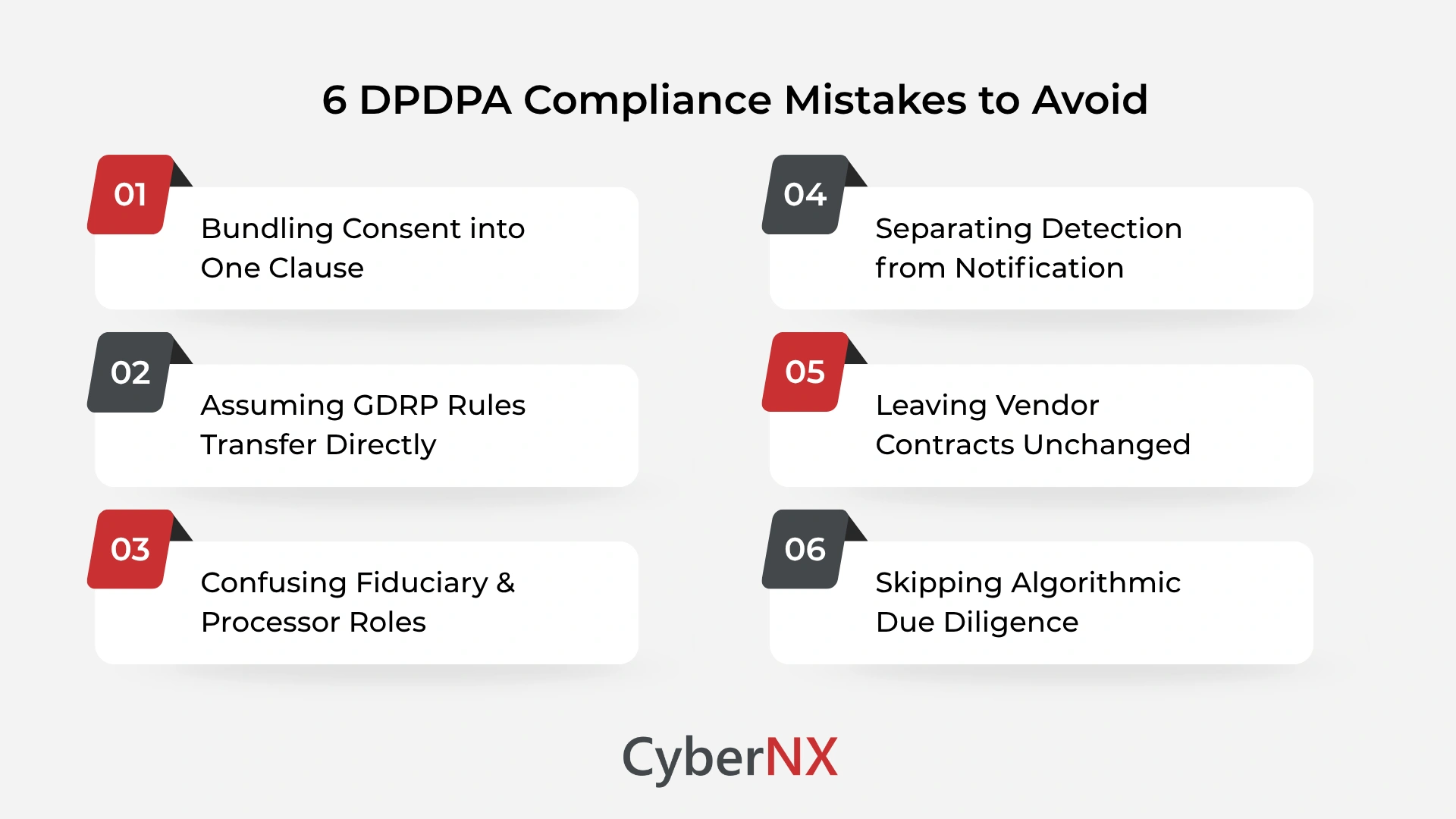
Bundling consent into a single broad clause
DPDPA requires consent to be free, specific, informed and unambiguous for each processing purpose.
Why this happens
Many organisations carry forward a single terms-of-service consent clause that covers service delivery, marketing, analytics and third-party sharing all at once. This pattern was common under older data protection approaches and does not satisfy DPDPA’s purpose limitation principle.
What it looks like in an audit
An auditor reviewing consent records will ask which specific purpose a Data Principal agreed to. If the answer is “all of the above, via one checkbox,” that consent is unlikely to hold up, and every processing activity relying on it becomes exposed.
Assuming a GDPR compliance programme transfers directly
DPDPA and GDPR share structural similarities, which leads some compliance teams to assume their existing GDPR programme covers DPDPA obligations with minor edits.
The legitimate interest gap
DPDPA has no equivalent to GDPR’s “legitimate interest” basis for processing. Every activity needs explicit consent or a specific statutory exemption. Any processing your organisation runs under a legitimate interest basis in a GDPR context has no direct equivalent basis under DPDPA and needs its own consent pathway.
Different rights, different timelines
DPDPA’s breach notification rule, discussed further below, has no materiality threshold, unlike GDPR’s risk-based approach. Treating the two frameworks as interchangeable creates gaps in exactly the areas where enforcement is strictest.
Confusing data fiduciary & data processor roles
A single organisation can be both a data fiduciary and a data processor depending on which data flow is being assessed, and getting this wrong is a recurring audit finding, particularly for IT and SaaS companies.
Where this trips organisations up
A SaaS company processing its enterprise clients’ end-user data acts as a processor for that flow, but the same company is a fiduciary for its own employee data and account-level data. Each flow needs to be mapped and classified independently rather than assigning one role to the entire organisation.
The downstream consequence
Getting this classification wrong means applying the wrong obligations to the wrong data flow, which typically surfaces during an audit as a mismatch between documented roles and actual data handling practice.
Treating breach detection as separate from breach notification readiness
Rule 7 of the DPDP Rules 2025 requires notification to the Data Protection Board without delay upon confirmation, with no threshold below which reporting is optional.
The timing problem
Many breach response plans focus on containment and remediation but do not clearly define the detection timestamp that starts the regulatory clock. Without a documented, tested process for identifying and timestamping a breach the moment it is confirmed, the notification window is already compressed before the response even begins.
The dual notification gap
Rule 7 requires simultaneous notification to both the Data Protection Board and affected Data Principals. Response plans that only address DPB notification, or that treat Data Principal notification as a secondary step, leave a documented gap that auditors flag consistently.
Leaving processor & vendor contracts unchanged
DPDPA holds the data fiduciary responsible for a processor’s failures, which makes vendor contract language a direct compliance control rather than a legal formality.
What generic contracts miss
Standard vendor agreements often include general confidentiality and data security clauses without DPDPA-specific obligations for breach notification timelines, sub-processor restrictions or Data Principal rights support. A contract that does not explicitly require a processor to notify your organisation fast enough to meet your own Rule 7 obligations creates a gap you inherit regardless of what the contract says elsewhere.
Sub-processor visibility
Prohibiting sub-contracting without prior written consent is a specific control many vendor agreements omit entirely, leaving organisations unable to answer a basic audit question: which sub-processors actually touch your data.
Skipping algorithmic due diligence for Significant Data Fiduciaries
Organisations that expect Significant Data Fiduciary designation under Section 10 sometimes prepare for the general SDF obligations, such as appointing a Data Protection Officer, while overlooking Rule 13’s specific requirement around algorithmic software.
The gap this creates
Rule 13 requires due diligence confirming that algorithmic software used for storing, processing, transmitting or modifying personal data does not pose a risk to Data Principal rights. This obligation applies distinctly from general security controls and often has no owner assigned within compliance programmes built primarily around consent and breach response.
Conclusion
DPDPA compliance mistakes spring up from applying familiar patterns, whether from GDPR, from a single blanket consent clause, or from generic vendor contracts to a framework that requires purpose-specific, auditable precision. Each mistake above has a defined fix and addressing them before enforcement fully lands is significantly less costly than addressing them after a Data Protection Board enquiry begins.
Our DPDPA Consultation practice works directly with compliance, legal and IT teams to identify these operational gaps through structured audits and turn them into a prioritised remediation plan. If your organisation wants a clear-eyed look at where these mistakes might already exist in your programme, talk to our GRC experts about a readiness assessment.
FAQs
Are these mistakes specific to large enterprises?
No. Consent bundling, role confusion and processor contract gaps show up across organisation sizes, since they stem from process design rather than scale.
Can these mistakes be fixed after the May 2027 enforcement deadline?
Fixing them later is possible but carries active penalty exposure once enforcement begins. Addressing them now avoids that window entirely.
Does fixing consent bundling require a full website or app redesign?
Usually not a full redesign, but it does require restructuring consent capture points and the underlying data flow so each purpose is tracked separately.