Choose Language
Google Translate
Skip to content
Facebook X-twitter Instagram Linkedin Youtube
  • sales@cybernx.com
  • +91 90823 52813
CyberNX Logo
  • Home
  • About
    • About Us
    • CERT-In Empanelled Cybersecurity Auditor
    • Awards & Recognition
    • Our Customers
  • Services

    Peregrine

    • Managed Detection & Response
    • AI Managed SOC Services
    • Elastic Stack Consulting
    • CrowdStrike Consulting 
    • Threat Hunting Services
    • Digital Risk Protection Services
    • Threat Intelligence Services
    • Digital Forensics Services
    • Brand Risk & Dark Web Monitoring
    • Full Stack Observability

    Pinpoint

    • Red Teaming Services
    • Vulnerability Assessment
    • Penetration Testing Services
    • Secure Code Review Services
    • Cloud Security Assessment
    • Phishing Simulation Services
    • Breach and Attack Simulation Services

    MSP247

    • 24 X 7 Managed Cloud Services
    • Cloud Security Implementation
    • Disaster Recovery Consulting
    • Security Patching Services
    • WAF Services

    nCompass

    • SBOM Management Tool
    • Cybersecurity Audit Services
    • Virtual CISO Services
    • DPDP Act Consulting
    • ISO 27001 Consulting
    • RBI Master Direction Compliance
    • SEBI CSCRF Framework Consulting
    • SEBI Cloud Framework Consulting
    • Security Awareness Training
    • Cybersecurity Staffing Services
  • Industries
    • Banking
    • Financial Services
    • Insurance
  • Resources
    Blogs
    Case Studies
    Downloads
    Whitepapers
    Buyer’s Guide
    Research & Guides
    Data Sheets
  • Careers
  • English (US)
    • English
Contact Us
CyberNX Logo
  • English (US)
    • English
  • Home
  • About
    • About Us
    • CERT-In Empanelled Cybersecurity Auditor
    • Awards & Recognition
    • Our Customers
  • Services

    Peregrine

    • Managed Detection & Response
    • AI Managed SOC Services
    • Elastic Stack Consulting
    • CrowdStrike Consulting
    • Threat Hunting Services
    • Digital Risk Protection Services
    • Threat Intelligence Services
    • Digital Forensics Services
    • Brand Risk & Dark Web Monitoring
    • Full Stack Observability

    Pinpoint

    • Red Teaming Services
    • Vulnerability Assessment
    • Penetration Testing Services 
    • Secure Code Review Services
    • Cloud Security Assessment
    • Phishing Simulation Services
    • Breach and Attack Simulation Services

    MSP247

    • 24 X 7 Managed Cloud Services
    • Cloud Security Implementation
    • Disaster Recovery Consulting
    • Security Patching Services
    • WAF Services

    nCompass

    • SBOM Management Tool
    • Cybersecurity Audit Services
    • Virtual CISO Services
    • DPDP Act Consulting
    • ISO 27001 Consulting
    • RBI Master Direction Compliance
    • SEBI CSCRF Framework Consulting
    • SEBI Cloud Framework Consulting
    • Security Awareness Training
    • Cybersecurity Staffing Services
  • Industries
    • Banking
    • Financial Services
    • Insurance
  • Resources
    Blogs
    Case Studies
    Downloads
    Whitepapers
    Buyer’s Guide
    Research & Guides
    Data Sheets
  • Careers
  • Contact

What Is a Significant Data Fiduciary Under DPDPA? Explained

3 min read
18 Views
  • DPDPA

A Significant Data Fiduciary (SDF) is a Data Fiduciary that the Central Government formally notifies under Section 10 of the DPDPA, based on the scale or risk of its data processing. SDF status is not something an organisation declares about itself. It is a government notification, published in the Official Gazette, naming a specific entity or class of entities.

Table of Contents

Who decides SDF status

Under Section 10(1), the Central Government makes this determination, not the organisation. There is no self-assessment checklist built into the Act itself. An entity becomes an SDF only when named in a notification.

What factors trigger SDF classification

Section 10(1) lists the volume and sensitivity of personal data processed as a factor the government considers, along with other relevant factors it may determine — including risk to the rights of Data Principals and potential impact on India’s sovereignty and integrity. The Act does not fix numerical thresholds for “volume.” Those figures, if set, would come through subordinate rules or specific notifications, not the Act’s text.

What an SDF must do

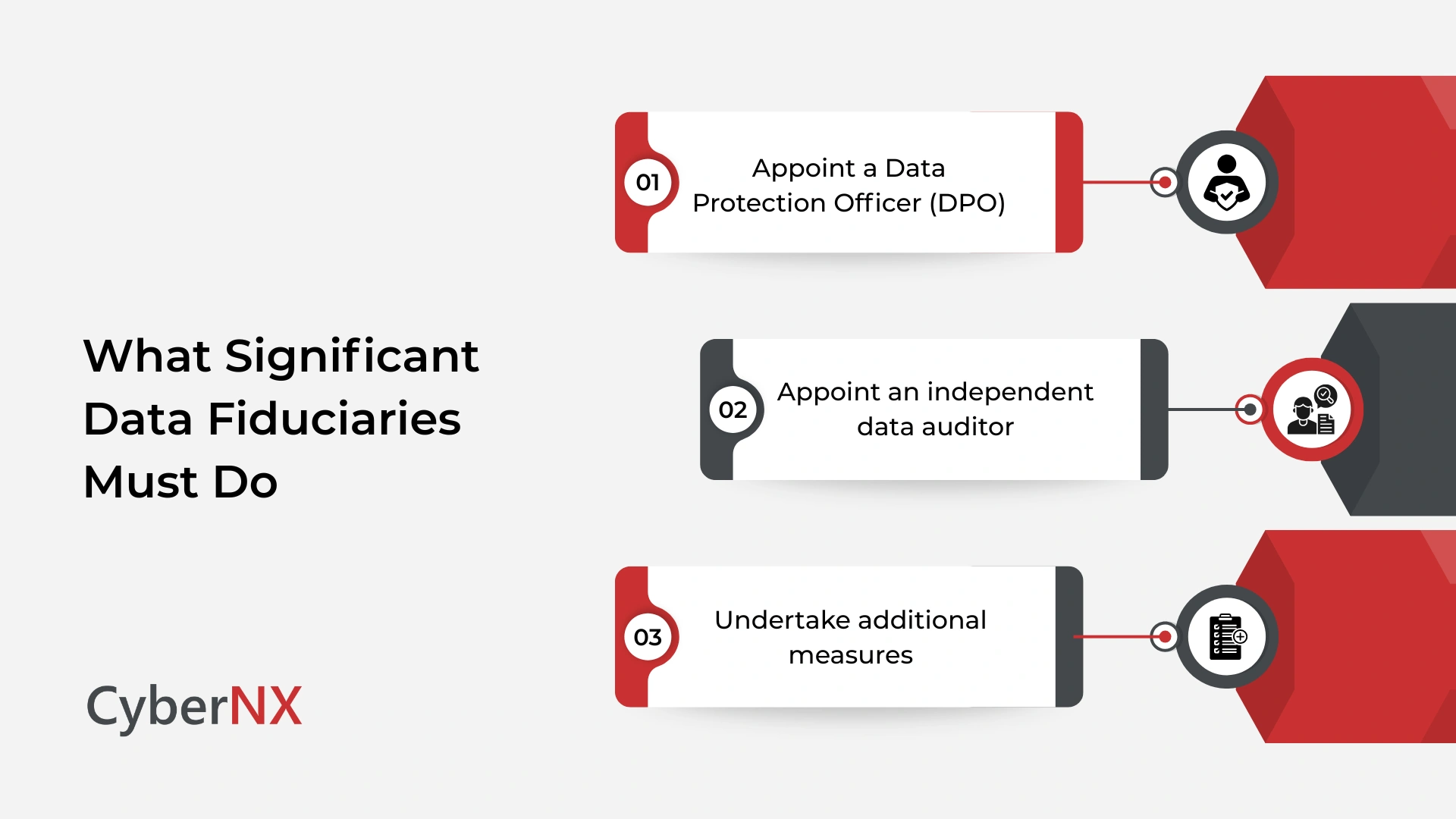
Once notified, Section 10(2) sets out three obligations:
What Significant Data Fiduciaries Must Do

  • Appoint a Data Protection Officer (DPO): based in India, accountable to the Board of Directors or equivalent governing body, and serving as the point of contact for grievance redressal
  • Appoint an independent data auditor: to evaluate the SDF’s compliance with the Act
  • Undertake additional measures: including periodic Data Protection Impact Assessments (DPIAs) covering the rights of Data Principals affected by processing, and – under Rule 13 of the DPDP Rules 2025 – due diligence to confirm that any algorithmic software used for processing does not pose a risk to those rights

What this means for your organisation

If your organisation processes large volumes of personal data, operates in a sector the government has flagged for scrutiny, or uses automated decision-making that affects individuals at scale, SDF notification is a realistic possibility once the government begins issuing these notifications.

The practical step available today is not waiting for a notification but building the underlying capability the obligations require. They include DPO function, audit readiness, and a DPIA process that can be activated without a rebuild.

Organisations already meeting general DPDPA obligations under Section 8 are closer to SDF-readiness than they may assume, since data mapping and consent infrastructure overlap significantly with DPIA requirements.

What we recommend

Waiting for a formal SDF notification before building the underlying capability is the most common mistake we see. A DPO function, an audit-ready processing record, and a working DPIA template take months to stand up properly. It is not something to assemble under regulatory pressure. Our recommendation:

  • Treat the Section 10(2) obligations as a target state to build toward now, regardless of whether your organisation has been notified.
  • Start with a data inventory and a named privacy owner.
  • If you already run DPIAs for GDPR or similar regimes, extend that process to cover DPDPA’s specific rights framework rather than building a parallel one from scratch.

Conclusion

Significant Data Fiduciary status under DPDPA is a government designation tied to the scale and risk of an organisation’s data processing, carrying specific obligations around DPO appointment, independent audits, and DPIAs once notified. Building this capability ahead of a notification, rather than after one, gives your organisation more room to implement it properly. Our DPDPA compliance consultancy can help you assess where your organisation stands against these obligations today.

What is Significant Data Fiduciary in DPDPA FAQs

Is Significant Data Fiduciary status self-declared under DPDPA?

No. Section 10(1) states that the Central Government notifies an entity or class of entities as an SDF. It is not a self-assessment or voluntary registration.

Does DPDPA specify a numerical threshold for SDF classification?

No. The Act refers to “volume and sensitivity of personal data processed” as a factor without fixing a number. Specific thresholds, if introduced, would appear in subordinate rules or notifications, not the Act itself.

What is the penalty for SDF non-compliance under DPDPA?

Breach of the additional obligations specific to SDFs – DPO appointment, independent audit, or DPIA requirements – can attract a penalty of up to ₹150 crore. This is separate from the higher ₹250 crore tier tied to failure to implement reasonable security safeguards, which applies to any Data Fiduciary, not SDFs alone.

When do SDF obligations come into force?

Provisions relating to Significant Data Fiduciaries – including mandatory DPO appointment and independent audit obligations – are expected to come into force on 13 May 2027, alongside the DPDPA’s full enforcement deadline.

How is an SDF different from a regular Data Fiduciary?

Every Data Fiduciary carries baseline obligations under the Act – valid consent, clear notice, reasonable security safeguards, and breach reporting. An SDF carries all of these plus the Section 10(2) obligations: a DPO, an independent auditor, periodic DPIAs, and algorithmic due diligence under Rule 13.

Can a foreign company be classified as an SDF?

The DPDPA applies to processing of personal data outside India if it relates to offering goods or services to Data Principals within India. Section 10 does not exclude foreign entities from SDF notification, so a foreign Data Fiduciary meeting the government’s criteria could be notified in the same way as a domestic one.

Author
Krishnakant Mathuria
LinkedIn

With 12+ years in the ICT & cybersecurity ecosystem, Krishnakant has built high-performance security teams and strengthened organisational resilience by leading effective initiatives. His expertise spans regulatory and compliance frameworks, security engineering and secure software practices. Known for uniting technical depth with strategic clarity, he advises enterprises on how to modernise their security posture, align with evolving regulations, and drive measurable, long-term security outcomes.

Share on

WhatsApp
LinkedIn
Facebook
X
Pinterest

For Customized Plans Tailored to Your Needs, Get in Touch Today!

Connect with us

RESOURCES

Related Blogs

Explore our resources section for insightful blogs, articles, infographics and case studies, covering everything in Cyber Security.
Find Out Common DPDPA Compliance Mistakes to Avoid

Common DPDPA Compliance Mistakes to Avoid

Previously, we have covered Penalties under the DPDP Act which tells you what non-compliance costs. This blog looks at the

DPDPA Gap Analysis with Scoring Framework

DPDPA Gap Analysis: Practical Scoring Framework for Compliance Teams

As compliance deadline looms, a DPDPA gap analysis will do a world of good for enterprises operating in India. A

How will the DPDPA Impact AI Adoption in India?

How Will the DPDPA Impact AI Adoption in Indian Enterprises

An AI system runs on data, and a meaningful share of that data is personal. So, the natural question in

RESOURCES

Cyber Security Knowledge Hub

Explore our resources section for insightful blogs, articles, infographics and case studies, covering everything in Cyber Security.

BLOGS

Stay informed with the latest cybersecurity trends, insights, and expert tips to keep your organization protected.

CASE STUDIES

Explore real-world examples of how CyberNX has successfully defended businesses and delivered measurable security improvements.

DOWNLOADS

Learn about our wide range of cybersecurity solutions designed to safeguard your business against evolving threats.
CyberNX Footer Logo
Book a Free Call

Peregrine

  • Managed Detection & Response
  • AI Managed SOC Services
  • Elastic Stack Consulting
  • CrowdStrike Consulting
  • Threat Hunting Services
  • Digital Risk Protection Services
  • Threat Intelligence Services
  • Digital Forensics Services
  • Brand Risk & Dark Web Monitoring
  • Full Stack Observability

Pinpoint

  • Red Teaming Services
  • Vulnerability Assessment
  • Penetration Testing Services
  • Secure Code Review Services
  • Cloud Security Assessment
  • Phishing Simulation Services
  • Breach and Attack Simulation Services

MSP247

  • 24 X 7 Managed Cloud Services
  • Cloud Security Implementation
  • Disaster Recovery Consulting
  • Security Patching Services
  • WAF Services

nCompass

  • SBOM Management Tool
  • Cybersecurity Audit Services
  • Virtual CISO Services
  • DPDP Act Consulting
  • ISO 27001 Consulting
  • RBI Master Direction Compliance
  • SEBI CSCRF Framework Consulting
  • SEBI Cloud Framework Consulting
  • Security Awareness Training
  • Cybersecurity Staffing Services
  • About
  • CERT-In
  • Awards
  • Careers
  • Sitemap
Facebook Twitter Instagram Youtube

Copyright © 2026 CyberNX | All Rights Reserved | Terms and Conditions | Privacy Policy

  • English (US)
    • English
Copyright © 2026 CyberNX | All Rights Reserved | Terms and Conditions | Privacy Policy
Scroll to Top

WhatsApp us

Not Sure Where to Start with Cybersecurity?

We value your privacy. Your personal information is collected and used only for legitimate business purposes in accordance with our Privacy Policy.