API breaches do not always start with complex attacks. They begin with an endpoint that was never tested thoroughly.
Akamai’s 2026 research found that 87% of surveyed organisations experienced an API-related security incident in the previous year.
However, many organisations still test them the way they test web pages. This is where Dynamic Application Security Testing (DAST) for APIs proves its value. In this blog, we explain how it works and what it detects. We also cover its limits and the best ways to apply it.
What is DAST for APIs?
DAST for APIs tests a running API from the outside, as an attacker would.
Dynamic application security testing sends carefully designed requests to an API and analyses every response. It does not read the source code. Instead, it observes how the API behaves under real conditions.
APIs have no visual interface to browse. The scanner needs a definition file, such as OpenAPI, WSDL or a GraphQL schema. This file lists the available endpoints and explains how to call them. The scanner then sends unexpected inputs, altered parameters and swapped tokens. It records how the API responds to each one.
Why DAST for APIs deserves a place in your testing plan
Static tools review code, but they cannot confirm what an attacker can reach.
SAST (Static Application Security Testing) and SCA (Software Composition Analysis) tools are valuable, as they examine source code and software dependencies.
They cannot show whether a flaw is reachable on a live API. A misconfigured gateway or a stale token validator will pass every code scan. A forgotten debug route will do the same.
Analysis of over 40 million exposures found that 80% came from misconfigurations. Only testing a running API can reveal issues of this kind.
SAST tools secure what you write, while DAST confirms what you deploy. Together, they cover both sides of the risk.
DAST also differs from API gateways and Web Application Firewalls (WAFs). Those tools block attacks as they occur. DAST is preventive, because it finds the flaw so your team can fix it.
What DAST finds in your APIs
A thorough scan typically identifies the following API weaknesses.
- Broken authentication: Weak session handling, missing checks or misconfigured access tokens. The DAST tool tests whether protected endpoints respond to missing, expired or altered tokens.
- Injection flaws: SQL, NoSQL and OS command injection through crafted payloads. The DAST tool submits malicious input through parameters, headers and request bodies. It then checks whether the backend executes it.
- Insecure direct object references (IDOR): Access to another user’s records by changing an ID. Testing with several identities confirms whether object-level checks work.
- Excessive data exposure: Responses that return more fields than the client needs. Attackers can read these fields even when the front end hides them.
- Security misconfigurations: Weak TLS settings, missing security headers, detailed error messages and exposed admin routes can reveal server versions, internal paths or other sensitive information.
- Runtime logic gaps: Issues such as weak rate limiting that appear only during live workflows. Examples include unlimited login attempts or repeated coupon use.
Because these issues appear only at runtime, attackers often target them first.
DAST vs SAST: How do they differ for API security?
DAST and SAST examine application security from different perspectives. SAST analyses source code to identify potentially insecure coding patterns. DAST tests a running application to observe how vulnerabilities behave during execution.
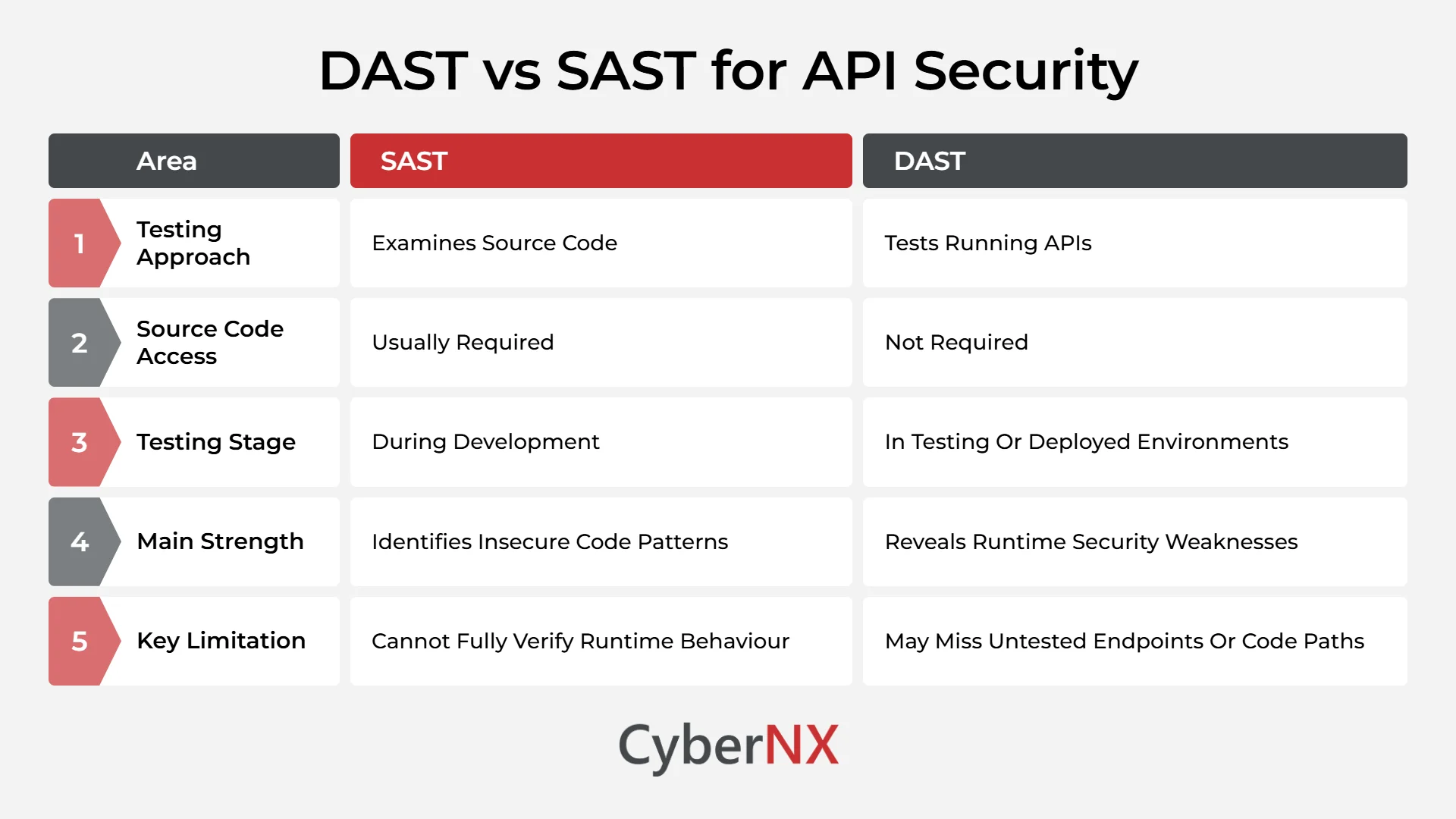
Neither approach replaces the other. SAST can identify coding weaknesses before deployment, while DAST evaluates runtime behaviour. Using both helps teams build a more complete application security testing programme.
Where DAST has blind spots with modern APIs
DAST is useful, but it cannot carry the entire job alone.
Scanners were built for pages and forms, so DAST for APIs has limits. Modern APIs behave very differently, which creates several gaps.
Limited visibility and thin documentation
A black box scanner tests only what it knows about. Internal, partner and low-traffic APIs often remain out of scope. Specifications also miss parameters and accepted values, so the scanner tests without full context.
Authentication and authorisation gaps
OAuth flows and short-lived JWTs often expire during a scan. Teams then reduce the scope just to complete the run. Even when authentication works, scanners usually send valid calls with valid identities.
Consider a “get account balance” call that works with the correct token and ID. The scanner confirms this and moves on. An attacker replaces the ID with another customer’s ID and reads that balance. This flaw is called broken object level authorisation (BOLA).
Infrequent scanning
APIs often change every week, while many scans run monthly or quarterly. New risks can therefore reach production between two reports.
We close these gaps by combining automated DAST with manual API penetration testing. Our testers map every endpoint, test with multiple identities and validate each finding.
How to get more from DAST for APIs
A few good practices make scan results more accurate and easier to act on.
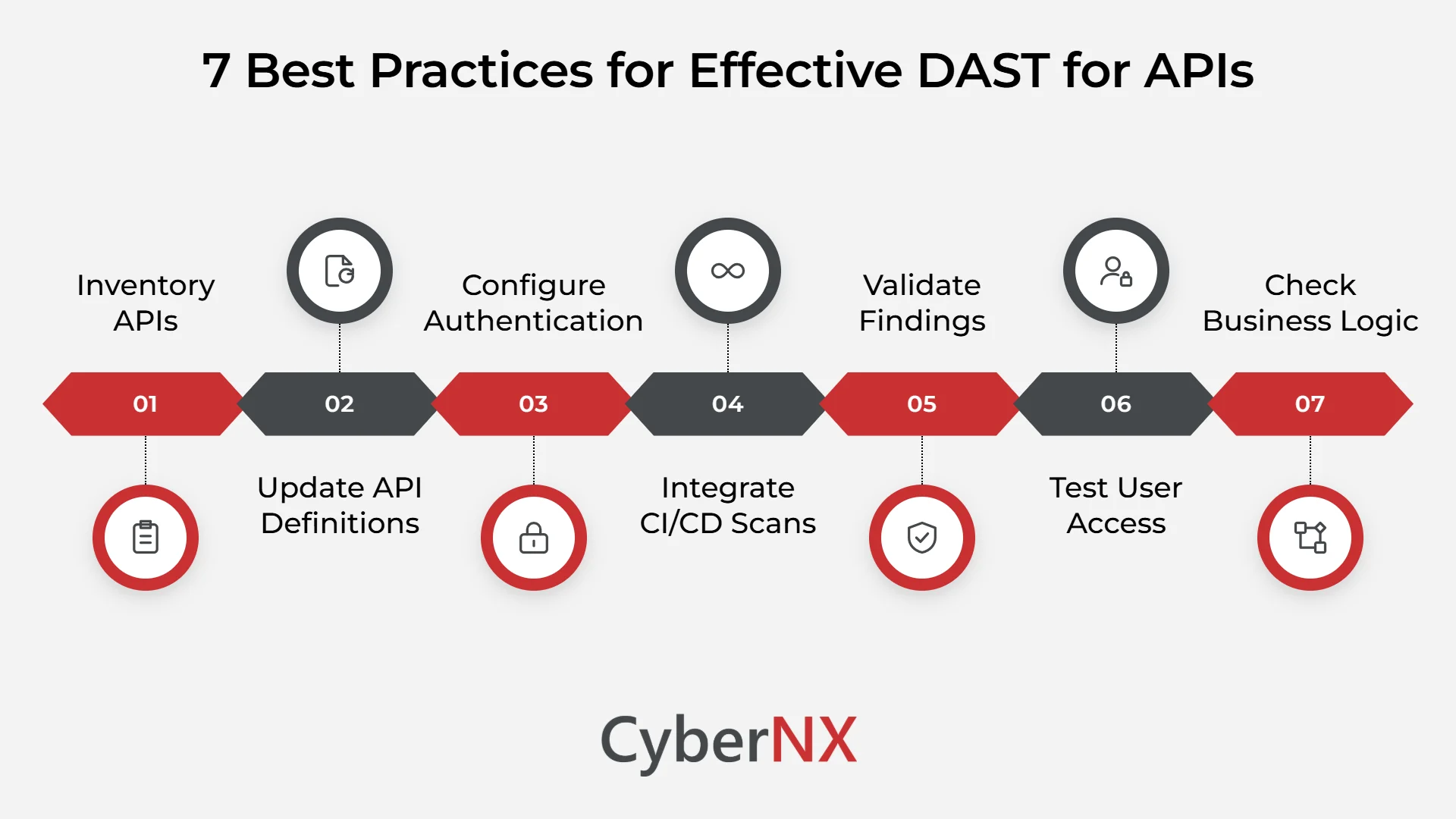
- Inventory APIs: Identify all public, internal and partner endpoints.
- Update API definitions: Keep API specifications current.
- Configure authentication: Test protected endpoints across user roles.
- Integrate CI/CD scans: Test APIs throughout development.
- Validate findings: Confirm vulnerabilities and reduce false positives.
- Test user access: Detect BOLA and IDOR vulnerabilities.
- Check business logic: Test payments, approvals and account changes.
Testing should take place within an authorised scope. Use suitable test environments and controlled accounts wherever possible. Production assessments require appropriate safeguards to avoid disrupting services or altering real customer data.
Where DAST for APIs fits in your security programme
DAST works best as one layer within a wider testing approach.
No single tool covers every API risk. A balanced programme gives each method a clear role.
- SAST and SCA: review code and dependencies during development.
- DAST for APIs: validates running endpoints in staging and pre-production.
- API discovery: finds undocumented and forgotten endpoints.
- Manual penetration testing: examines business logic and chained attacks.
- Secure code review: traces confirmed flaws to their root cause.
Each layer closes a gap that the others leave open.
Timing matters as well. Early scans in development catch simple errors at low cost. Scans before release confirm that your fixes work. Periodic scans in production help you spot configuration drift.
Common mistakes teams make during API scans
Most weak results come from setup errors, not from the tool itself.
- Scanning only documented endpoints: Unlisted routes stay untested.
- Using a single test account: This hides authorisation flaws between users and roles.
- Ignoring scan failures: A scan that stops at the login step may report a clean result without testing anything.
- Treating every finding equally: Rank issues by exposure, data sensitivity and exploitability.
- Scanning once a quarter: Frequent releases need frequent checks.
Avoiding these mistakes improves your coverage without adding much effort.
Conclusion
APIs hold your most sensitive data, so they need attacker-style testing. DAST for APIs provides that view by showing how endpoints respond to misuse.
However, DAST reports the symptom and not always the cause. After a scan flags a flaw, your team must still locate its cause. This is where our secure code review service adds value. At CyberNX, our experts review your source code manually and with tools. We then trace each finding back to its root cause.
We are a CERT-In empanelled organisation. We adhere to all CERT-In mandated requirements and best practices for testing and reporting. This ensures that you receive accurate, well-documented findings that are ready for audit.
If your APIs are growing faster than your testing, speak to our team. We will help you close the gaps before attackers find them.
DAST for APIs FAQs
What is DAST for APIs?
DAST for APIs tests running API endpoints by sending controlled requests and analysing responses. It identifies potential security weaknesses without requiring access to source code. Depending on the tool, it can test authentication, access controls, input validation and runtime behaviour.
Can DAST test authenticated APIs?
Yes, provided the testing tool supports the API’s authentication method and is configured correctly. Testing can use API keys, bearer tokens or OAuth 2.0 credentials. Testing multiple user roles also helps identify access control weaknesses.
What vulnerabilities can DAST detect in APIs?
DAST can identify injection flaws, authentication weaknesses, broken access controls, excessive data exposure and certain security misconfigurations. Coverage depends on the tool and assessment scope. Complex business logic issues may require manual testing.
What is the difference between API DAST and API penetration testing?
API DAST typically uses automated testing to identify potential vulnerabilities in running endpoints. API penetration testing involves a broader, often manual assessment of attack paths, permissions and business logic. Both approaches complement each other when used appropriately.
Can DAST find vulnerabilities in undocumented APIs?
Some DAST tools can discover undocumented endpoints through traffic analysis, crawling or other discovery methods. However, discovery is not guaranteed. Maintaining an API inventory and reviewing scan coverage helps reduce the risk of overlooked endpoints.
When should organisations perform DAST for APIs?
Organisations should consider DAST during pre-release testing, after significant API changes and at appropriate intervals for deployed services. Risk-based scheduling helps teams focus on sensitive endpoints. Regular testing should complement secure coding, code review and penetration testing.