Only 19% of organisations have full visibility into where and how AI is used across their development environments, according to Cycode’s 2026 State of Product Security Report. Most companies today are running AI models they cannot fully account for.
An AI Bill of Materials (AIBOM) is the answer to this gap. It is an organised list of every model, dataset, dependency, and governance control that makes up an AI system. Think of it as the AI-era extension of the Software Bill of Materials (SBOM) that security teams already use to track code dependencies.
But building an AIBOM is harder than you might expect. This blog breaks down the real challenges when implementing AIBOM and what Indian firms should keep in mind while building this capability.
What is AIBOM and why does it matter?
It lists all the components behind an AI system: the model itself, its training data, third-party libraries, hardware dependencies, and the governance metadata around how it was built and deployed. This gives security and compliance teams a single, reliable record of what is actually running inside an AI application.
For Indian companies, this record is quickly becoming non-negotiable. Regulatory bodies are asking tough questions about AI systems, and this documentation is the evidence base that answers them.
Key challenges when implementing AIBOM
Rolling this out is not exactly a one-time documentation exercise. It runs into some technical as well as organisational friction. Here are the six challenges that come up most often.
- Evolving scope: AI systems now include prompts, agent identities, and retraining events as core artefacts. Deciding what belongs in the record keeps changing as foundation models and agentic systems become more common.
- Continuous lifecycle management: AI models retrain, adapt and drift constantly. A static record quickly becomes outdated, so maintaining provenance across ongoing model updates has to be dynamic.
- Interoperability gaps: Most firms already run SBOM and MLOps tooling. This new layer needs to plug into that existing infrastructure instead of sitting as a separate, disconnected system.
- Transparency versus IP protection: Companies want to prove compliance without exposing proprietary model architecture or training methods. Balancing transparency with intellectual property is the most sensitive issue, as companies want to disclose enough to prove compliance without revealing sensitive models or training methods.
- Provenance gaps: Tracing where training data and third-party models actually came from is difficult when development workflows and metadata is inconsistent.
- Tooling maturity and awareness: Generation and consumption tooling is still immature, and many teams are not yet totally familiar with what complete coverage should include.
The India-specific compliance layer
Indian enterprises face an additional layer on top of these technical challenges: regulatory pressure that is moving faster than most internal AI governance programmes.
The Reserve Bank of India’s FREE-AI framework, released in 2026, sets out structured expectations for AI governance in regulated entities, building on existing RBI master directions around outsourcing, IT governance, and cyber security. Banks, NBFCs and fintechs now need to show accountability for every AI system they run, including ones bought from vendors.
At the same time, the Digital Personal Data Protection Act (DPDPA) Rules 2025 apply to any AI system that processes personal data of Indian citizens, regardless of where that system runs or who built it. According to IBM Institute for Business Value’s November 2025 report, 83% of Indian executives consider AI governance is needed for scaling AI, but only 4% have actually built the systems that are needed to manage the risk.
That gap between intent and execution is exactly where this kind of documentation helps. It gives compliance teams a documented, auditable answer instead of a scramble every time a regulator or auditor asks a question.
How to approach AIBOM implementation practically
Getting started does not require solving every challenge at once. A few practical steps make the difference:
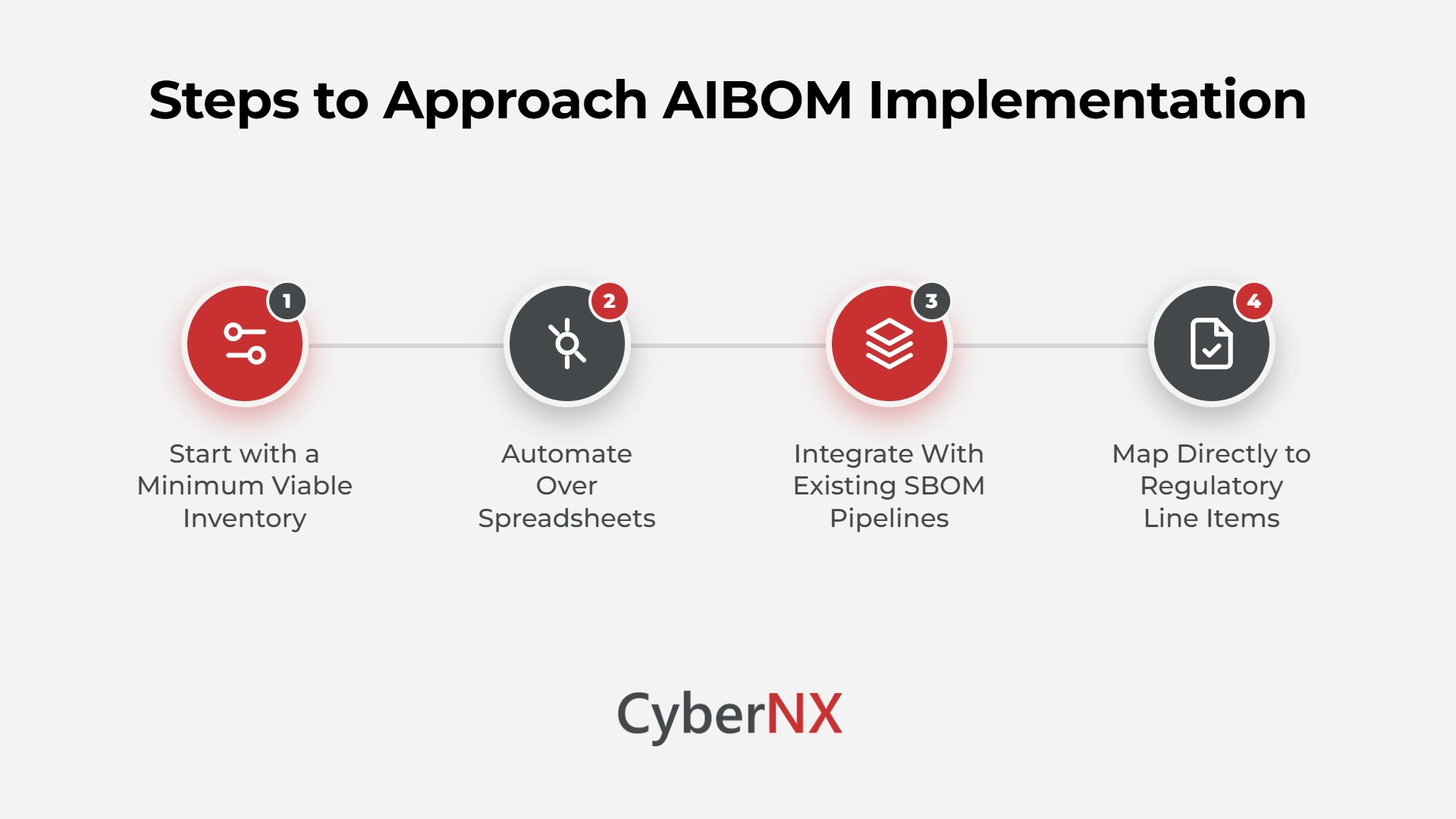
- Start with a minimum viable inventory: Capture the fields that matter most for audit and risk decisions first, then expand scope as tooling matures.
- Automate over spreadsheets: Manual tracking cannot keep pace with model updates and retraining cycles.
- Integrate with existing SBOM pipelines: Extending your current software supply chain visibility to cover AI components is faster than building a separate system from scratch.
- Map directly to regulatory line items: Structure this documentation so it answers RBI, SEBI CSCRF, and DPDPA questions directly, not generic best-practice checklists.
Conclusion
Implementing an AI Bill of Materials comes with real issues like evolving scope, constant model updates, tooling gaps, and the added weight of RBI and DPDPA compliance expectations. But these challenges when implementing AIBOM are all the more reason why you should start with the right foundation.
Our AIBOM solutions help companies manage bill of materials at scale, mapped directly to RBI, SEBI CSCRF, and CERT-In requirements. Connect with our experts to see how we can support your AIBOM journey.
Challenges When Implementing AIBOM FAQs
What is AIBOM?
AIBOM stands for AI Bill of Materials. It is a structured inventory of the models, datasets, dependencies and governance metadata that make up an AI system.
How is AIBOM different from SBOM?
SBOM tracks software components and their dependencies. This extends the same idea to AI-specific artefacts like model lineage, training data provenance, and retraining events.
Is AIBOM mandatory for Indian enterprises?
There is no single standalone mandate covering this yet. However, frameworks like RBI’s FREE-AI and DPDPA Rules 2025 create indirect obligations that this kind of documentation helps satisfy.
Do smaller organisations need an AIBOM?
Any organisation using or building AI systems will benefit from the visibility an AIBOM provides, regardless of size. Sector-regulated businesses, including BFSI entities under RBI and SEBI frameworks, face extra pressure to maintain it as compliance expectations mature.