If you are a regulated entity in India, you have a cybersecurity deadline that cannot be ignored. On May 25, 2026, the Reserve Bank of India formed the Q-SAFE Expert Committee to prepare the financial sector for quantum computing risks. One of its first tasks is testing the financial sector’s cryptographic inventory through a CBOM. Quantum computers that are strong enough to break today’s encryption may still be years away. But the clock on fixing cryptographic blind spots has already started.
Your firm may not answer to RBI. The blind spots are the same regardless. This blog covers why Indian firms need a CBOM before the quantum deadline, and exactly how to build one.
What is a Cryptographic Bill of Materials (CBOM)?
A CBOM is a structured inventory of every cryptographic asset your systems use. Think certificates, keys, algorithms and protocols. It shows where cryptography lives, how it is used and which apps depend on it.
A CBOM is different from a Software Bill of Materials (SBOM). An SBOM lists the software components inside your applications. A CBOM zooms into the cryptography running inside that software. Together, these two inventories close a security gap. Weak algorithms and expiring certificates often hide inside code that already passed a security audit. A CBOM brings that hidden layer into view.
Why the quantum deadline matters for Indian enterprises now
Quantum computers capable of breaking RSA and ECC encryption do not exist yet. But the risk starts today. Attackers can steal encrypted data now and decrypt it later, once quantum computing matures. Security teams call this a harvest-now, decrypt-later attack.
India’s national quantum-safe roadmap targets quantum resiliency for critical infrastructure by 2029 and broader enterprise adoption by 2033. That gap looks like a lot. But building a complete cryptographic inventory across a large enterprise takes months.
RBI’s Q-SAFE committee reflects this urgency. It must evaluate the financial sector’s cryptographic inventory through a CBOM, assess crypto agility, and identify the systems most vulnerable to quantum threats, with a report due within six months of its first meeting. Enterprises that wait for a formal mandate risk starting years behind regulated banks.
Regulatory pressure driving CBOM adoption in India
CBOM adoption is soon becoming a compliance expectation. RBI Advisory 11/2024 references CERT-In Technical Guidelines v2.0, which call for a cryptographic inventory at regulated and critical infrastructure entities.
SEBI’s CSCRF framework carries similar expectations for market infrastructure institutions. Auditors may ask a direct question during reviews: can you show every algorithm and certificate your systems depend on? A CBOM is the practical way to answer with evidence, not just assumptions.
How to build a CBOM
Building a CBOM does not need to start as an enterprise-wide project. Security teams typically move through four stages, from discovery to ongoing maintenance.
- Discover cryptographic assets: Scan networks, code repositories, cloud environments and HSMs. List every algorithm, key and certificate in use.
- Catalog and add context: Record key lengths, expiry dates and which applications depend on each asset. A flat list without context is not a CBOM.
- Assess quantum risk: Flag algorithms such as RSA and ECC, since the immediate driver behind this work is migration to post-quantum cryptography standards published in August 2024. Prioritise systems that protect long-lived sensitive data.
- Maintain and monitor: Treat the CBOM as a living record. Update it as certificates rotate, libraries change and new applications go live.
A CBOM delivers the most value when it moves beyond a static list and captures operational dependencies, system criticality and migration readiness for each asset. This context is what turns a spreadsheet into an actionable security tool.
Benefits of a CBOM for quantum readiness
A CBOM pays off well before quantum computers become a practical threat. It changes how enterprises answer basic security questions.
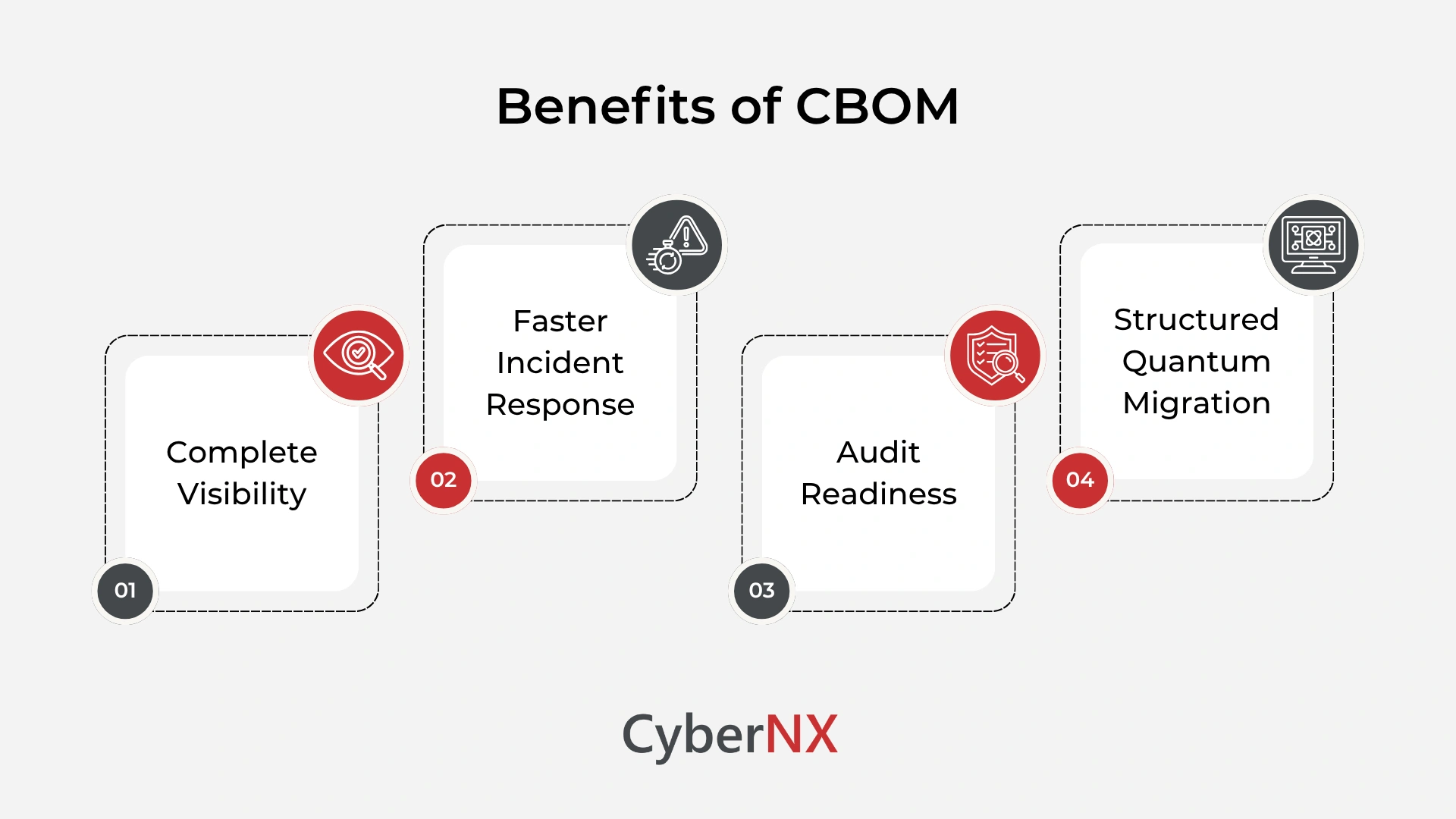
- Complete visibility: You know exactly which algorithms and certificates run across every application.
- Faster incident response: When a cryptographic library is found vulnerable, you find every affected system in hours, not weeks.
- Audit readiness: Auditors get evidence instead of a manual, error-prone spreadsheet.
- Structured quantum migration: You replace weak algorithms based on risk, not guesswork.
Conclusion
Quantum computing will not wait for enterprise IT roadmaps to catch up. RBI’s Q-SAFE committee and India’s national quantum-safe roadmap have already set the pace. Indian companies need a CBOM before the quantum deadline arrives, not after regulators make it mandatory.
A CBOM gives you complete visibility into every cryptographic asset across your systems. It turns quantum readiness into a structured, evidence-backed plan instead of a guessing game.
CyberNX’s CBOM solutions build this inventory using network scans, code analysis and HSM integrations, mapped directly to RBI and CERT-In requirements. Talk to our CBOM experts to understand why Indian enterprises need a CBOM before the quantum deadline and start building your cryptographic inventory today.
Why Indian Enterprises Need a CBOM Before the Quantum Deadline FAQs
What is the difference between a CBOM and an SBOM?
An SBOM lists the software components in an application. A CBOM focuses only on cryptographic assets, such as keys, algorithms and certificates, and how they are used. Enterprises need both for complete visibility.
Is a CBOM mandatory for Indian enterprises?
CERT-In Technical Guidelines v2.0 and RBI Advisory 11/2024 require a cryptographic inventory for regulated entities and critical infrastructure operators. Enterprises outside these categories are not yet mandated but face the same quantum deadline.
What is RBI’s quantum deadline for banks?
RBI’s Q-SAFE Expert Committee must submit its roadmap within six months of its first meeting, following its formation in May 2026. India’s national roadmap sets 2027 to 2029 as the migration window for critical infrastructure.
How enterprises can start building a CBOM
Start with discovery. Scan code repositories, networks and cloud environments to find every cryptographic asset. From there, add context, assess quantum risk and set up ongoing monitoring.