In November 2024, RBI Advisory encouraged regulated entities to adopt CERT-In guidance and maintain cryptographic inventories as part of quantum-safe preparedness. Eight months later, CERT-In Technical Guidelines v2.0 expanded BOM guidance to include CBOM and introduced expectations for covered sectors.
In latest update, RBI has constituted Q-SAFE Expert Committee (Quantum Secure and Adaptive Financial Ecosystem). This primary task of the committee is to take stock of what cryptography Indian banks are using and assess their crypto agility. Indian regulators have moved faster on cryptographic transparency than most firms expected.
For security and compliance teams running apps on cloud, on-premise and third-party environments, this creates a direct question – at what level does your cryptographic governance actually operate today?
The CBOM maturity model answers that question. It gives teams a structured way to measure where they stand, what they are missing and what it takes to close the gap before regulatory deadlines arrive.
This post walks you through the five levels of CBOM maturity, what each level means in practice and why Indian regulated firms need to accelerate their progress.
What is a CBOM maturity model?
A CBOM maturity model is a framework that measures how well an organisation can document, govern and monitor its cryptographic assets. It moves the question of cryptographic security from “do we have a CBOM?” to “how operationally mature is our CBOM programme?”
You can think of it like the difference between owning a fire extinguisher and running a fire safety programme. A CBOM scan is the extinguisher. A mature CBOM programme is the full system, with monitoring, testing and a response plan built in.
The model is even more relevant right now because India’s regulatory expectations have moved ahead of most enterprise programmes. CERT-In’s Technical Guidelines v2.0 (July 2025) supports standards-based CBOM generation using formats like CycloneDX (v1.6 or later; v1.7 is the current edition as of October 2025) or SPDX and defines specific minimum elements by cryptographic asset type: algorithms, keys, protocols and certificates. The maturity model gives organisations a way to measure how well their programme actually meets those expectations.
The 5 levels of CBOM maturity
There is no single universally accepted CBOM maturity framework, but the progress is consistent across NIST guidance, CERT-In Technical Guidelines and industry practice. The following five-level model is a practical maturity framework derived from industry guidance and regulatory expectations:
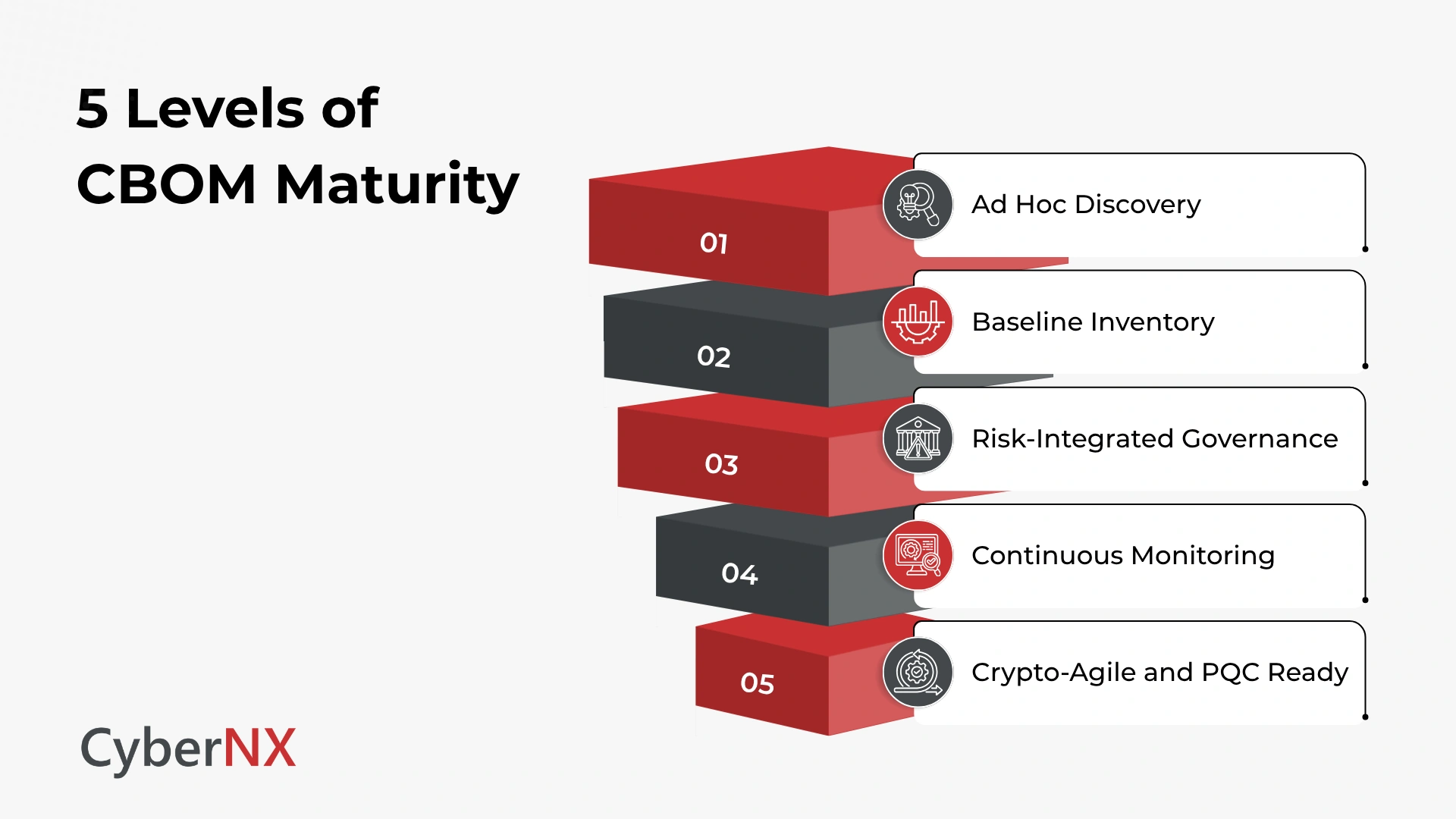
Ad hoc discovery
No formal cryptographic inventory exists. Cryptographic assets are identified reactively – usually after a certificate expiry incident or disclosed vulnerability. Deprecated algorithms running in production may go undetected for months or years.
Baseline inventory
A formal CBOM has been generated for at least critical applications. It documents algorithms, certificates, key types and protocols in use. But the inventory is a one-time snapshot with no automated refresh, meaning it goes further from reality with every new change or deployment.
Risk-integrated governance
The CBOM is connected to the company’s risk management and compliance frameworks. Findings are prioritized by severity and business impact and not treated as a flat list. Regulatory evidence for RBI or CERT-In audits can be drawn directly from CBOM data.
Continuous monitoring
CBOM generation is automated and embedded in CI/CD pipelines. Any new deployment change triggers a CBOM update. Alerts fire automatically when deprecated algorithms appear or certificates approach expiry.
Crypto-agile and PQC ready
NIST-approved post-quantum algorithms, including ML-KEM (formerly CRYSTALS-Kyber) and ML-DSA – are tracked and migration roadmaps are active. CERT-In’s Technical Guidelines v2.0 also address quantum readiness, making it increasingly relevant for regulated organizations.
How to test your current CBOM maturity level
Use these questions to test your position on the CBOM maturity model:
- Can you produce a complete list of every algorithm, certificate and cryptographic library in use across all your applications within 24 hours?
- Is your CBOM updated automatically when new code is deployed or dependencies change?
- Can you generate audit evidence directly from your CBOM for RBI or CERT-In review?
- Do your third-party vendors and software suppliers provide CBOM data as required under RBI Advisory?
- Are your CBOM findings connected to a risk score that drives remediation priority?
Conclusion
The CBOM maturity model gives security and compliance teams a clear, measurable path from reactive discovery to a fully crypto-agile programme. For Indian BFSI entities and regulated enterprises, the combination of RBI and CERT-In mandates, active harvest-now-decrypt-later threats and NIST’s 2030 migration timeline makes progressing up the maturity scale an operational priority.
CyberNX’s CBOM solutions is built to speed up that journey across all five levels. From multi-source automated discovery to purpose-built regulatory reporting mapped directly to RBI, CERT-In and NIST frameworks, our CBOM solutions give your team the foundation to move from baseline CBOM maturity model test to continuous monitoring and post-quantum readiness. Connect with our experts to test your current CBOM maturity model and build a roadmap tailored to your environment.
CBOM maturity model FAQs
What is the difference between a CBOM and a CBOM maturity model?
A CBOM is a structured inventory that documents every cryptographic asset in use across your systems – algorithms, keys, certificates and protocols. A CBOM maturity model measures how systematically that inventory is generated, maintained and integrated into security and compliance operations. The CBOM is the artefact; the maturity model is the governance framework around it.
At what CBOM maturity level does post-quantum readiness begin?
Meaningful post-quantum readiness begins at Level 4, where continuous monitoring detects quantum-vulnerable algorithms in real time across your application estate. Full PQC readiness is achieved at Level 5, where NIST-approved post-quantum algorithms are tracked, hybrid cryptography is adopted and migration roadmaps are actively maintained. For Indian regulated entities, CERT-In’s Technical Guidelines also address quantum readiness expectations, making Level 5 directly relevant for supervisory audit preparedness.
Is CBOM mandatory under Indian regulations?
Yes, for regulated entities. CERT-In’s Technical Guidelines mandate CBOM for critical applications and require standards-based generation. RBI Advisory requires regulated entities to ensure CBOM accuracy and completeness across internal development and third-party vendor software.
How long does it take to move from Level 1 to Level 3 CBOM maturity?
The timeline depends on the size of your application estate, existing tooling and the scope of third-party dependencies. Organisations with structured application inventories and established CI/CD pipelines typically reach Level 3 within 6 to 12 months using a purpose-built CBOM platform. Starting with high-risk or customer-facing applications speeds up the transition significantly.