Your organisation has firewalls, endpoint protection and even a SOC. But can you answer this right now: which cryptographic algorithms are protecting your customer data, and are any of them already vulnerable?
For most Indian firms, that answer is not exactly clear. Encryption secures your banking APIs, HSMs, cloud connections and internal communications, yet the cryptographic layer stays invisible to most security teams. For example, certificates expire unnoticed or weak algorithms sit in legacy systems for years. Quantum computing will eventually break RSA and elliptic curve cryptography.
Cryptographic Bill of Materials (CBOM) management is how enterprises take back control. Visibility over every cryptographic asset means you can protect it, update it and prove to regulators that it is governed. This guide breaks down what CBOM management means, why it matters for Indian enterprises and how to approach it.
What is a cryptographic bill of materials?
A Cryptographic Bill of Materials (CBOM) is a structured list or inventory of every cryptographic asset in your systems – basically a full map of your firm’s encryption footprint.
A CBOM captures:
- Algorithms in use: RSA, ECC, AES, SHA variants and their key sizes
- Cryptographic libraries and modules: OpenSSL versions, BouncyCastle, PKCS configurations
- Digital certificates: issuer, expiry date and the applications they are bound to
- Keys and key material: where keys are stored, lifecycle and rotation history
- Protocols: TLS versions, cipher suites, VPN configurations
CBOM management means understanding how these assets connect to your applications, which ones carry risk and how quickly you can replace any of them when a vulnerability appears or a standard is deprecated.
Why CBOM management can’t wait
Consider a few reasons why it’s not advisable to delay your CBOM management:
1. Regulators are already pointing at your crypto layer
CERT-In released Version 2.0 of its Technical Guidelines on Bill of Materials on 9 July 2025. This update formally defined CBOM and QBOM as distinct inventory categories under Section 8, alongside SBOM, AIBOM and HBOM. CERT-In under MeitY recommends cryptographic inventory a standard expectation for government, essential-services, public sector and software-export organisations.
2. The DST Task Force deadline
In February 2026, the Department of Science and Technology published its Task Force report on India’s Quantum-Safe Ecosystem. The foundation milestone – cryptographic inventory and CBOM governance – is required to be in place for Critical Information Infrastructure (CII) operators by December 2027. CBOM submissions are recommended as mandatory from FY 2027–28. For BFSI organisations and regulated enterprises, that deadline is close and the discovery work must start now.
3. The quantum threat
There is a threat pattern called “Harvest Now, Decrypt Later.” Hackers steal encrypted data today and intend to decrypt it later, when quantum capability arrives. For customer records, financial transactions and regulatory filings, the clock started years ago. Without CBOM management, your team has no way to know which systems carry quantum-vulnerable algorithms or where to begin migration.
What good CBOM management looks like
Effective management is not a one-time audit. It is a continuous discipline that connects discovery, risk assessment and remediation into a repeatable process.
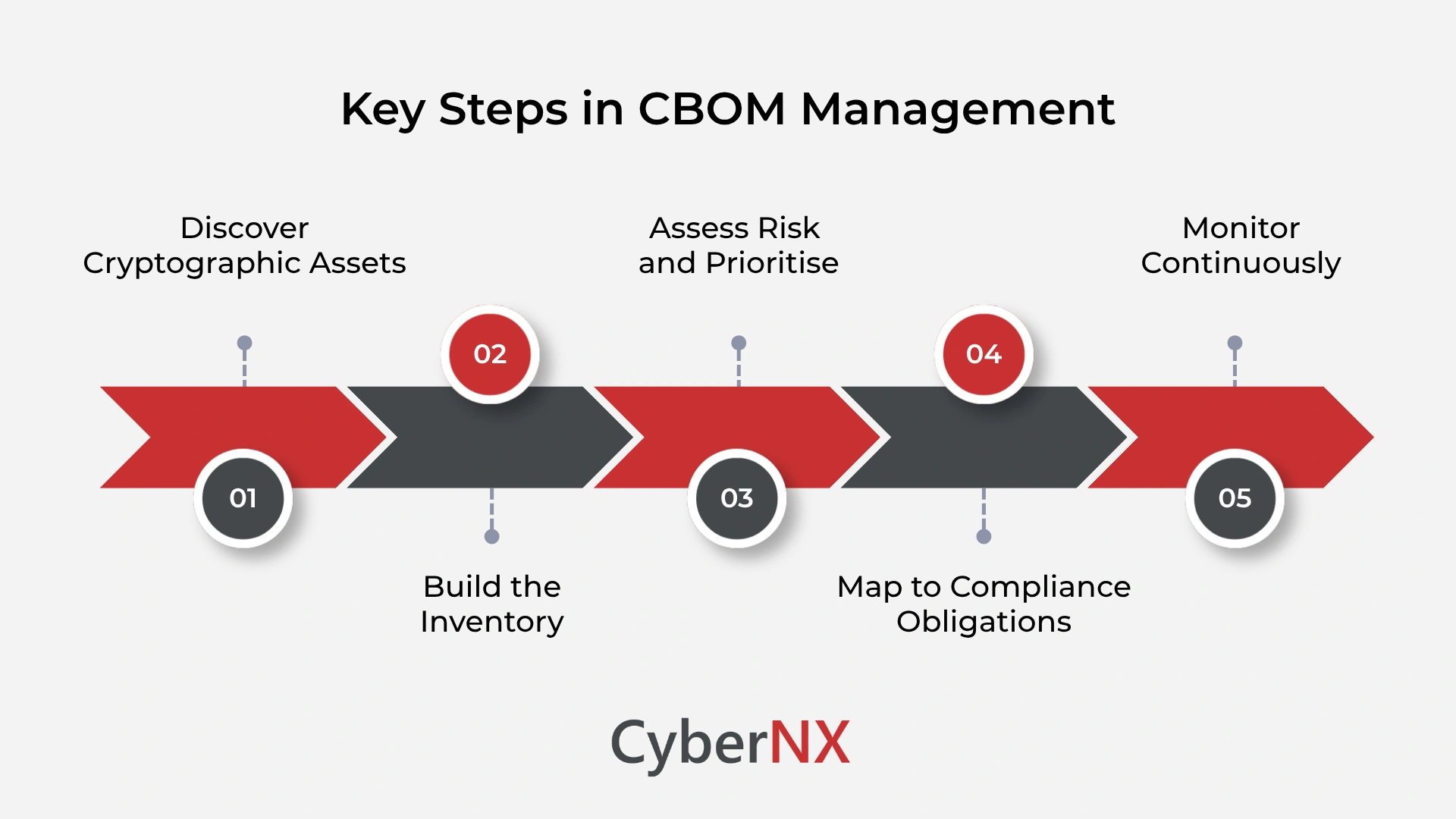
- Discover cryptographic assets: Scan code repositories, network infrastructure, build artifacts and HSM/KMS integrations. Automated scanning is essential; manual reviews alone miss assets.
- Build the inventory: Structure findings by application. Capture the algorithm, key size, library version, certificate details and usage context. Structure the CBOM using a recognized machine-readable format such as SPDX or CycloneDX, both of which are referenced by CERT-In.
- Assess risk and prioritise: RSA-2048 and ECC P-256 are quantum-vulnerable and should be flagged for migration first. Expired certificates or weak cipher suites in production need immediate attention.
- Map to compliance obligations: Align findings to CERT-In Technical Guidelines v2.0 and RBI Advisory 11/2024. This turns your inventory into a compliance evidence pack.
- Monitor continuously: Cryptographic assets change with every deployment and certificate renewal. A static CBOM goes stale fast. Continuous monitoring keeps the inventory accurate.
CBOM management and post-quantum readiness
NIST finalised its first post-quantum cryptographic standards in 2024, including ML-KEM for key encapsulation and ML-DSA for digital signatures. These will replace RSA and ECC – but migration is impossible without first knowing where current algorithms are deployed. CBOM makes that mapping possible.
With a live CBOM, your team can identify which applications use quantum-vulnerable algorithms, sequence migration by priority, track PQC adoption over time and prove to regulators that the transition is structured and measurable. Without a CBOM, post-quantum migration becomes a manual scramble. The DST Task Force has been explicit: for CII operators, that is not an option.
Conclusion
CERT-In’s Technical Guidelines v2.0 have formalised CBOM as an expected practice. The DST Task Force has tied it to India’s national PQC migration timeline. And the “Harvest Now, Decrypt Later” threat makes the risk active today, not future. Good management gives your organisation the visibility to protect what you have today, plan what to change and prove to regulators that your cryptographic posture is under control.
At CyberNX, we help Indian enterprises discover, document and continuously monitor their cryptographic assets through our CBOM solutions. To see how we can help you build and maintain complete CBOM management across your systems, talk to our team and take a free demo.
CBOM management FAQs
What is CBOM management?
It is the ongoing process of discovering, inventorying, assessing and monitoring all cryptographic assets across your systems – algorithms, certificates, keys, libraries and protocols – and connecting them to the applications that use them. The goal is continuous visibility and control over your cryptographic posture.
Is CBOM mandatory in India??
CBOM requirements depend on the applicable organisation, sector, procurement requirements and regulatory framework. CERT-In’s Version 2.0 Technical Guidelines provide detailed CBOM recommendations and specifically call for government, public-sector and essential-services organisations to require CBOMs in relevant procurements, developments and integrations. The DST’s quantum-safe roadmap also calls for vendor CBOM submissions through procurement starting FY 2027–28. This should not be interpreted as a blanket statutory CBOM requirement for every Indian enterprise.
How is a CBOM different from an SBOM?
An SBOM inventories the software components in an application – libraries, modules and dependencies. A CBOM documents how cryptography is used inside those components. The two work together: an SBOM tells you what is in your software; a CBOM tells you how it is protected.
Where do I start with CBOM management?
Begin with automated discovery across your highest-risk applications – those handling customer data or financial transactions. Use a tool that scans code repositories, network infrastructure and certificate stores simultaneously. Structure findings in CycloneDX format for compatibility with CERT-In and regulatory reporting.