When a building is constructed, every wire, every pipe and every load-bearing wall is documented in a blueprint. Maintenance teams rely on that blueprint for decades. Without it, fixing one thing can risk breaking another. And the older the building gets, the more critical that blueprint becomes.
Cryptography works the same way. Every algorithm, every certificate, every key is a structural layer in your digital systems. Over time, new services get added, old ones are forgotten and the cryptographic layer slowly grows more complex. A CBOM audit helps you build that blueprint. Without it, you are making security decisions about systems that you cannot fully see, and in today’s regulatory and post-quantum environment, that is a serious risk.
What is a CBOM audit?
It’s the process of discovering, documenting and evaluating every cryptographic asset in your systems. Think of it as a health check for your encryption layer.
A Cryptographic Bill of Materials (CBOM) is a structured inventory of algorithms, keys, certificates, protocols and cryptographic libraries in use across your applications and third-party dependencies. The audit goes one step further: it validates whether those assets are correctly configured, whether any are outdated or quantum-vulnerable, and whether the overall cryptographic posture meets your regulatory and operational requirements.
Why the process is harder than it looks
Most companies underestimate the scope of a cryptographic inventory. Cryptography hides in more places than teams expect. It sits inside application code, open-source libraries, APIs, cloud key management services, hardware security modules, firmware, network devices and third-party integrations. A payment gateway, an identity provider, an HSM vendor, a cloud database, your own mobile app: all of these carry cryptographic assets that a standard IT inventory will not surface.
The result is that many companies believe they can manage their cryptographic footprint, only to discover hundreds or thousands of assets during their first real assessment. Unknown certificates, keys and hidden dependencies can delay modernisation and increase exposure to known threats.
How the CBOM audit process works
A well-structured audit follows a clear sequence. Here is how it typically unfolds for an enterprise environment.
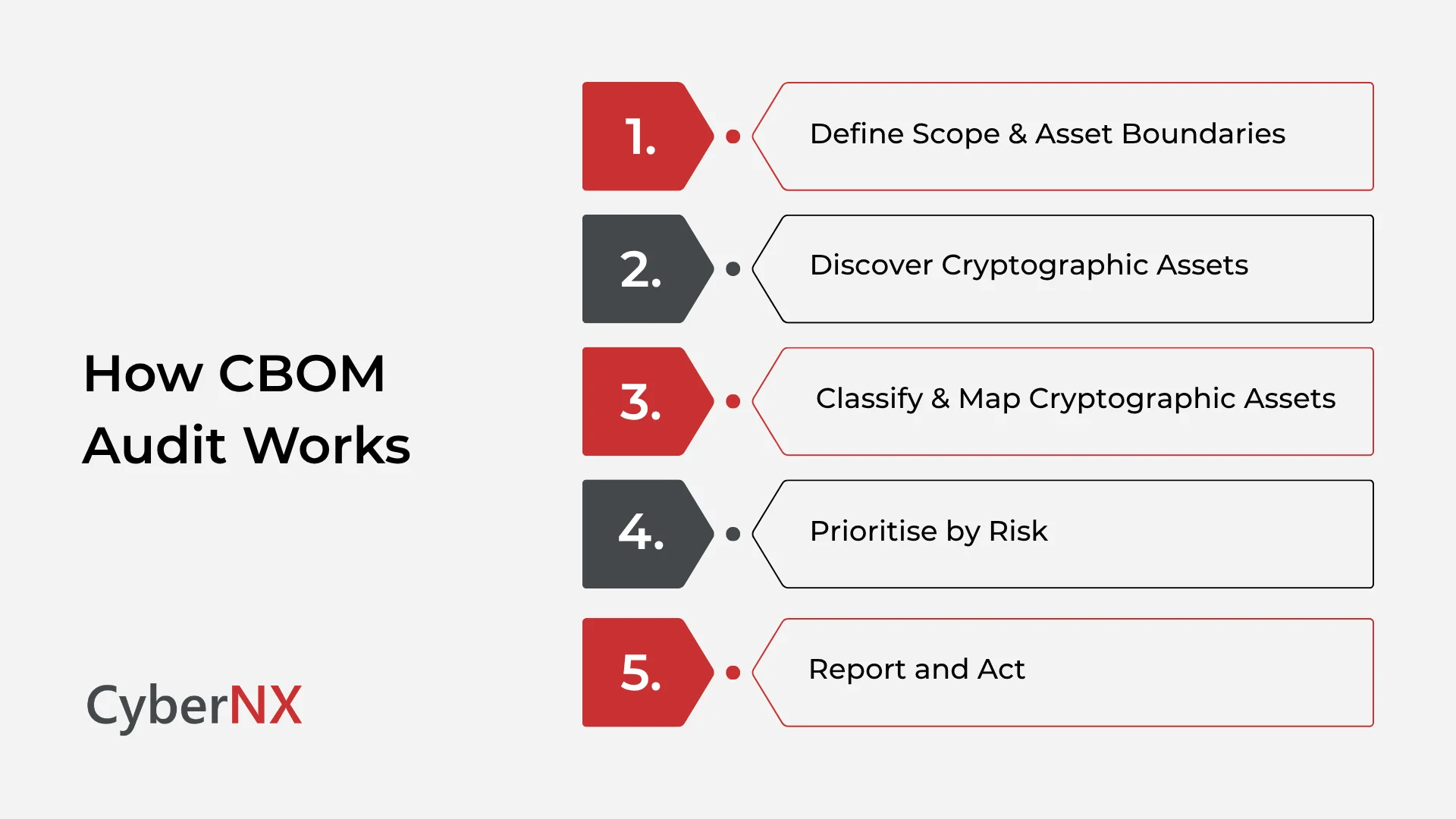
1. Define scope and asset boundaries
Before scanning anything, you need to define what is in scope:
- Application portfolio: which systems, products and services are covered
- Infrastructure layer: servers, containers, cloud workloads, APIs, network devices
- Third-party dependencies: libraries, SDKs, external integrations, vendor-supplied software
- HSMs and key management systems: where keys are generated, stored and rotated
2. Discover cryptographic assets
Discovery involves scanning across multiple sources, not just one:
- Source code and binary analysis
- Certificate authority records and CLM platforms
- Cloud KMS and HSM integrations
- Build artifacts and container registries
- Network configuration and traffic inspection
3. Classify and map cryptographic assets
Once discovered, assets need to be classified by type, algorithm, key length, location, owner and function. Key dimensions include:
- Algorithm type: symmetric, asymmetric, hashing, signing, key exchange
- Algorithm strength and deprecation status: RSA-2048, ECC P-256, SHA-1, AES-256
- Quantum vulnerability status
- Certificate validity and expiry
- Ownership: which team or service is responsible
4. Prioritise by risk
Every finding does not require immediate action. Risk prioritisation involves ranking assets by:
- Cryptographic weakness severity
- Sensitivity of the data or function being protected
- Exposure (internet-facing vs. internal only)
- Regulatory implication (RBI, SEBI or CERT-In scope)
Assets protecting long-lived data, like financial records or customer identity information, that use quantum-vulnerable algorithms like RSA or ECC should be treated as high priority. This is because of the Harvest Now, Decrypt Later (HNDL) risk: attackers can capture encrypted data today and decrypt it once a capable quantum computer arrives.
5. Report and act
A well-executed audit report should do two things: document the current cryptographic state in a format auditors can review, and give your teams a clear action plan. This means:
- A machine-readable CBOM using a recognised format like CycloneDX or SPDX
- A risk-ranked finding set with remediation recommendations
- A regulatory mapping to applicable CERT-In, RBI, SEBI and other sector-specific requirements
- A migration roadmap for quantum-vulnerable assets
Where most audits fall short
A few failure patterns often repeat across organisations:
- Treating it as a one-time project: A cryptographic inventory goes stale fast. Without continuous monitoring or scheduled re-assessment, findings become inaccurate fast.
- Scoping too narrowly: Scanning only application code misses the cryptography running in cloud services, network devices, third-party APIs and HSMs. A partial inventory gives a false sense of completeness.
- No ownership assigned: Finding an expired certificate or a deprecated algorithm is only useful if someone is accountable for fixing it. Programs without clear ownership often stall at the reporting stage.
- Skipping the regulatory mapping: In India’s current environment, findings need to connect to specific requirements. Without this mapping, the work may satisfy internal teams but fail external auditors.
Conclusion
A CBOM audit is the starting point for every meaningful decision about cryptographic risk: what to fix first, what to migrate before the quantum deadline and what your regulators will ask for next year.
Most firms complete their first audit and find assets they did not know existed. The second thing they often find is that they are already behind on the regulatory timeline. CyberNX offers CBOM solutions that are built to close both gaps fast, automate discovery across code, cloud and HSMs, provide regulator-ready output for CERT-In and RBI, and a clear migration roadmap for every vulnerable asset found. If you have not started your CBOM audit, the right time is now. Talk to our experts to learn more.
CBOM audit FAQs
What is a CBOM audit?
It is the process of discovering, documenting and evaluating every cryptographic asset in an organisation’s systems, including algorithms, keys, certificates, protocols and libraries. It produces a Cryptographic Bill of Materials and assesses whether assets are correctly configured, current and aligned with regulatory requirements.
Is a CBOM audit mandatory in India?
CBOM audits are not currently a blanket mandatory requirement for every Indian enterprise. CERT-In’s Technical Guidelines Version 2.0 provide detailed CBOM guidance and requirements for applicable organisational contexts, while India’s National Quantum Mission roadmap calls for organisations to mandate vendor CBOM submissions through procurement starting in FY 2027–28. RBI- and SEBI-regulated entities should assess CBOM readiness against their applicable cybersecurity, technology-risk, outsourcing and sector-specific requirements rather than assuming a universal CBOM mandate.
How often should a CBOM audit be conducted?
At least annually for a comprehensive assessment, with continuous monitoring in between. Cryptographic assets change frequently, and a point-in-time assessment becomes inaccurate quickly as certificates expire, libraries update and new services are deployed.
What is the difference between CBOM and SBOM?
An SBOM inventories the software components and dependencies in a system. A CBOM specifically inventories cryptographic assets, including algorithms, key lengths, certificates and the libraries that implement encryption. An SBOM tells you what software is present. A CBOM tells you how that software uses cryptography and whether that usage is secure. tells you what software is present. A CBOM tells you how that software uses cryptography and whether that usage is secure.