
Blue teaming technique is often misunderstood. Many security leaders use the term interchangeably with tools or exercises. Others assume it simply means running a SOC. In reality, it is neither that narrow nor that simple.
For CISOs and IT heads, this confusion creates a real problem. Investments are made in technology, yet detection and response outcomes remain inconsistent. Teams respond to alerts, but struggle during real incidents. This gap usually points to missing or poorly defined blue teaming technique in cybersecurity.
We see this often when working with enterprise security teams. They have capable people and strong tools but lack structured defensive techniques that guide how those assets are used. This blog clarifies what blue teaming techniques are, how they work, and how they differ from scenarios and tools. The goal is to help you build defensive capability with intent, not assumption.
What is a blue teaming technique?
A blue teaming technique is a structured defensive method used by security teams to detect, analyse, respond to and recover from cyber threats. It defines how defenders think and act when facing adversarial behaviour.
Unlike tools, which provide visibility, or scenarios, which simulate attacks, blue teaming techniques focus on how teams apply judgement. They shape investigation workflows, decision-making paths and response actions.
In simple terms, a blue teaming technique is the playbook behind the practice. It answers questions such as:
- How do we validate an alert before escalation?
- How do we prioritise multiple threats at once?
- How do we contain risk without disrupting critical services?
Blue teaming technique in cybersecurity brings consistency. It reduces reliance on individual experience and replaces it with repeatable defensive behaviour.
Core objectives of blue teaming techniques
Before exploring examples, it helps to understand what these techniques aim to achieve.
First, they improve detection accuracy. Instead of reacting to every alert, teams learn how to identify true threats faster.
Second, they shorten response time. Clear techniques reduce hesitation during high-pressure incidents.
Third, they improve coordination. Analysts, incident responders and leadership operate with shared expectations.
Finally, they support continuous improvement. Each incident feeds lessons back into the technique itself.
When these objectives are met, security becomes calmer and more predictable, even during serious incidents.
Common blue teaming techniques in cybersecurity
Blue teaming technique in cybersecurity spans technical and procedural approaches. Below are widely adopted techniques used in mature security programmes.
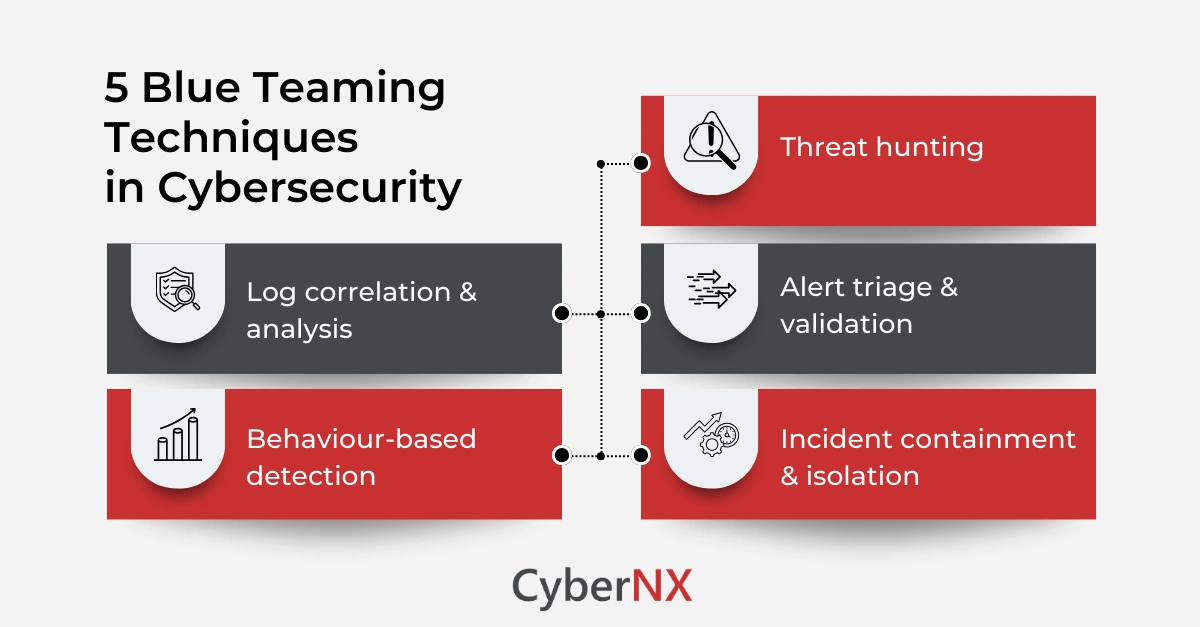
1. Threat hunting
Threat hunting is a proactive blue teaming technique. Instead of waiting for alerts, analysts actively search for signs of compromise.
This technique relies on hypotheses. For example, an attacker may be abusing service accounts. The team then looks for evidence across logs and endpoints.
Threat hunting sharpens analytical skills and improves understanding of the environment. Over time, it also improves detection rules and reduces blind spots.
2. Alert triage and validation
Not all alerts deserve the same attention. Alert triage is a blue teaming technique that helps teams assess severity, credibility and impact quickly.
It defines what signals matter, which require escalation, and which can be closed with confidence.
Without this technique, teams drown in noise. With it, they preserve focus and reduce analyst fatigue.
3. Incident containment and isolation
Containment techniques define how teams limit damage once a threat is confirmed.
This includes isolating endpoints, disabling accounts, blocking network paths and preserving evidence.
The technique matters because rushed containment can cause outages or destroy forensic data. Practised containment balances speed with control.
4. Log correlation and analysis
Modern environments generate massive volumes of logs. Log analysis techniques help teams connect events across systems to tell a coherent story.
This technique supports root cause analysis and attacker tracking. It also strengthens post-incident reviews and reporting.
5. Behaviour-based detection
Signature-based alerts have limits. Behaviour-based techniques focus on deviations from normal activity.
This includes unusual login times, abnormal data access patterns or unexpected system changes.
These techniques are especially valuable against insider threats and sophisticated attackers who avoid known indicators.
How blue teaming techniques differ from blue team scenarios
This distinction is critical and often blurred.
Blue team scenarios are simulations. They create artificial incidents to test people, processes and technology under controlled conditions.
Blue teaming techniques are methods. They define how defenders operate during both simulated and real incidents.
Think of scenarios as rehearsals. Techniques are the skills being rehearsed.
For example, a ransomware scenario may test detection and response. The underlying techniques include alert triage, lateral movement analysis and containment decision-making.
Without defined techniques, scenarios become chaotic. Teams improvise. Results vary wildly. Lessons are hard to generalise.
Strong blue teaming technique in cybersecurity gives scenarios structure and meaning.
How blue teaming techniques differ from blue team tools
Blue team tools are enablers, not techniques. SIEM platforms, EDR solutions and SOAR tools provide visibility and automation. They do not decide what to investigate or how to respond.
A blue teaming technique defines how tools are used. Two teams with the same tools can perform very differently based on technique maturity.
We often see organisations buying advanced platforms but using only basic features. The missing link is technique. Without it, tools become expensive dashboards.
By contrast, teams with strong techniques often extract more value from modest tooling.
Measuring maturity of blue teaming techniques
Maturity is not about perfection. It is about consistency. Key indicators include reduced mean time to detect, clearer escalation decisions and calmer incident handling. You should also see improved collaboration between security, IT and leadership. If outcomes improve even as threats grow more complex, your techniques are working.
Conclusion
Blue teaming technique in cybersecurity defines how defenders defend. It sits between tools and scenarios, shaping daily security operations and crisis response alike.
Without strong techniques, tools underperform and scenarios lose value. With them, teams gain clarity, confidence and control.
At CyberNX, we help organisations design and mature blue teaming techniques that fit their environment, people and risk profile. If you want your security operations to respond with intent rather than instinct, we are ready to work alongside your team.
Speak to us today to know more about our blue teaming services with proven techniques.
Blue teaming techniques FAQs
Are blue teaming techniques only for large enterprises?
No. Organisations of any size benefit from defined defensive techniques. They scale with complexity.
How long does it take to mature blue teaming techniques?
Initial techniques can be established within weeks. Maturity develops over months through practice and refinement.
Do blue teaming techniques require automation?
Automation helps, but techniques come first. Automation should support human decision-making, not replace it.
Can blue teaming techniques reduce analyst burnout?
Yes. Clear techniques reduce noise, uncertainty and stress during incidents.