This question is worth addressing today: should you move towards an autonomous SOC?
Not everyone is ready. Perhaps not every environment is the right fit. But the decision is becoming harder to defer. Attackers are moving faster than manual processes can match with some intrusions achieving lateral movement in under a minute.
The gap between what a script-based, automated SOC can handle and what the current threat environment demands is widening in real time.
That’s why this blog. Here, we try to break down what the shift from automated to autonomous involves, how to place yourself on that journey and where the decision points are.
Separating automated from autonomous
You might have heard security leaders use these terms interchangeably, but they describe fundamentally different operating models. So, what is the difference? An automated SOC runs on scripts and playbooks. It executes predefined steps when predefined conditions are met. It is fast at what it knows and completely unprepared for anything outside its rules. When an attack deviates from the playbook, which modern attacks routinely do, the automation stalls and the analyst takes over.
An autonomous SOC operates differently. Instead of executing fixed instructions, AI agents analyse context, correlate signals across multiple security tools and decide on a course of action without waiting for a human to initiate each step. The system reasons through what it is seeing, not just reacts to what it recognises.
In the current scenario, experts believe the analyst should remain in command, validating findings, making high-impact decisions and setting the boundaries within which agents operate. However, as you can see the investigative work no longer depends entirely on human availability or speed.
Scripted vs reasoning
An automated SOC cannot reason. It can match a pattern and trigger a response. An autonomous SOC, built on agentic AI, can analyse context, correlate signals across multiple tools, adapt to what it is seeing and decide on a course of action without waiting for a human to initiate each step.
Reactive vs continuous
Automation is reactive by design. It waits for a trigger. An autonomous SOC operates continuously, learning from each investigation and strengthening its threat model over time. The posture shifts from responding to incidents to anticipating how threats develop.
How security operations have evolved: quick overview
The journey from manual operations to autonomous security has moved through four distinct phases. Understanding where you sit on this timeline is the starting point for any honest evaluation.
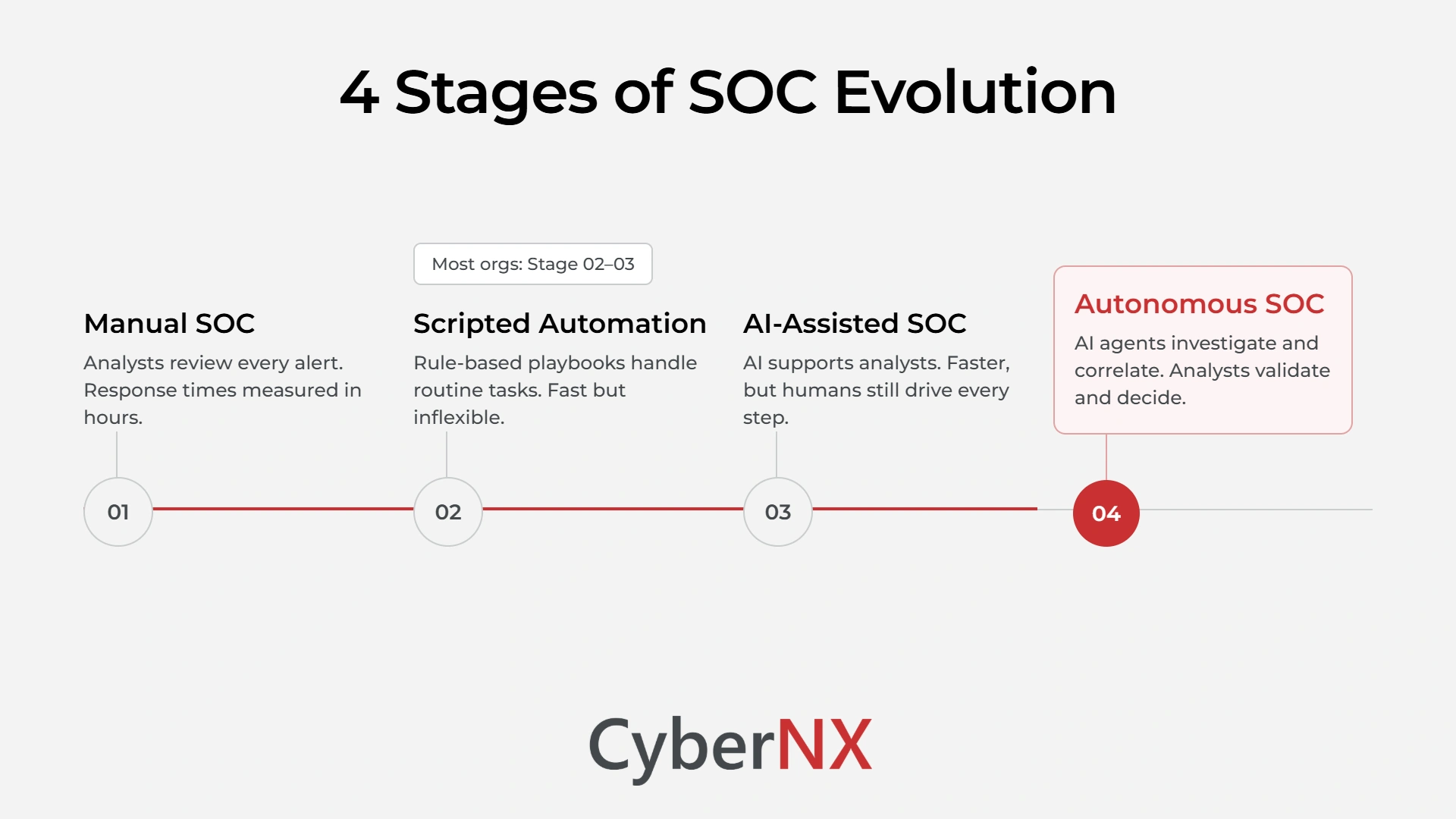
1. Stage 01 – Manual SOC
Analysts review every alert individually. High false positive rates, alert fatigue and response times measured in hours. Effective only at low alert volumes.
2. Stage 02 – Scripted automation
Rule-based playbooks handle routine, repetitive tasks – ticket creation, notifications, basic enrichment. Consistent but inflexible. Fails when conditions fall outside the script.
3. Stage 03 – AI-assisted SOC
AI supports analysts with summarisation, query generation and investigation context. Faster, but the analyst still drives every step. The investigation workload remains largely human.
4. Stage 04 – Autonomous SOC
Specialised AI agents investigate, correlate and collaborate across security tools. The analyst validates findings and makes critical decisions. AI handles the volume; humans handle the judgement.
Most organisations in 2026 are sitting at Stage 02 or early Stage 03. The gap to Stage 04 is real, but it is navigable with the right sequence.
The four-step journey to an autonomous SOC
If you are planning to boost your SOC with AI, know that moving from automated to autonomous is not a single deployment. It is a phased transition that needs to be sequenced correctly to avoid compounding existing problems.
The four steps that reflect how mature implementations actually progress:
1. Build an AI-ready data foundation
Consolidate telemetry into a unified, clean and contextual data layer. AI agents cannot reason reliably from fragmented or mislabelled data. This step is a prerequisite, not a parallel workstream.
2. Deploy agents for discrete, high-volume tasks
Start with out-of-the-box agents for alert triage, CVE analysis and incident documentation. These are the highest-volume, lowest-ambiguity tasks – the right place to build confidence before expanding agent scope.
3. Build custom agents that reflect your environment
Encode your organisation’s specific policies, escalation logic and decision models into purpose-built agents. This is where institutional knowledge becomes a durable operational asset.
4. Orchestrate a multi-agent defence
Move to a coordinated ecosystem where specialised agents collaborate – a triage agent passes findings to an investigation agent, which triggers a response agent. The SOC operates as a connected system, not a collection of individual tools.
When to use automation, AI agents and human judgement
One of the most useful frameworks for evaluating where to deploy each capability is the decision tier model. The three tiers operate together.
- Rule-based automation works best for low-impact, deterministic tasks. Notification triggers, basic enrichment and known-pattern blocking are the right scope. These tasks are predictable enough that a script handles them reliably.
- AI agents are appropriate for tasks that are repeatable but require context-dependent reasoning. Malware analysis, complex alert correlation and behavioural pattern recognition fall into this category. The agent reasons from what it sees; the human validates what the agent concludes.
- Human judgement remains essential for decisions that carry significant business consequence, require regulatory accountability or involve ambiguity that data alone cannot resolve. The autonomous SOC is designed to protect it by ensuring analysts spend their time on decisions that need them.
What this means for your SecOps team
The shift to an autonomous SOC does not reduce the importance of your security team. It changes what the team spends its time on.
Analysts move from manual triage and documentation to oversight, validation and higher-complexity investigations. The work becomes more demanding in the right ways and the burnout driven by repetitive, high-volume alert queues is significantly reduced.
The technology is one component. The data foundation, governance framework and team capability that surrounds it determines whether the investment compounds or stalls.
Conclusion
The transition from an automated SOC to an autonomous SOC is a sequenced journey with clear steps and genuine checkpoints along the way. Understanding where your operations currently sit, what the next step looks like and what needs to be in place before agents can function reliably is the work that separates a successful transition from a costly one.
CyberNX’s AI Managed SOC is built on this operating model, combining AI-driven investigation with analyst oversight and governance frameworks suited to regulated Indian enterprises. If your team is evaluating what the path to an autonomous SOC looks like for your environment, our team is glad to walk through it with you. Talk to our SOC experts.
Automated SOC to Autonomous SOC FAQs
Is an autonomous SOC the same as an unmanned SOC?
No. Autonomous refers to how investigations are conducted, not whether humans are present. In an autonomous SOC, AI agents handle the volume and repetition of security investigations while analysts remain responsible for validation, high-impact decisions and governance.
Does moving to an autonomous SOC mean replacing our existing security tools?
Not necessarily. Most mature agentic SOC implementations are designed to operate as a layer on top of your existing SIEM, EDR and XDR stack. The agents connect to what you already have and correlate across it. The decision to replace individual tools is separate from the decision to adopt an agentic operating model.
How long does the transition from an automated to an autonomous SOC typically take?
It depends on the state of your data foundation more than anything else. Organisations with clean, well-labelled telemetry can deploy initial agents and see measurable results within weeks. Those starting with fragmented data sources will spend more time on the foundation before agents can function reliably. There is no standard timeline.
Is an autonomous SOC only relevant for large enterprises?
The operational pressure driving autonomous SOC adoption includes alert volume, analyst shortage, attacker speed which are not exclusive to large organisations. Mid-size enterprises and regulated entities in sectors like BFSI and healthcare face the same gap with fewer resources to close it manually. In many cases, the business case for an autonomous model is stronger for leaner security teams, not weaker.