Choose Language
Google Translate
Skip to content
Facebook X-twitter Instagram Linkedin Youtube
  • sales@cybernx.com
  • +91 90823 52813
CyberNX Logo
  • Home
  • About
    • About Us
    • CERT-In Empanelled Cybersecurity Auditor
    • Awards & Recognition
    • Our Customers
  • Services

    Peregrine

    • Managed Detection & Response
    • AI Managed SOC Services
    • Elastic Stack Consulting
    • CrowdStrike Consulting 
    • Threat Hunting Services
    • Digital Risk Protection Services
    • Threat Intelligence Services
    • Digital Forensics Services
    • Brand Risk & Dark Web Monitoring
    • Full Stack Observability

    Pinpoint

    • Red Teaming Services
    • Vulnerability Assessment
    • Penetration Testing Services
    • Secure Code Review Services
    • Cloud Security Assessment
    • Phishing Simulation Services
    • Breach and Attack Simulation Services

    nCompass

    • Cybersecurity Audit Services
    • Virtual CISO Services
    • DPDP Act Consulting
    • ISO 27001 Consulting
    • RBI Master Direction Compliance
    • SEBI CSCRF Framework Consulting
    • SEBI Cloud Framework Consulting
    • Security Awareness Training
    • Cybersecurity Staffing Services

    NXRadar

    • SBOM Solutions
    • CBOM Solutions
    • AIBOM Solutions
  • Industries
    • Banking
    • Financial Services
    • Insurance
  • Resources
    Blogs
    Case Studies
    Downloads
    Whitepapers
    Buyer’s Guide
    Research & Guides
    Data Sheets
  • Careers
  • English (US)
    • English
Contact Us
CyberNX Logo
  • English (US)
    • English
  • Home
  • About
    • About Us
    • CERT-In Empanelled Cybersecurity Auditor
    • Awards & Recognition
    • Our Customers
  • Services

    Peregrine

    • Managed Detection & Response
    • AI Managed SOC Services
    • Elastic Stack Consulting
    • CrowdStrike Consulting
    • Threat Hunting Services
    • Digital Risk Protection Services
    • Threat Intelligence Services
    • Digital Forensics Services
    • Brand Risk & Dark Web Monitoring
    • Full Stack Observability

    Pinpoint

    • Red Teaming Services
    • Vulnerability Assessment
    • Penetration Testing Services 
    • Secure Code Review Services
    • Cloud Security Assessment
    • Phishing Simulation Services
    • Breach and Attack Simulation Services

    nCompass

    • Cybersecurity Audit Services
    • Virtual CISO Services
    • DPDP Act Consulting
    • ISO 27001 Consulting
    • RBI Master Direction Compliance
    • SEBI CSCRF Framework Consulting
    • SEBI Cloud Framework Consulting
    • Security Awareness Training
    • Cybersecurity Staffing Services

    NXRadar

    • SBOM Solutions
    • CBOM Solutions
    • AIBOM Solutions
  • Industries
    • Banking
    • Financial Services
    • Insurance
  • Resources
    Blogs
    Case Studies
    Downloads
    Whitepapers
    Buyer’s Guide
    Research & Guides
    Data Sheets
  • Careers
  • Contact

AIBOM Tools Guide: Building Visibility into Your AI Supply Chain

3 min read
17 Views
  • AIBOM

Ask five teams in an organisation which AI models they run, and five different answers would usually come back. Marketing runs one copilot. Engineering fine tunes another. A vendor’s chatbot plugs straight into the CRM with a model nobody outside that vendor has inspected. Each one is a working part of the business, and still, they usually do not sit in a single list anywhere.

That gap is exactly what AIBOM tools are built to close. An AI Bill of Materials brings the same discipline that SBOM brought to software – applied instead to models, datasets and dependencies. This guide covers what these tools do, why Indian companies need them now and what to check before choosing one.

Table of Contents

What are AIBOM tools

They generate and maintain an AI Bill of Materials which is basically a structured inventory of every part inside an AI system. This includes the model itself, its version, the datasets used to train or fine tune it, software dependencies and the infrastructure it runs on.

A standard Software Bill of Materials (SBOM) tracks code libraries and packages. An AIBOM extends this idea to AI specific components, since a model’s behaviour depends on training data and weights as much as on code. Most firms build on existing SBOM tooling and add AI specific fields instead of starting from scratch.

Why AIBOM tools matter for Indian enterprises now

RBI’s draft Guidance on Regulatory Principles for Model Risk Management, 2026 requires every regulated entity – including banks, NBFCs and payment banks – to maintain a board approved model risk management framework. This framework should cover every AI and ML model in use, whether built in-house or sourced from a vendor. Entities remain accountable for vendor models too, so a usable model inventory becomes key to compliance.

SEBI’s Advisory on Emerging Advanced AI Tools for Vulnerability Detection, issued in May 2026, pushes regulated entities toward AI tool inventories and closer tracking of AI based systems used in security operations.

Neither directive names AIBOM directly, but both describe the same underlying need, a current and auditable record of every AI model in production. AIBOM tools are the practical way to produce and maintain that record without manual tracking.

Types of AIBOM tools

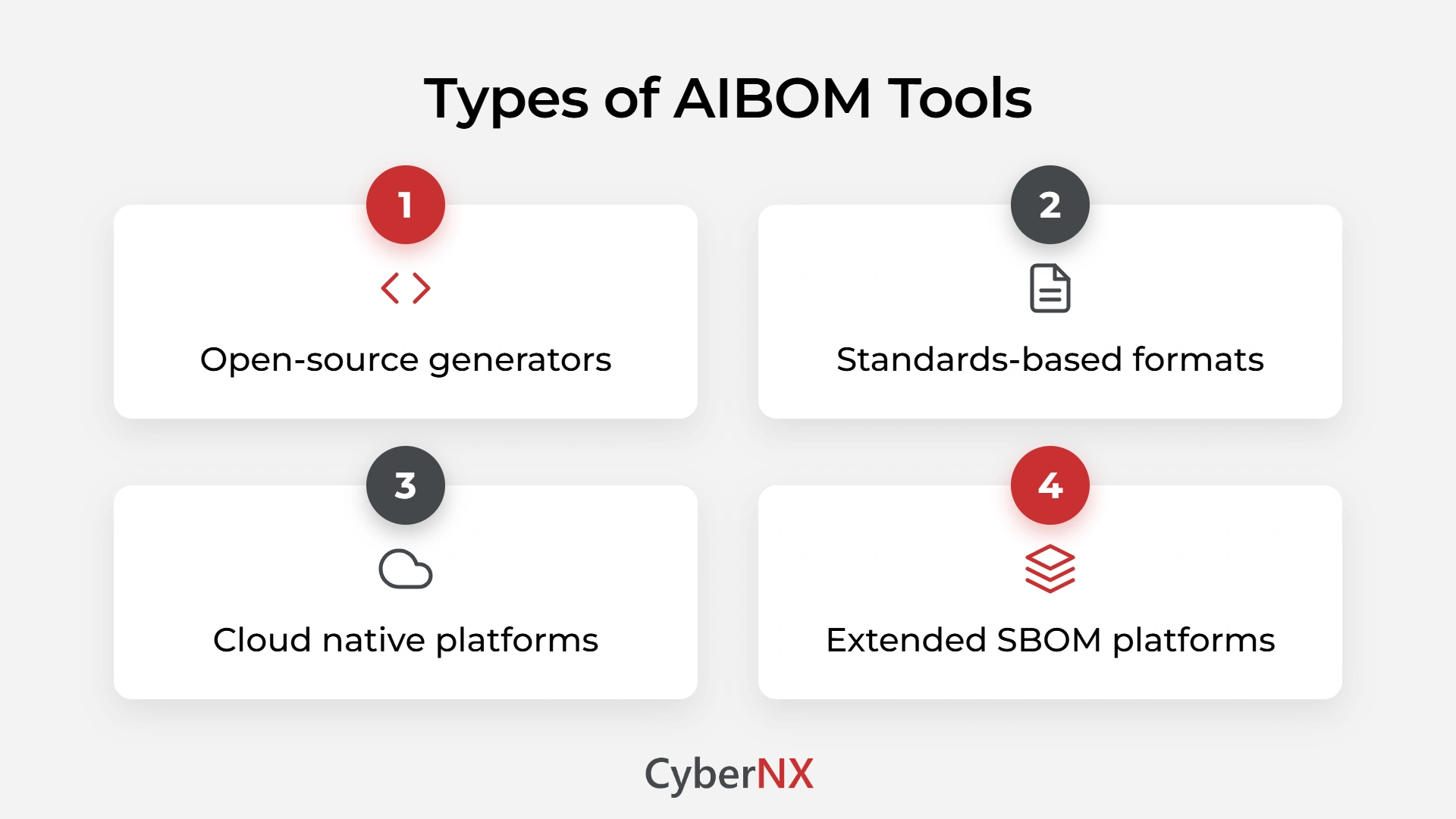
These tools generally fall into four categories, each suited to different stages of AI maturity.
Types of AIBOM Tools

  • Open-source generators: Tools like the OWASP AIBOM Generator and cdxgen scan models, often ones hosted on Hugging Face, and produce a structured AIBOM automatically.
  • Standards-based formats: CycloneDX ML-BOM and the SPDX AI Profile define the fields an AIBOM should contain, so outputs stay inter-operable across tools and vendors.
  • Cloud native platforms: Broader cloud security platforms are adding AIBOM generation along with existing asset discovery, useful for firms tracking AI across multiple cloud environments.
  • Extended SBOM platforms: Many teams add AI specific fields to their existing SBOM tooling instead of adopting a separate AIBOM system.

What to look for before choosing an AIBOM tool

A few checks help narrow the list of options.

  • Coverage of vendor models: The tool should track third party and vendor sourced models, not just models built internally.
  • Continuous updates: Static, one-time snapshots can quickly become outdated, since models get retrained and fine-tuned often.
  • Regulatory alignment: Look for output formats and fields that map to RBI, SEBI and CERT-In documentation expectations.
  • Integration with existing SBOM tooling: A platform that plugs into an existing software supply chain security setup reduces duplicate work.

Conclusion

AI systems are becoming as embedded in enterprise workflows as any other software component, and the visibility gap around them is becoming a compliance gap too. AIBOM tools give security and compliance teams an organised way to track every model and dependency in use, including the ones sourced from vendors.

As RBI and SEBI move toward formal AI governance expectations, a working AI Bill of Materials is a practical starting point. We can help you bring that visibility to your bills of material through our AIBOM solutions – that gives teams one audit ready record for RBI, SEBI and CERT-In requirements. Connect with our experts to know more.

AIBOM Tools FAQs

What is an AIBOM tool?

It generates and maintains a structured inventory of the models, datasets and dependencies inside an AI system, similar to how SBOM tools track software components.

How is an AIBOM different from an SBOM?

An SBOM tracks code libraries and packages. An AIBOM extends this to AI specific elements such as model versions, training data and model weights, since AI behaviour depends on data as much as code.

Do Indian regulators require an AIBOM?

No regulator names AIBOM directly yet. RBI’s draft Model Risk Management guidance and SEBI’s AI advisory both call for model and AI tool inventories, which this tooling category helps maintain.

Can these tools cover third party AI models?

Yes. Many are built specifically to document vendor sourced models, since regulated entities remain accountable for these models under frameworks like RBI’s draft guidance.

Gopakumar Panicker

Author
Gopakumar Panicker
LinkedIn

An accomplished security professional with extensive experience in Digital Security, Cloud Security, Cloud Architecture, Security Operations, and BFSI Compliance, Gopa has contributed to designing and strengthening enterprise-grade security environments, ensuring alignment with both technical and regulatory requirements. His work focuses on building resilient, scalable architectures and guiding organisations in elevating their operational maturity while meeting the stringent expectations of modern BFSI and cloud-driven ecosystems.

Share on

WhatsApp
LinkedIn
Facebook
X
Pinterest

For Customized Plans Tailored to Your Needs, Get in Touch Today!

Connect with us

RESOURCES

Related Blogs

Explore our resources section for insightful blogs, articles, infographics and case studies, covering everything in Cyber Security.
AIBOM Audit: What Regulators and Auditors Actually Check For

AIBOM Audit: What regulators and auditors will actually ask for

In Aug 2025, the RBI’s FREE-AI Committee recommended that regulated entities should maintain a proper inventory of AI models, use

AIBOM vs SBOM: Find Key Differences Between the Two

AIBOM vs SBOM: What Changes When Code Meets Data

Is Software Bill of Materials enough for visibility into AI tools? The answer is no. SBOM reveals what code is

AIBOM vs CBOM: Which Should You Build First?

Which BOM First? A Decision Framework for AIBOM vs CBOM Prioritisation

AIBOM vs CBOM is not a maturity contest. It is a sequencing decision, and the right sequence depends heavily on

RESOURCES

Cyber Security Knowledge Hub

Explore our resources section for insightful blogs, articles, infographics and case studies, covering everything in Cyber Security.

BLOGS

Stay informed with the latest cybersecurity trends, insights, and expert tips to keep your organization protected.

CASE STUDIES

Explore real-world examples of how CyberNX has successfully defended businesses and delivered measurable security improvements.

DOWNLOADS

Learn about our wide range of cybersecurity solutions designed to safeguard your business against evolving threats.
CyberNX Footer Logo
Book a Free Call

Peregrine

  • Managed Detection & Response
  • AI Managed SOC Services
  • Elastic Stack Consulting
  • CrowdStrike Consulting
  • Threat Hunting Services
  • Digital Risk Protection Services
  • Threat Intelligence Services
  • Digital Forensics Services
  • Brand Risk & Dark Web Monitoring
  • Full Stack Observability

Pinpoint

  • Red Teaming Services
  • Vulnerability Assessment
  • Penetration Testing Services
  • Secure Code Review Services
  • Cloud Security Assessment
  • Phishing Simulation Services
  • Breach and Attack Simulation Services

nCompass

  • Cybersecurity Audit Services
  • Virtual CISO Services
  • DPDP Act Consulting
  • ISO 27001 Consulting
  • RBI Master Direction Compliance
  • SEBI CSCRF Framework Consulting
  • SEBI Cloud Framework Consulting
  • Security Awareness Training
  • Cybersecurity Staffing Services

NXRadar

  • SBOM Solutions
  • CBOM Solutions
  • AIBOM Solutions
  • About
  • CERT-In
  • Awards
  • Careers
  • Sitemap
Facebook Twitter Instagram Youtube

Copyright © 2026 CyberNX | All Rights Reserved | Terms and Conditions | Privacy Policy

  • English (US)
    • English
Copyright © 2026 CyberNX | All Rights Reserved | Terms and Conditions | Privacy Policy
Scroll to Top

WhatsApp us

Not Sure Where to Start with Cybersecurity?

We value your privacy. Your personal information is collected and used only for legitimate business purposes in accordance with our Privacy Policy.