Picture a fintech application that passed its code review last quarter. Weeks after launch, an attacker changes one ID in an API call. Thousands of customer loan records are suddenly exposed.
The code was reviewed, but the review followed no defined method. Nobody mapped the attack paths or examined authorisation logic in depth. That gap turns a routine release into a regulatory incident and lost customer trust.
A clear secure code review methodology closes this gap before release. This article will be discussing about each phase with a real-world example.
Let’s begin.
What a secure code review methodology defines
A secure code review methodology is a repeatable framework for examining source code for security weaknesses. It defines what gets reviewed, in what order and against which standards. It also sets how findings are rated, reported and verified.
Why ad hoc reviews miss critical issues
Without a defined method, reviewers tend to follow personal habits and familiar patterns. Coverage then depends on who reviews the code, not on actual risk. A payment module may receive the same attention as a user interface update. Results also become hard to compare across releases or present to auditors.
Industry standards for secure code review
A mature secure code review methodology should follow recognised security standards and coding practices. These frameworks provide a foundation for identifying, classifying, and addressing code-level weaknesses.
| Framework | How it supports secure code review |
| NIST SP 800-218 (SSDF) | Integrates code review into secure software development practices. |
| MITRE Common Weakness Enumeration (CWE) | Provides a standard classification system for identifying and documenting software weaknesses. |
| CERT Secure Coding Standards | Provides language-specific coding guidelines to prevent common security vulnerabilities. |
| ISO/IEC 27034 | Provides guidance for integrating application security into the software development lifecycle. |
Secure code review methodology in detail
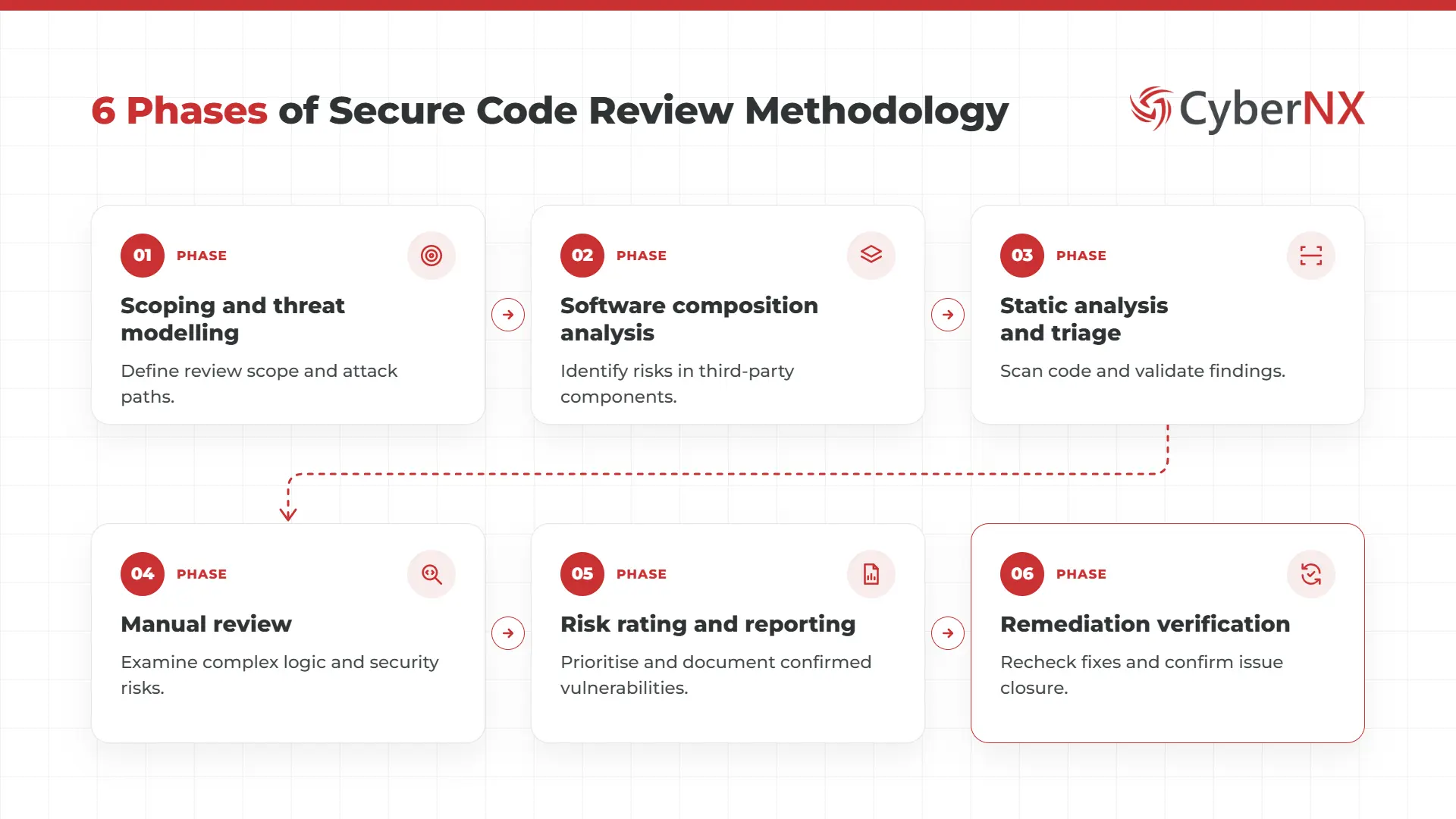
Secure code review methodology moves through six connected phases below:
Preparing the groundwork: Phases one to three
The first three phases build context and clear routine issues before deep manual work begins.
Scoping and threat modelling
Every review begins by mapping the application’s architecture, data flows and trust boundaries. Reviewers catalogue each externally reachable entry point, from API routes to file parsers. The STRIDE threat model then ranks the most likely attack paths. It covers spoofing, tampering, repudiation, information disclosure, denial of service and elevation of privilege.
Software composition analysis
Modern applications rely heavily on open-source libraries and frameworks. Software Composition Analysis (SCA) lists every component, version and licence in the codebase. This matters because open-source risk is rising fast. Black Duck’s 2026 Open Source Security and Risk Analysis studied commercial codebases across industries. It found each codebase contains 581 known open-source vulnerabilities on average. That figure is more than double the previous year’s average. Reviewers then confirm which flagged components the code actually calls.
Static analysis and triage
Static Application Security Testing (SAST) tools then scan the full codebase for known vulnerability patterns. Common detections include SQL injection, hardcoded credentials and unsafe deserialisation. Analysts triage every result to remove false positives before reporting.

Deep analysis and closure: phases four to six
The final three phases are where experienced reviewers add the most value.
Manual review of high-risk code paths
Reviewers trace untrusted input from each entry point to sensitive operations. These include database queries, file writes, command execution and output rendering. They also examine authorisation logic closely, because tools rarely understand intended access.
Bug bounty data from HackerOne’s 2025 Hacker-Powered Security Report confirms attackers target this gap. It recorded a 29% annual rise in valid Insecure Direct Object Reference (IDOR) reports. Improper access control reports grew 18% over the same period.
Risk rating and reporting
Each confirmed issue is mapped to a CWE identifier for consistent classification. Severity reflects real exploitability and business impact, not just tool scores. Every finding includes the affected file, a proof of concept and clear fix guidance.
Remediation verification
A methodology remains incomplete until every fix is confirmed. After remediation, reviewers re-examine the changed code to ensure each fix holds. This step also confirms the fix has not introduced a new weakness elsewhere.
Secure code review methodology example: Reviewing a loan application API
Let us apply the methodology to an illustrative engagement. A Non-Banking Financial Company (NBFC) is launching a new loan application API. It runs on Java Spring Boot and connects to a customer database.
Scoping: Threat modelling flags the loan status endpoint and document upload route as high risk. Both handle sensitive financial and identity data from untrusted users.
Composition analysis: The SCA phase reveals an outdated JSON parsing library with a known deserialisation vulnerability. The vulnerable function is reachable through the loan submission endpoint.
Static analysis: SAST flags a reporting query built through string concatenation. Triage confirms user input reaches it, creating a genuine SQL injection risk. It also dismisses several alerts in test code that never reaches production.
Manual review: Reviewer then examines the GET /loans/{loanId} endpoint closely. The code confirms the user is logged in but never validates loan ownership. Any authenticated customer could view another applicant’s income and Permanent Account Number details. No scanner flagged this IDOR, because the code looked syntactically safe.
Reporting and verification: All three findings are rated, mapped to CWE and reported with fixes. After remediation, re-review confirms ownership validation now runs on every request.
Common mistakes that weaken your methodology
Even well-intentioned teams weaken their methodology through a few recurring mistakes. Watch for these patterns in your own review process:
- Skipping threat modelling: Reviewers then spread effort evenly instead of focusing on high-risk paths.
- Treating SAST output as the final report: Unvalidated results bury genuine risk under false positives.
- Reviewing oversized changes in one pass: Attention and accuracy decline when analysts face thousands of changed lines at once.
- Ignoring configuration files: Misconfigured Cross-Origin Resource Sharing (CORS) policies often sit outside application logic.
- Closing findings without a retest: A partial fix can leave the original attack path open.
A methodology only delivers results when every phase receives the same discipline.
Conclusion
A good secure code review methodology gives every review a clear direction. Scoping tells reviewers where to focus their effort, while SCA and SAST then find known vulnerabilities quickly across the codebase. After that, manual review uncovers logic gaps that tools cannot see. Finally, verification makes sure every fix works as intended.
When one of these phases is missed, serious risks can slip through. The IDOR in our loan API example shows exactly how this happens.
Our Secure Code Review service follows all six phases in every engagement. Our CERT-In empanelled experts review web, mobile and API code in depth. You get clear findings and practical fixes that your developers can apply easily.
Planning a new release? Book a secure code review with us before it goes live.
Secure code review methodology FAQs
How often should a full methodology-based review run?
Run a full review before every major release and at least once a year. Lighter, risk-based reviews can then cover routine pull requests in between.
Does the methodology change for microservices or mobile apps?
The six phases stay the same, but the focus areas shift. Microservices reviews pay close attention to service-to-service authentication and API gateway configuration. Mobile reviews examine local data storage, certificate pinning and keys embedded in app binaries. Threat modelling also adapts to the trust boundaries of each architecture.
What documentation should a review produce for auditors?
Auditors typically expect a defined scope, the methodology followed and a dated findings report. Retest evidence showing closed findings strengthens your audit position considerably.
Can AI tools take over parts of the methodology?
AI tools can speed up triage and pattern detection. However, business logic and authorisation decisions still need experienced human judgement.