Applications can expose security weaknesses even after passing initial security checks. The only way to find them is to test it the way an attacker would. That is where Dynamic Application Security Testing (DAST) comes in. It tests your running application and shows you what is exploitable before someone else finds it.
At CyberNX, our hands-on experience with application security testing tools helps us assess their practical capabilities. In this review, we evaluate ten DAST tools, comparing their key strengths, limitations, and suitability for different security requirements.
This guide compares these tools to help you identify the right fit for your environment. Let’s first understand about DAST tools in short.
What are DAST tools and why are they important?
DAST tools test running applications by sending requests and examining their responses. Unlike source code analysis, this approach does not require direct access to application code. It helps identify vulnerabilities that become visible during actual application execution.
You can use these tools to detect security weaknesses such as:
- SQL injection: Identifies inputs that may allow unauthorised database queries.
- Cross-site scripting (XSS): Detects opportunities to execute malicious scripts through application inputs.
- Authentication weaknesses: Examines login processes, session handling, and access control behaviour.
- Security misconfigurations: Highlights exposed information, unsafe responses, and potentially insecure configurations.
- API vulnerabilities: Tests application interfaces for weaknesses affecting data access and functionality.
DAST testing tools also supports continuous security assessments throughout the software development lifecycle. Teams can scan applications after significant changes and retest them before releases. This makes runtime testing an important part of a broader application security programme.
How we assessed the top DAST tools
Choosing the right DAST solution involves more than comparing features. We considered several practical factors to understand how each tool supports application security testing. These criteria help explain the strengths, limitations, and suitability of the ten solutions reviewed below.
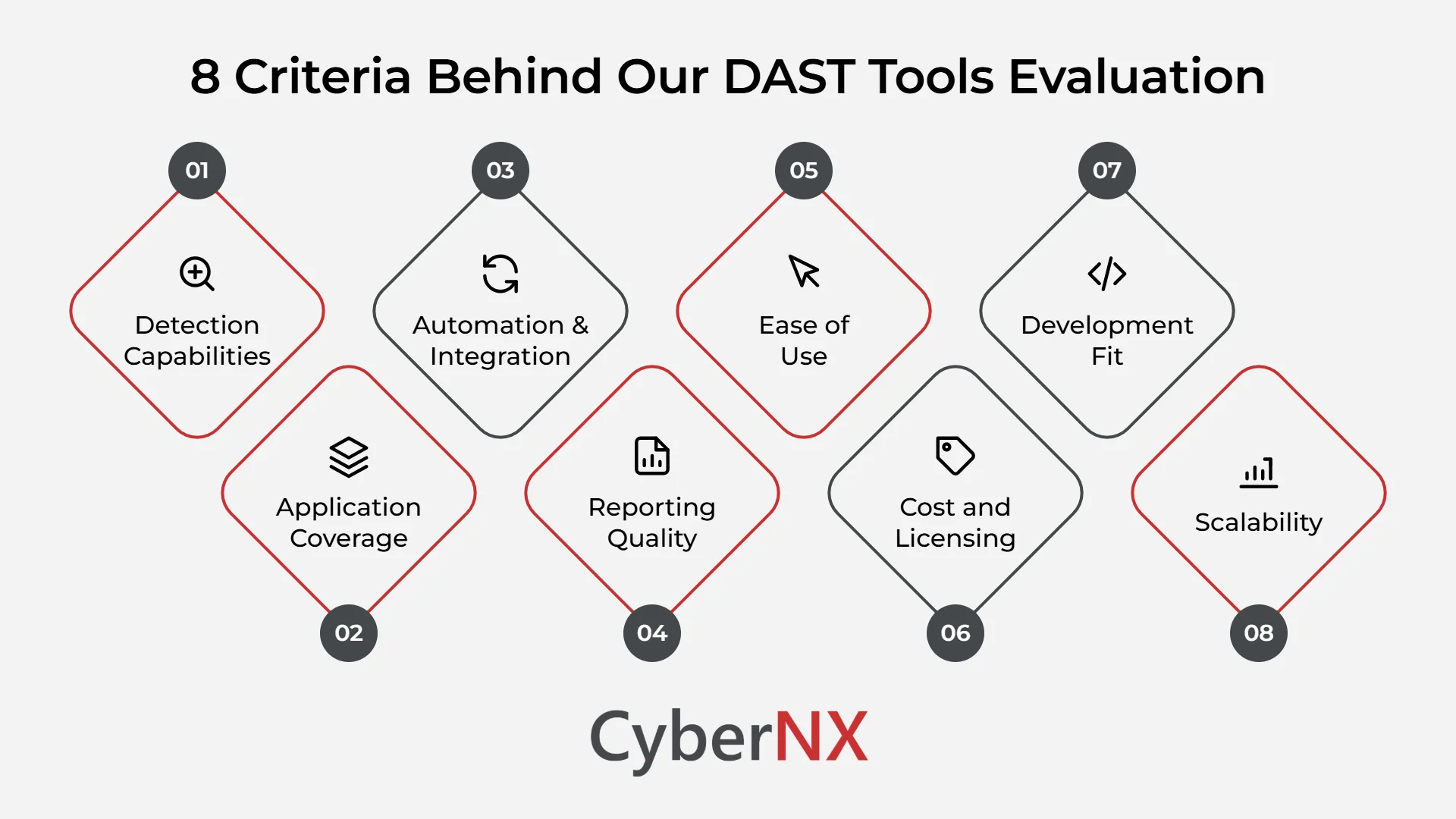
- Detection capabilities: Coverage of common application vulnerabilities.
- Application coverage: Web applications, APIs, and authentication.
- Automation and integration: Repeatable scans and development workflows.
- Reporting quality: Evidence, finding validation, and remediation guidance.
- Ease of use: Configuration and investigation effort.
- Cost and licensing: Licensing, accessibility, and operating costs.
- Development fit: Compatibility with existing security processes.
- Scalability: Support for growing application environments.
Top 10 DAST tools to consider in 2026
The following DAST tools cover open-source testing, specialist assessments, and enterprise security programmes.
1. Checkmarx DAST
Checkmarx DAST suits organisations seeking dynamic testing within a broader application security platform. It supports web applications and APIs, including complex authentication requirements. Its integrations can help teams incorporate scanning into development workflows.
Best suited for: Enterprise application security programmes requiring integrated testing and centralised visibility.
2. OWASP ZAP
OWASP ZAP is one of the popular DAST open-source tools for web application security testing. It offers automated scanners, proxy-based testing, and tools for manual investigation. Its extensibility also makes it useful for custom testing workflows.
Best suited for: Teams seeking a flexible, cost-effective starting point for DAST.
3. Burp Suite
Burp Suite provides web security testing capabilities for both automated scanning and manual assessments. Its scanner maps application content and tests discovered endpoints. Security professionals can also inspect requests and investigate suspicious application behaviour.
Best suited for: Security testers who need detailed control over web application assessments.
4. Invicti
Invicti focuses on automated testing across web applications and APIs. Its proof-based scanning approach helps validate certain findings with technical evidence. This can reduce time spent investigating false positives.
Best suited for: Organisations prioritising vulnerability validation and scalable application scanning.
5. Veracode Dynamic Analysis
Veracode Dynamic Analysis provides cloud-based testing for running web applications. It can support teams seeking repeatable assessments within a wider application security programme. Its suitability depends on required coverage, integrations, and reporting needs.
Best suited for: Organisations looking to incorporate dynamic testing into an established application security workflow.
6. StackHawk
StackHawk DAST tool focuses on developer-oriented security testing for applications and APIs. Its workflow supports automated scans within CI/CD pipelines. This approach helps development teams identify vulnerabilities during frequent software releases.
Best suited for: Development teams prioritising automated testing and rapid feedback.
7. Acunetix
Acunetix offers automated web application vulnerability scanning. It helps identify common weaknesses across websites and web applications. Teams should assess its coverage against their specific application frameworks and authentication flows.
Best suited for: Organisations seeking dedicated web vulnerability scanning capabilities.
8. HCL AppScan
HCL AppScan provides application security testing capabilities across multiple testing approaches. Its broader portfolio can help organisations manage security assessments across varied application environments. Evaluate the features available within the specific edition being considered.
Best suited for: Organisations requiring application security testing across diverse technology environments.
9. Rapid7 InsightAppSec
Rapid7 InsightAppSec is another DAST tool that focuses on automated dynamic application security testing. It supports recurring assessments and vulnerability management workflows. Its integration requirements and scanning coverage should be evaluated against existing security operations.
Best suited for: Teams seeking repeatable application assessments and structured vulnerability management.
10. Qualys Web Application Scanning
Qualys Web Application Scanning provides automated testing for web application vulnerabilities. It can suit organisations already using the Qualys platform for broader security management. Consider application coverage, authentication support, and reporting requirements before selecting it.
Best suited for: Organisations looking to align web application scanning with wider security management.
Note: Features, licensing, and supported integrations vary by product and edition. Confirm current capabilities directly with each vendor before making a purchasing decision.
Comparing DAST Tools
| DAST tool | Type | Deployment model | Automated scanning | API testing | Authentication support | CI/CD integration |
| Checkmarx DAST | Commercial | Cloud | ✓ | ✓ | ✓ | ✓ |
| OWASP ZAP | Open source | Self-hosted | ✓ | ✓ | ✓ | ✓ |
| Burp Suite | Commercial, with free edition | Desktop / enterprise | Depends on edition | ✓ | ✓ | Depends on edition |
| Invicti | Commercial | Cloud / on-premises | ✓ | ✓ | ✓ | ✓ |
| Veracode Dynamic Analysis | Commercial | Cloud | ✓ | ✓ | ✓ | ✓ |
| StackHawk | Commercial, with free options | Cloud / local agent | ✓ | ✓ | ✓ | ✓ |
| Acunetix | Commercial, with limited free options | Cloud / on-premises | ✓ | ✓ | ✓ | ✓ |
| HCL AppScan | Commercial, with free options | Cloud / on-premises | ✓ | ✓ | ✓ | ✓ |
| Rapid7 InsightAppSec | Commercial | Cloud | ✓ | ✓ | ✓ | ✓ |
| Qualys Web Application Scanning | Commercial | Cloud | ✓ | ✓ | ✓ | ✓ |
How to choose the right DAST tools
Selecting a scanner involves more than comparing vulnerability counts or licence prices. The solution must test your applications accurately and fit your operational requirements. Assess these factors before shortlisting DAST tools.
Application and API coverage
Check support for your web frameworks, REST APIs, GraphQL endpoints, and single-page applications. Confirm that the scanner can execute JavaScript and discover dynamic routes where necessary.
Authentication and scan accuracy
Applications often restrict sensitive functionality behind login screens. Choose a solution that supports your authentication methods and relevant user roles. Also, examine how it validates findings and manages false positives.
Automation and integration
Consider whether the tool integrates with your CI/CD pipelines and issue-tracking systems. Automated scans and retesting can help teams identify regressions without adding unnecessary manual effort.
Reporting and scalability
Look for clear vulnerability evidence, remediation guidance, and risk-based prioritisation. Larger environments may also require concurrent scans, centralised reporting, and flexible deployment options.
Cost and operational effort
Open-source scanners can reduce licensing expenses but require configuration and technical expertise. Commercial platforms may offer additional automation, support, and enterprise management features. Compare total operating costs rather than licensing alone.
Are open-source DAST tools enough?
Open-source options can provide valuable security testing without commercial licensing costs. OWASP ZAP is a strong starting point for teams developing automated scanning capabilities. However, effective implementation still requires configuration, interpretation, and ongoing maintenance.
Commercial solutions may suit organisations needing centralised governance, managed integrations, or scalable scanning. The choice ultimately depends on application complexity and available expertise. Neither approach replaces comprehensive security testing or expert assessment.
DAST vs SAST: Do you need both?
DAST and Static Application Security Testing (SAST) examine different aspects of application security. SAST tools analyses source code to identify potentially vulnerable coding patterns. DAST tests running applications to discover weaknesses exposed during execution.
Using both approaches provides broader coverage across the development lifecycle. SAST helps developers address issues early, while DAST validates runtime behaviour. Neither method identifies every vulnerability, so penetration testing can provide additional assurance.
Conclusion
Choosing the right DAST tool helps you identify vulnerabilities in running applications, but it is only one part of application security. Combining dynamic testing with other security practices can help address weaknesses throughout the development lifecycle.
At CyberNX, we provide Secure Code Review services to help organisations identify vulnerabilities in application code and strengthen application security. When combined with DAST, secure code reviews can provide a broader view of potential risks, from weaknesses in source code to vulnerabilities exposed during application runtime.
Looking to strengthen your application security approach? Connect with CyberNX to learn how our Secure Code Review services can help you identify and address security gaps.
DAST tools FAQs
What are DAST tools used for?
DAST tools test running applications to identify exploitable security weaknesses. They simulate attacks and analyse application responses. This helps security teams discover vulnerabilities before attackers can exploit them.
Which DAST tools are open source?
OWASP ZAP is a widely used open-source DAST tool. It supports automated scanning, manual testing, and custom workflows. Its effectiveness depends on configuration, application coverage, and the team’s technical expertise.
What is the difference between DAST and SAST?
SAST examines source code for potentially vulnerable patterns without running the application. DAST tests a running application from an external perspective. Using both approaches provides complementary coverage across application development and deployment.
Can DAST tools test APIs?
Yes, many DAST tools support API security testing. However, supported protocols, authentication methods, and endpoint discovery capabilities vary. Check compatibility with your REST, GraphQL, or other required API technologies.
How often should organisations run DAST scans?
Run scans after significant application changes and before important releases. Critical applications may also benefit from scheduled testing and CI/CD integration. Frequency should reflect application risk, release speed, and operational requirements.
Can DAST tools replace penetration testing?
No, DAST tools cannot replace every penetration testing activity. Automated scanners identify many known weaknesses, but complex business logic flaws may require expert investigation. Combining automated scanning with targeted penetration testing offers broader assurance.