Imagine two cricket teams – One is practising batting drills in one corner of the ground. The other is running bowling drills in the opposite corner. Both are working hard, but they are never actually playing against each other – so neither really knows how they will team up in a real match.
A lot of firm security works exactly like this. The red team runs attack simulations, writes a detailed report and hands it over. The blue team reads it and goes back to monitoring dashboards. Later, when a real attacker walks in using the exact technique from that report, the alert may or may not fire. But nobody is sure, because the two teams never actually tested it together.
This is the problem that the purple teaming methodology solves. It brings both the teams onto the same ground, at the same time, to test attacks and defences together – in real time and with immediate feedback.
For Indian companies, especially those regulated by SEBI’s Cybersecurity and Cyber Resilience Framework (CSCRF) or CERT-In guidelines, this kind of structured, collaborative testing is becoming a very important practice. This guide walks you through what purple teaming involves, how each step works and what your security team needs to get started.
What is purple teaming?
Purple teaming is a collaborative approach where red teams (offensive, attack simulation) and blue teams (defensive, detection and response) work together in real time. Instead of a red team running attacks in secrecy and handing over a report weeks later, both teams are in the same room, sharing findings as they happen.
The name is a blend: red plus blue makes purple. What makes it different from a standard penetration test is the feedback loop. Purple teaming focuses on knowledge transfer – defenders understand how each attack was carried out, not just that it happened.
Red team vs blue team vs purple team
Here’s how the three functions differ:
- Red team: simulates attackers, goal is stealth and finding weaknesses
- Blue team: defends systems, monitors, detects and responds to threats
- Purple team: bridges the two – real-time collaboration, shared objectives and faster improvement
How the purple teaming methodology works
This is where the value gets delivered. A well-run purple teaming exercise follows a structured cycle.
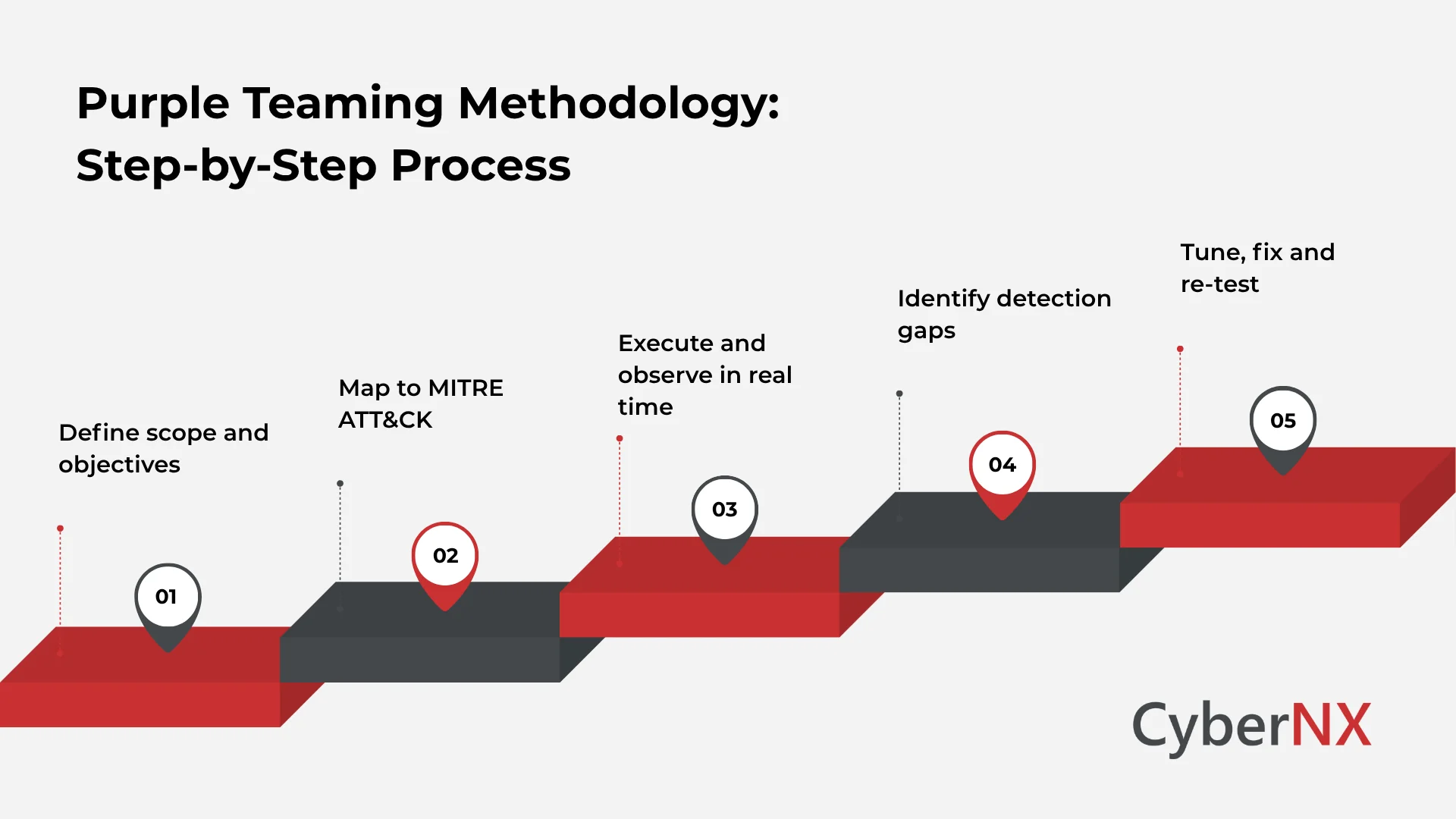
1. Define scope and objectives
Start by agreeing on what you’re testing. Which systems, applications or attack surfaces are in scope? Which threat actors are relevant to your industry? For BFSI organisations in India, this usually includes DDoS scenarios, credential-based attacks and application-layer threats – all referenced scenarios under the SEBI CSCRF framework.
2. Map to MITRE ATT&CK
Select the tactics, techniques and procedures (TTPs) your exercise will simulate. The MITRE ATT&CK framework is the industry-standard taxonomy for this. It provides a shared language so both red and blue teams know exactly what’s being tested and what a successful detection looks like.
3. Execute and observe in real time
The red team runs the selected technique while the blue team monitors their detection tools – SIEM, EDR, logs – simultaneously. A-LIGN’s purple teaming framework describes this step as the point where blue teams share screens to review alerts and forensic artefacts as the attack runs.
4. Identify detection gaps
Did the SIEM alert fire? Did the right analyst see it? Did the playbook hold up? Every TTP that runs without triggering a detection is a documented gap – not a failure to be embarrassed by, but a finding to act on immediately.
5. Tune, fix and re-test
Detection rules are updated. Playbooks are adjusted. The same technique is run again to confirm the fix holds. This test-fix-verify loop is what separates purple teaming from traditional red team engagements where gaps sit in a report indefinitely.
Why purple teaming matters for Indian enterprises
Regulatory pressure is one reason. Under SEBI CSCRF (circular SEBI/HO/ITD-1/ITD_CSC_EXT/P/CIR/2024/113), MIIs and Qualified REs are required to conduct red-teaming exercises as part of their cybersecurity framework, with the framework specifying a half-yearly periodicity. Beyond compliance, the operational case is straightforward:
- A red team report tells you what’s broken. Purple teaming tells you whether your team can catch it.
- Detection coverage gaps are identified and closed during the exercise, not weeks after.
- Both teams leave with better skills – the red team understands what blue can and cannot see, while the blue team understands attacker behaviour at a technique level.
CERT-In’s 2025 drill programme ran 122 exercises across roughly 1,570 organisations in finance, power and telecom – a clear signal that regulators expect active, evidence-based security validation, not checkbox compliance.
What a mature purple teaming programme looks like
A single exercise is a starting point. A programme means applying the purple teaming methodology continuously rather than as a one-off event.
Mature teams move from one-off engagements to a regular cadence – with automated Breach and Attack Simulation (BAS) tools running some TTPs between human-led exercises. The MITRE ATT&CK Navigator helps visualise which techniques your controls currently detect and where the blind spots remain.
Key metrics to track include:
- Mean Time to Detect (MTTD): how quickly a TTP triggers an alert
- Detection coverage: percentage of tested techniques that generated a confirmed alert
- Remediation closure rate: how fast identified gaps are fixed and validated
Conclusion
The purple teaming methodology works because it treats security testing as a shared exercise, not an audit. Red teams explain what they did. Blue teams explain what they saw – and what they missed. Controls get tuned with repeated tests and the gap closes.
For Indian firms under SEBI CSCRF, RBI and CERT-In frameworks, this approach delivers something that a static report never can: verified, documented evidence that your detections actually work.
If you’re interested to move from isolated testing methods to real collaboration, our purple team services are built for exactly this. At CyberNX, we bring your red and blue teams together in structured, scenario-customised exercises. We also help you turn simulated attacks into better detection rules and sharper playbooks. Talk to our team and find out where your detection gaps actually are.
Purple teaming methodology FAQs
What is the purple teaming methodology?
The purple teaming methodology is a structured collaborative approach where red teams (offensive) and blue teams (defensive) work together in real time. The red team simulates adversary techniques mapped to MITRE ATT&CK, while the blue team monitors, detects and responds. Findings are shared immediately, detection gaps are identified and controls are tuned before the next technique runs.
How is purple teaming different from penetration testing?
Penetration testing is typically an independent red team exercise with findings delivered in a report. Purple teaming keeps both teams in the room together, sharing findings as attacks happen. The goal shifts from proving vulnerabilities exist to validating whether your detection and response actually works.
Is purple teaming required under SEBI CSCRF?
SEBI CSCRF requires MIIs and Qualified REs to conduct red-teaming exercises on a half-yearly basis, using red/blue teams as specified in the framework. Purple teaming is not named as a separate mandatory compliance requirement. However, organisations can use a purple-team methodology to make these exercises more collaborative and to improve detection and response capabilities.
How often should purple teaming exercises be run?
SEBI CSCRF specifies half-yearly adversarial exercises for MIIs and Qualified REs. As a programme standard, quarterly human-led exercises supported by continuous BAS-based testing is the direction most enterprise security teams are moving toward. The cadence should match your threat exposure and the pace at which your attack surface changes.