Hiring someone to attack your own systems in Singapore? Check their licence before you check anything else. Singapore regulates this work. Penetration testing is a licensable cybersecurity service under the Cybersecurity Act. If a red team engagement includes penetration testing, the provider must be licensed to deliver it, including overseas firms serving Singapore clients.
So, a shortlist here starts with a compliance question. Only after that, does the usual work begin: methodology, threat intelligence, reporting and the people who actually show up.
This guide covers how to compare top red teaming companies in Singapore, the checks you must make before you sign, and four providers worth a look.
What makes red teaming in Singapore different?
Two things shape how red teaming firms in Singapore operate, and both are worth understanding before the first vendor call.
- Licensing: Under Section 49 of the Cybersecurity Act, providers of penetration testing services need a licence to operate in Singapore. Licensing is administered by the Cybersecurity Services Regulation Office (CSRO), which sits under the Cyber Security Agency of Singapore (CSA). CSA has clarified that red teaming is covered when the engagement involves licensable penetration testing
- The AASE guidelines: For financial institutions, the Association of Banks in Singapore publishes the Adversarial Attack Simulation Exercise guidelines, developed with the Monetary Authority of Singapore. The September 2024 edition sets out five phases: planning, attack preparation, attack execution, exercise closure and post-exercise actions
The AASE guidelines also suggest a rhythm. They recommend an exercise at least once every 24 months, with the flexibility to move to every 12 months where the risk profile calls for it.
How to choose the best red teaming companies in Singapore
The AASE guidelines devote a full section to picking a provider. These five checks draw on it.
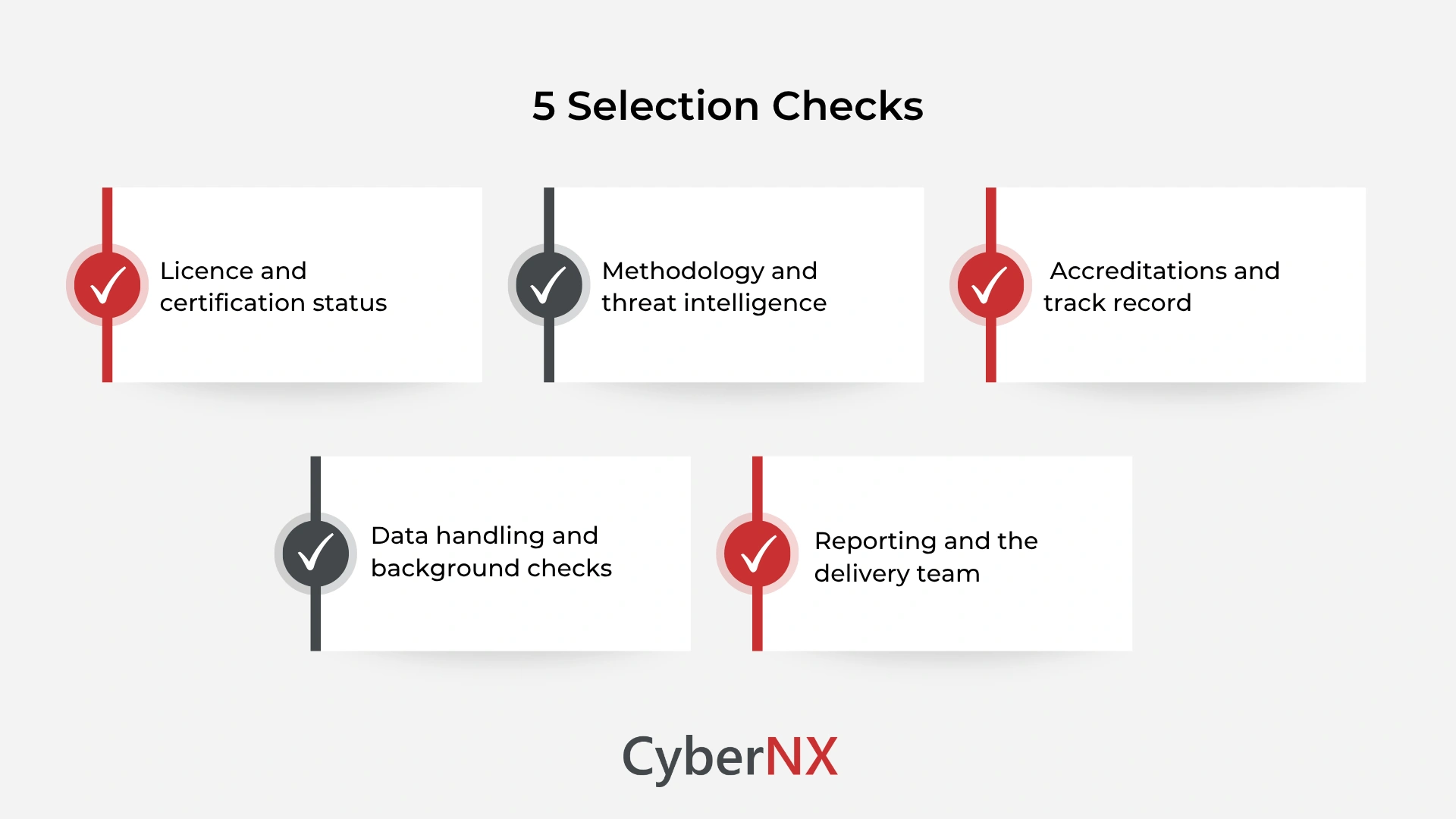
1. Licence and certification status
If the engagement includes licensable penetration testing, ask for the provider’s CSRO licence details before anything else. Then ask where they stand on Cyber Trust Mark Tier 3, given the December deadline.
2. Methodology and threat intelligence
AASE expects a provider to curate threat intelligence and show why it is relevant to your organisation. A strong answer explains how the scenario was built from that intelligence and which adversary objectives it reflects.
A quick note on frameworks, because these three get muddled. AASE is Singapore guidance for financial sector attack simulation. TIBER-EU is a threat intelligence led red teaming framework from the European Central Bank. MITRE ATT&CK is a knowledge base that gives everyone a shared vocabulary for tactics and techniques.
3. Accreditations and track record
AASE asks that providers and their practitioners hold accreditations requiring practical demonstration of offensive skill. It also notes that accreditation bodies have regional reach, so a provider should not be ruled out purely for lacking one specific badge.
4. Data handling and background checks
This one gets skipped often. A red team will touch sensitive systems. Ask about data retention and destruction, and confirm the provider runs criminal background checks on its consultants.
5. Reporting and the delivery team
The report is the product. Ask to see a sample, and check it links attack activity to business impact. Then ask who sits on the team, where they are based and how continuity works across engagements.
Top red teaming companies in Singapore
Below are a few companies that can be considered when you are looking for reliable red teaming companies:
1. CyberNX
CyberNX is a cybersecurity firm that provides red teaming and security testing services, with delivery across India, Singapore, UAE and the US. Engagements can cover infrastructure, applications, people and physical access, depending on the agreed rules of engagement.
Reports combine executive level findings with the technical detail a blue team needs to build detections. Findings are mapped back to the framework you report against, so a single partner can help coordinate testing evidence and remediation across jurisdictions. For Indian groups running a Singapore entity, that coordination is usually the hard part.
2. Ensign InfoSecurity
Formed in 2018 through a joint venture involving Temasek and StarHub, and headquartered in Singapore. Red teaming sits within a broad managed security portfolio, which suits large enterprises buying several services under one contract.
3. Vantage Point Security
A Singapore based security testing firm founded in 2014, covering applications, networks and cloud infrastructure. Its client base includes banking, insurance, telecom, healthcare and fintech.
4. ST Engineering Cybersecurity
It is part of the Singapore headquartered ST Engineering group. Its broader IT and operational technology capabilities may make it relevant for companies running transport, utilities or industrial environments.
Conclusion
Comparing red teaming companies comes down to three questions.
- Are they licensed for the work you are buying?
- Can they show where the scenario came from?
- And does the report change what your team does next?
CyberNX runs intelligence led red team engagements for banks, NBFCs, fintechs and technology firms across Asia. We build each scenario around the threats most relevant to your business, then work alongside your blue team on what we find.
If you’re still weighing up red teaming companies in Singapore for your next exercise, then explore our red teaming services and talk to our team about scope.
Red teaming companies in Singapore FAQs
Do red teaming companies in Singapore need a government licence?
A licence is required when the provider delivers a licensable cybersecurity service, and penetration testing is one. CSA has clarified that red teaming needs licensing where the engagement involves penetration testing as defined under the Cybersecurity Act. Overseas providers serving Singapore clients are covered as well.
What should you check first when comparing top red teaming firms in Singapore?
Start with the CSRO licence and Cyber Trust Mark status. Then move to methodology, threat intelligence, accreditations, data handling and the delivery team.
Which frameworks do the best red teaming companies in Singapore follow?
For financial institutions, the ABS AASE guidelines are the key Singapore reference for adversarial attack simulation. MITRE ATT&CK complements them by supplying a common vocabulary for adversary tactics and techniques. Organisations with international obligations may also work to TIBER based approaches.
What is the difference between red teaming and penetration testing?
Penetration testing looks for as many vulnerabilities as possible inside a defined scope, and stakeholders know it is happening. An adversarial attack simulation is objective based and open scoped, stays covert, and may include social engineering or physical access. The AASE guidelines draw exactly this distinction. It matters commercially too, because red teaming companies in Singapore need a licence once the engagement includes penetration testing.