Ask your security team one question. If an attacker landed on a single finance laptop this morning, how far could they travel before anyone noticed? The answer would usually sound confident, but it is rarely tested.
The distance between what your dashboards report and what your defences catch is where purple team scenarios earn their place. A red team breaks in and reports back weeks later. A blue team watches alerts and trusts the rules will fire. A purple team exercise puts both in the same room, runs one technique at a time and checks whether the alert appears, who owns it and how fast the response begins.
For Indian regulated firms, this type of testing is becoming more and more relevant. For example, SEBI’s CSCRF requires applicable entities to conduct red team exercises and provides specific expectations around testing and remediation.
This blog covers what purple team scenarios are, why they matter for regulated entities in India and six exercises your team can run without a six-week engagement.
What are purple team scenarios?
A purple team scenario is a controlled attack simulation that is designed to test and improve how effectively a firm can investigate and respond to potential attacks on their systems. Offensive and defensive teams collaborate during the exercise, using real or simulated attack techniques and available data to identify detection gaps and improve defensive controls.
The red team runs the technique, and the blue team watches the console. Both then compare what happened against four questions:
- Did the technique execute
- Did any telemetry capture it
- Did a detection rule fire
- Did an analyst act on it
Each scenario maps to a technique in MITRE ATT&CK, which gives both teams a shared language and turns detection coverage into something you can measure.
Why purple team scenarios matter for Indian regulated entities
Indian regulators have shifted the question from “do you have controls” to “have you tested them”.
Under the SEBI Cybersecurity and Cyber Resilience Framework (CSCRF), Market Infrastructure Institutions and Qualified Regulated Entities must carry out goal-based adversarial simulation red teaming exercises. The framework specifies half-yearly red-team exercises using red and blue teams, with results placed before the IT Committee and Governing Board.
CERT-In has also placed strong emphasis on cybersecurity exercises. According to a Ministry of Electronics and Information Technology statement on CERT-In’s 2025 activity, the agency ran 122 cybersecurity drills and exercises covering roughly 1,570 organisations across sectors including finance, power and telecom.
The message is consistent. You should be able to show, with proper evidence, that a realistic attack was executed and that your response held. The purple team scenarios cyber security leaders choose should reflect local risk and local reporting duties, not a generic global template.
Six purple team scenarios worth running this year
Start with techniques that show up in real intrusions against Indian companies. These are purple team scenarios cyber security teams can run in half-day blocks, one technique per session.
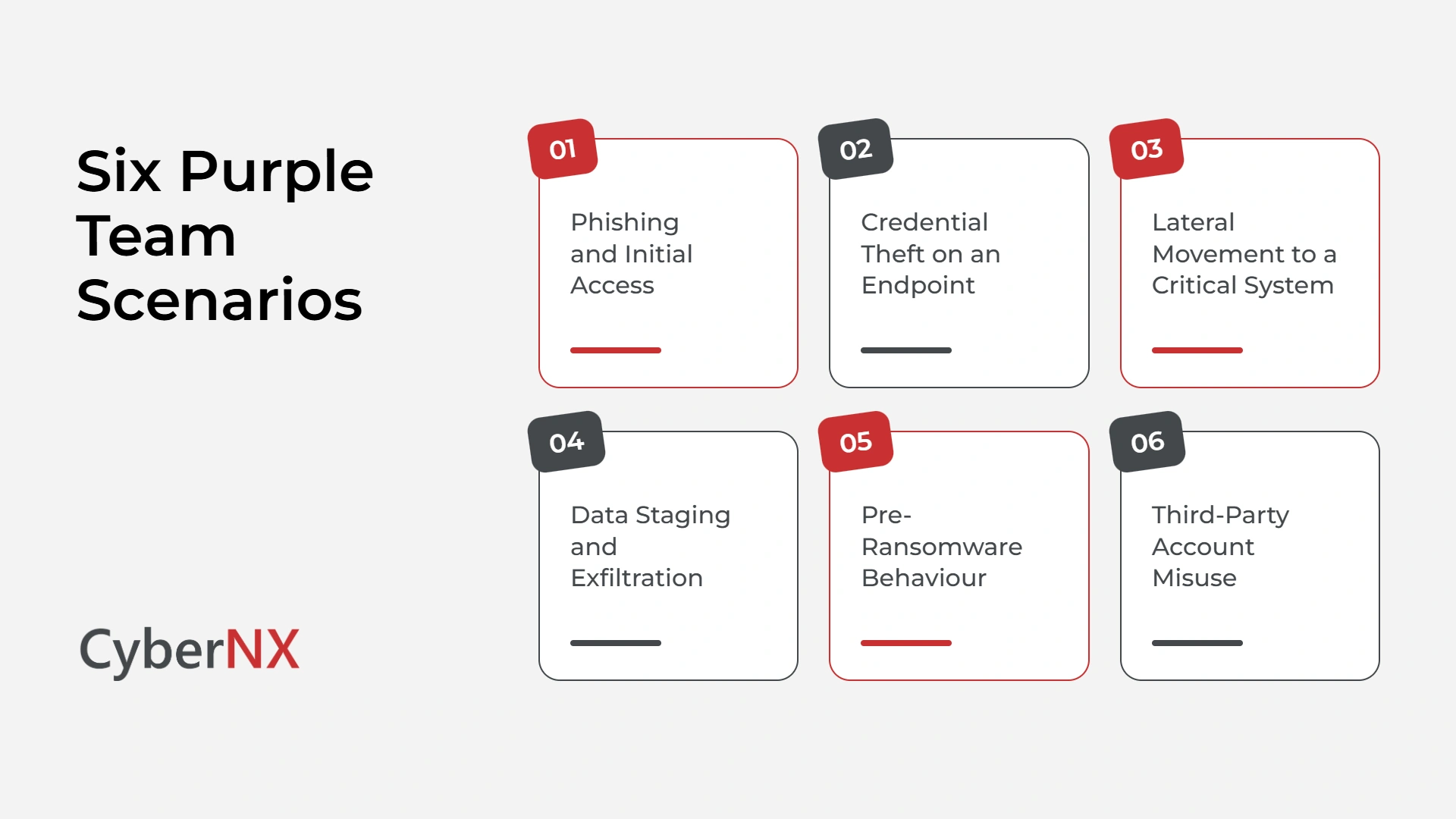
- Phishing and initial access: Test whether email security, endpoint controls, identity controls and SOC processes detect a controlled phishing attempt.
- Credential theft on an endpoint: Test whether attempts to access or dump credentials generate useful endpoint and identity telemetry.
- Lateral movement to a critical system: Test whether movement from a user workstation toward a sensitive or representative critical system is detected.
- Data staging and exfiltration: Use synthetic data to test whether unusual staging, compression and outbound transfer behaviour is detected.
- Pre-ransomware behaviour: Delete shadow copies, disable a backup agent and stop security services on a test host. These steps come before encryption and are your cheapest warning.
- Third-party account misuse: Test whether anomalous use of vendor or privileged third-party accounts is detected based on time, location, device, privilege and behavioural context.
How to run an exercise that actually improves detection
Most of these sessions stall for practical reasons, not technical ones. A tight format fixes that.
- Agree one goal first: test a single business outcome, not twenty techniques
- Keep it open book: the blue team knows the exercise is running
- Log live: technique, timestamp, telemetry source, rule fired, analyst action
- Fix in the room: write or tune the detection rule before moving to the next technique
- Retest later: rerun the same technique a quarter on to prove the fix held
The SANS purple team resources cover this cycle in depth and are a good starting reference.
Purple teaming does not replace full red teaming. Red teaming answers whether an adversary can reach your crown jewels undetected. Purple teaming answers whether your team gets better after every attempt. Regulated entities need both.
Conclusion
Collaborative attack simulation turns security assumptions into evidence. It exposes the gap between a logged event and an actioned alert, then closes it while both teams are still in the room. For SEBI and RBI regulated organisations, well-documented exercises can also provide useful evidence of detection, response and remediation activities. However, the exact documentation and testing requirements depend on the applicable regulatory framework.
At CyberNX, our red teaming services help Indian firms design and run purple team scenarios cyber security teams can repeat every quarter, mapped to MITRE ATT&CK and aligned with CSCRF, RBI and CERT-In expectations. As a CERT-In empanelled auditor, we work alongside your SOC rather than around it. Talk to our experts and find out what your defences would actually catch.
Purple team scenarios FAQs
What are purple team scenarios?
They are controlled attack simulations where offensive and defensive teams work together in real time. The red team executes one technique, the blue team watches for telemetry and alerts, and both tune detections immediately. The aim is measurable improvement in detection and response, not a longer list of vulnerabilities.
How purple teaming differs from penetration testing
A penetration test finds exploitable weaknesses and reports them afterwards. Purple teaming tests whether your monitoring stack sees an attack while it happens. It measures visibility and response speed.
Which exercises should teams start with?
The purple team scenarios cyber security teams run most often are phishing to first foothold, credential theft and lateral movement toward a critical system. Start with the one that maps to your most likely intrusion path, then add pre-ransomware behaviour and vendor access abuse.
Are these exercises required under SEBI CSCRF?
CSCRF requires goal-based adversarial simulation red teaming for Market Infrastructure Institutions and Qualified Regulated Entities. Collaborative purple exercises are not named as a separate mandate. They are, however, a practical way to generate the detection and response evidence the framework expects.