Five years ago, organizations started embracing transformation with IT services penetrating across the business spectrum. There were yet unseen levels of surge in adoption of cloud-based environments, agile application development practices and use of diverse, custom operational tools. Fast-forward today, it is AI driving unprecedented changes, almost every day.
Amid this frequent changes, the attack patterns have considerably changed as well. The end-user focused endpoints are the primary target in the attack campaigns of today.
Security operations teams can now leverage Extended Detection and Response (XDR) tool, which is seen as a better alternative to or extension of other security tools.
This next-gen security approach and advanced features make it an industry standard, empowering teams to detect, investigate and respond faster and smarter.
What is an XDR Tool?
Some see XDR as a technology for unifying telemetry while others as a comprehensive response automation solution. This is because different vendors have built XDR with different features.
Gain deep insight about XDR with our blog Extended Detection and Response (XDR) Guide.
XDR tool is a threat detection and response tool in cybersecurity that extends beyond the capabilities of its predecessors like EDR and NDR. It consolidates telemetry across multiple security layers such as endpoint, email, server, cloud and network. It uses AI models for automation of repetitive tasks. Adds data analytics and threat intelligence to analyse and correlate data, detect and investigate threats and automate centralized and appropriate responses across the entire IT ecosystem.
Compared to EDR, XDR offers broader visibility beyond endpoints. While MDR is a service-driven model often leveraging EDR or XDR, organizations can manage XDR tool internally or in a hybrid model.
Still find detection and response tools puzzling? Read our detailed blog EDR vs MDR vs XDR.
Benefits of Extended Detection and Response Tools
Those organizations still struggling to fill the security gaps for effective detection and response, can benefit from XDR tools. It amplifies the speed and scale at which detection and response is done. Here are some key benefits:
- Improves threat detection accuracy by unifying signals from multiple vectors
- Reduces false positives
- Cuts investigation time
- Enhances endpoint security
- Reduces alert fatigue by correlating alerts into prioritized threat stories
It lowers the total cost of ownership and future proofs your cybersecurity strategy in a multi-vector attack landscape.
Top 5 XDR Tools
There are several Extended detection and response tool options available in the market today, but their functionalities differ. Therefore, to make it easier for you, we have given an overview of the top 5 XDR tools in 2026:
1. CrowdStrike Falcon Insight XDR
It is not surprising to see CrowdStrike Falcon Insight at the top. This XDR tool builds upon their industry-leading endpoint protection foundation with extended capabilities that span across cloud, identity, and workloads.
Key Features:
- Native integration with their EDR and threat intelligence
- Correlates data across endpoints, identity, and workloads
- AI-powered threat detection with automation, detecting wide array of threats
- Real time response actions via single console
- Lightweight agent with minimal performance impact
2. Palo Alto Networks Cortex XDR
Another well-known vendor in the cybersecurity space, Cortex XDR by Palo Alto Networks gathers data from network, endpoint and cloud, offering a holistic view of existing and emerging threats. It is known for integrations with other Palo Alto security products.
Key Features:
- Unified, automated incident management across endpoints, cloud, and network
- Machine learning-focused behavioural analytics
- Native integration with Palo Alto firewalls and Prisma Cloud
- Root cause analysis and threat visualization capabilities
- Automated playbook execution via Cortex XSOAR
3. Microsoft Defender XDR
Include in their security suite, Microsoft Defender XDR (formerly Microsoft 365 Defender) offers native XDR capabilities across Microsoft’s ecosystem that includes endpoints, identity, email and cloud apps.
Key Features:
- Integration with Microsoft 365, Azure and Windows endpoints
- Cross-domain threat correlation (email, identity and endpoint)
- Attack simulation and secure score benchmarking
- Automated investigation and response
- AI-driven incident timelines and analytics
4. SentinelOne Singularity XDR
SentinelOne’s Singularity XDR, released in 2020, is known for autonomous, real time threat mitigation. Plus, this Extended detection and response tool uses AI and machine learning to detect and respond at good speed.
Key Features:
- Autonomous detection and response without cloud dependency
- Patented Storyline™ technology for contextual threat visualization
- Script less malware and fileless attack detection
- Ransomware rollback and real time remediation possible
- Cloud, container and IoT visibility
5. Sophos XDR
Sophos XDR upgrades its Intercept X with insights across email, server, firewall and cloud workloads, making it equal to other similar XDR tools. Plus, it integrates smoothly with the Sophos Central platform.
Key Features:
- Data lake analytics from multiple sources
- Extended telemetry from firewall, server, mobile and email
- Threat hunting using SQL-based queries
- Easy integration with MDR services from Sophos
- Scheduled reports and trend analytics
Bonus mentions include Trend Micro Vision One and Cynet. The former offers robust detection and correlation capabilities tailored for hybrid cloud and containerized environments. The later is known for its built-in automation, MDR capabilities and all-in-one security stack suited for lean IT teams.
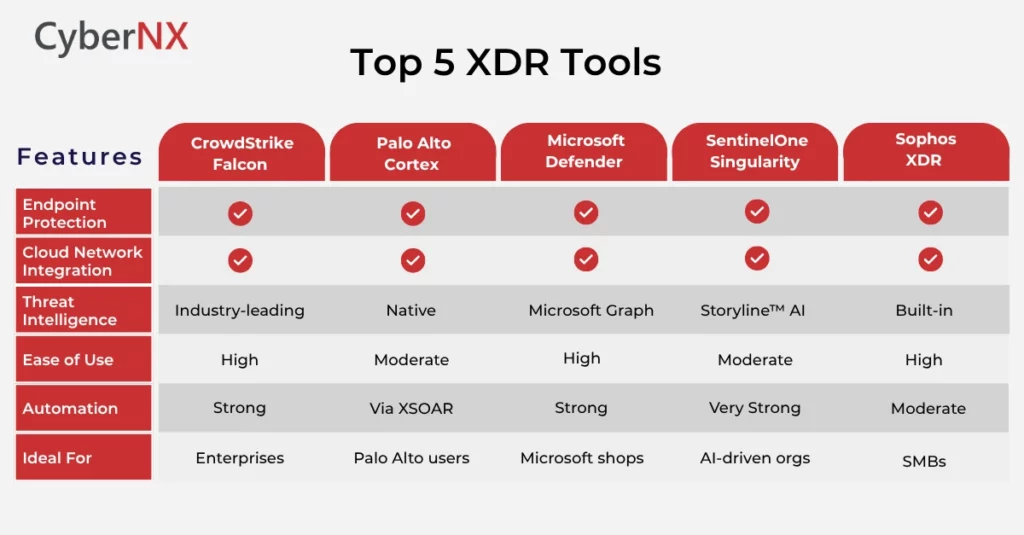
Comparison Chart of Top 5 XDR Tools
Here, you will find key features that differentiate the top 5 XDR tools.
How to Choose the Right Extended Detection and Response Tool
First, assess your IT environment, existing tool stack and in-house security resource. Based on this assessment, you should choose the right XDR tool. Also, here are few other considerations:
- Existing tech stack compatibility
- Cloud, hybrid or on-premises deployment needs
- Required level of automation and AI support
- Budget and licensing model
- Internal team maturity
How AI is Rewriting the Rules for XDR Tool Adoption
AI has moved from a supporting feature in XDR platforms to the core engine driving detection, investigation, and response. Agentic AI now enables XDR systems to autonomously correlate threats across endpoints, cloud, and identity, acting at machine speed without waiting for human input at every step.
The release of Anthropic’s Claude Mythos Preview in April 2026, a model capable of autonomously discovering and chaining zero-day exploits across major operating systems, has made this shift urgent.
XDR tool selection criteria must now go beyond detection accuracy to include agentic workflow support, AI-assisted attack chain visibility, and explainable, auditable automated response. This is because the threats organisations face are now AI-powered too.
Why a Trusted MDR Partner Like CyberNX May Be the Smarter Choice
Selecting the right XDR tool is only half the equation. The other half is who operationalises it. XDR platforms are powerful but complex, and most organisations lack the in-house expertise to extract their full value. This is where a MDR partner like CyberNX makes a decisive difference.
Our MDR-first model means clients get expert-led monitoring, continuous threat hunting, and proactive incident management built directly into the service, not sold as expensive add-ons. Key capabilities include:
- AI-Powered Investigations: Automated and analyst-guided detection that cuts through alert noise and surfaces real threats fast.
- Cross-Domain Threat Visibility: Correlating signals across endpoints, cloud, and user behaviour – exactly what XDR was designed for, delivered with human expertise behind it.
- Real-Time Containment: Automated and analyst-led playbooks that isolate threats instantly, before they escalate into business disruption.
- Compliance-Ready: Built-in alignment with ISO 27001, PCI DSS, and CERT-In across BFSI, healthcare, and government sectors.
For organisations weighing enterprise-grade XDR capability against budget and resource realities, CyberNX offers the platform, the expertise, and the regional threat intelligence to make it work without the bloated pricing that usually comes with either.
Conclusion
Once, XDR was considered as the future concept. Today, it has become a reality with advanced features, necessary for proactive, intelligent and unified threat defence. It empowers internal SOC teams to offer complete security to organizations.
Our XDR services promise to offer you advanced automation, deeper visibility and better ROI on security investments. Plus, our experts can help you protect your entire IT environment from modern and advanced threats. Contact us today.
XDR Tool FAQs
How does XDR improve analyst efficiency compared to traditional security tools?
XDR streamlines security operations by consolidating alerts from multiple vectors – endpoints, cloud, email, and network – into a single platform. Analysts no longer need to manually stitch together fragmented data from disparate tools. With correlated incidents, prioritized threat stories, and automated investigations, XDR significantly reduces mean time to detect (MTTD) and respond (MTTR). This allows teams to focus on high-value tasks instead of alert triage.
Can XDR be used in small to mid-sized businesses, or is it only for large enterprises?
While XDR is often marketed toward enterprises, many modern XDR platforms are designed with scalability in mind. Vendors offer XDR solutions tailored for SMBs, featuring simpler deployments, intuitive dashboards, and even managed services. Smaller businesses benefit from centralized visibility and threat response without needing large security teams or complex integrations.
Is XDR compatible with existing SIEM or SOAR systems?
Yes, most leading XDR solutions are designed to integrate with existing SIEM and SOAR tools. While XDR consolidates data and automates many tasks, it can complement SIEM systems by feeding enriched telemetry and correlation insights. Similarly, integration with SOAR platforms allows for deeper playbook customization and cross-environment automation. Organizations can enhance – not replace – their existing security stack with XDR.
What types of threats does XDR detect more effectively than EDR or standalone tools?
XDR shines in detecting multi-stage and lateral movement attacks that span across endpoints, email, cloud, and network layers. Unlike EDR, which is limited to endpoint data, XDR correlates diverse signals to uncover stealthy threats like credential abuse, supply chain compromises, and cross-domain phishing campaigns. Its ability to spot patterns across multiple surfaces makes it especially powerful against advanced persistent threats (APTs).