
Picture this – Your security team ran a vulnerability scan last quarter, the report came back, findings were logged and the critical ones were handed to the IT team. Three months later, an attacker walked in through a flaw that was on that report. Not some sophisticated nation-state technique – a known vulnerability. One that had a patch available and simply never got fixed.
This is not a hypothetical scenario. It is one of the most common stories behind enterprise breaches today – and it plays out just as often in Indian BFSI organisations as anywhere else.
The problem is often how the teams scan, how they prioritise what they find and whether remediation actually happens before the next audit cycle. For companies governed by SEBI CSCRF, CERT-In guidelines and RBI Master Direction, getting this wrong is a major compliance failure.
This guide walks through the vulnerability scanning best practices that separate a mature, audit-ready programme from one that only works in theory.
What is vulnerability scanning?
Vulnerability scanning is an automated process that examines your IT environment – networks, applications, endpoints, cloud infrastructure – to identify known security weaknesses. These include unpatched software, misconfigurations, outdated components and insecure access settings.
It is important to be clear on what scanning is not: it is not penetration testing. A vulnerability scan identifies potential weaknesses. A penetration test uses skilled analysts to actively exploit them. In India, both are commonly bundled as VAPT, and both are required under SEBI CSCRF for regulated entities.
6 vulnerability scanning best practices that actually matter
Most guides give you a generic list. These are the practices that make a measurable difference, particularly for enterprise teams in India’s compliance landscape.
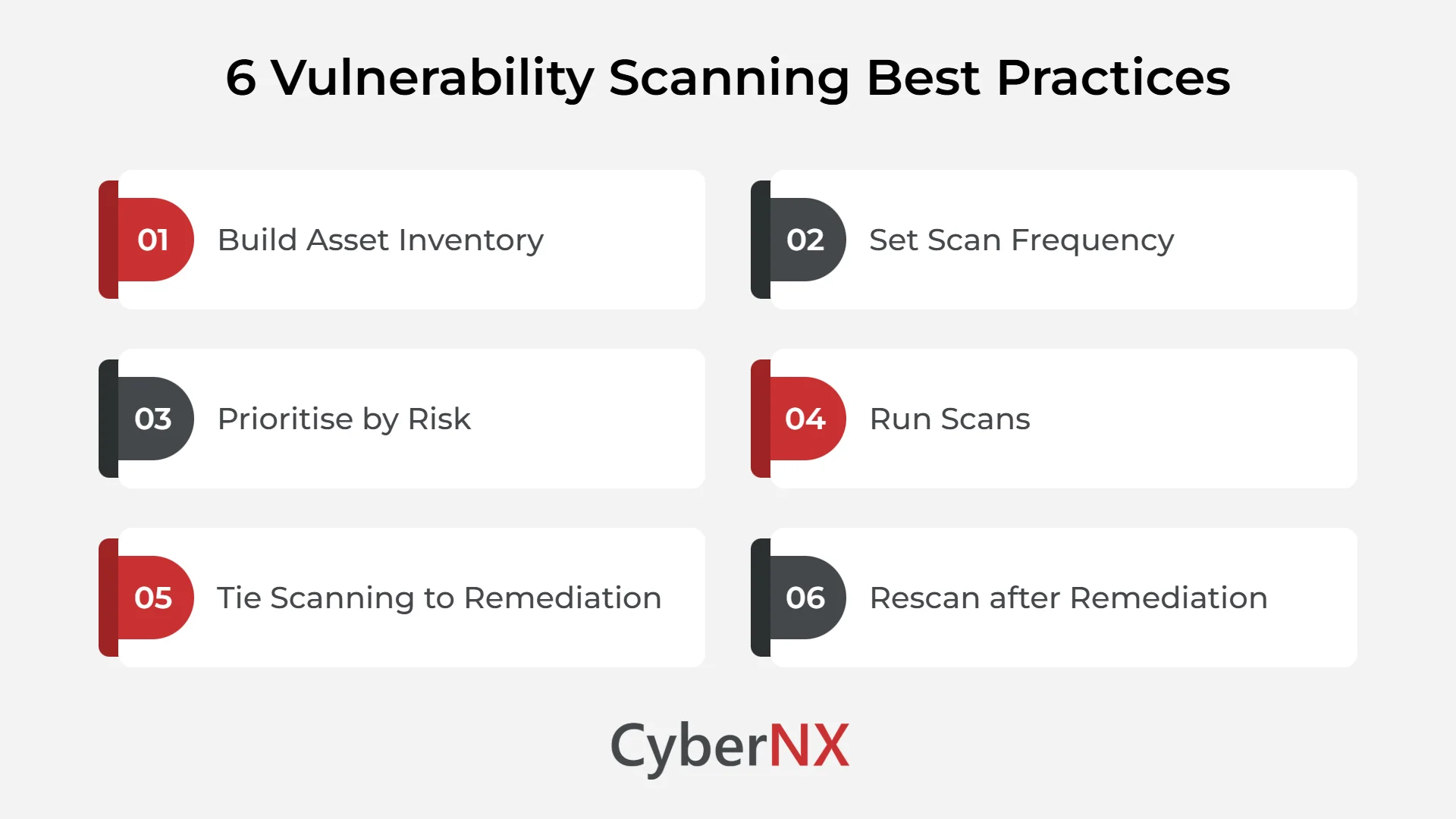
1. Build a complete asset inventory first
You cannot protect what you cannot see. Before applying any vulnerability scanning best practices, maintain a current register of all assets: servers, endpoints, applications, APIs, cloud workloads and third-party integrations. Classify each asset by criticality and internet-facing status. This classification shapes scan frequency and prioritisation decisions directly.
2. Set scan frequency according to risk
A quarterly scan may not provide enough visibility for rapidly changing internet-facing environments, but there is no single scanning frequency that is appropriate for every asset.
A practical risk-based approach is:
- Internet-facing assets: Consider continuous or frequent automated scanning, particularly where assets change rapidly.
- Critical internal systems: Establish a recurring scanning schedule based on business criticality, exposure and regulatory requirements.
- Cloud environments: Integrate vulnerability detection into cloud security and CI/CD processes where appropriate.
- After major changes: Perform targeted reassessment after significant infrastructure, application or configuration changes.
3. Prioritise by risk
A fresh scan on a mid-size enterprise environment can return hundreds of findings. Acting on them in the wrong order is as dangerous as not acting at all. Effective prioritisation combines:
- Exploitability data: Is there a known exploit in the wild? CISA’s Known Exploited Vulnerabilities catalogue is a reliable reference
- Business context: What data or processes does this system support?
- Reachability: Is the vulnerable component actually exposed?
- Compensating controls: Are other defences already in place?
A CVSS 9.8 vulnerability on an isolated internal system may be less urgent than a CVSS 7.0 flaw on an internet-facing payment gateway with no compensating controls.
4. Run both authenticated and unauthenticated scans
Many teams run only unauthenticated (external) scans. These simulate what an external attacker can see – but they miss significant exposure. Authenticated scans log into systems using valid credentials and surface vulnerabilities invisible from the outside: local privilege escalation paths, misconfigured services and internally unpatched software.
A mature vulnerability scanning best practices programme runs both. External scans model the attacker’s view. Internal authenticated scans model what happens after a breach, or when an insider poses a risk.
5. Tie scanning directly to remediation
A vulnerability report that sits in an inbox is not a vulnerability management programme. Findings should flow into ticketing or risk-management workflows, be assigned to accountable owners and be tracked through remediation and verification. Organisations can define internal remediation SLAs based on severity and business risk. For example:
- Critical: Immediate remediation or compensating control, with a target of 24–72 hours
- High: Target remediation within 7–14 days
- Medium: Target remediation within 30 days
- Low: Address during the next planned maintenance cycle
These are example organizational SLAs, not universal regulatory deadlines. For RBI-regulated entities, the applicable requirement is that identified vulnerabilities and associated risks are remediated through requisite corrective measures in a time-bound manner.
6. Always rescan after remediation
Remediation without verification is assumption. A significant share of “fixed” vulnerabilities reappear because patches were applied incorrectly, rolled back or only partially deployed. After every remediation cycle, rescan the affected assets to confirm the finding is closed. SEBI-regulated entities must retain VAPT reports – a verified closure is strong audit evidence.
What a compliant scanning programme looks like
For BFSI and other regulated enterprises, a mature vulnerability management programme should be able to demonstrate:
- Regular scan cycles documented and aligned to asset criticality
- Engagement of CERT-In empanelled auditors for formal assessments
- Remediation timelines tracked against defined SLAs
- VAPT reports and supporting assessment evidence
- Continuous internal scanning between formal VAPT cycles
The framework does not ask whether you scan. It asks for the evidence trail that proves what you found, how you scored it and whether it was closed.
Conclusion
Vulnerability scanning is a discipline you are supposed to build – with the right scope, the right frequency, risk-based prioritisation and a remediation process that actually closes findings.
For Indian firms navigating SEBI CSCRF, CERT-In requirements and the broader compliance landscape, getting vulnerability scanning best practices right – matters more than ever. At CyberNX, our team works with BFSI, fintech and enterprise organisations to design and run reliable assessment programmes. If you want to learn more about our vulnerability scanning services, talk to our experts.
Vulnerability scanning best practices FAQs
How often should vulnerability scanning be done?
There is no single scanning frequency that applies to every organisation or asset. Internet-facing and rapidly changing environments may benefit from frequent or continuous automated scanning, while internal systems can follow a risk-based schedule.
What is the difference between vulnerability scanning and penetration testing?
Vulnerability scanning primarily uses automated techniques to identify known or suspected weaknesses in systems, applications and infrastructure. Penetration testing is a controlled security exercise in which qualified testers attempt to validate vulnerabilities and demonstrate potential impact.
What assets should be included in a vulnerability scan?
A comprehensive scan should cover servers, web and mobile applications, cloud infrastructure, APIs, endpoints, network devices and third-party integrations. Starting with an accurate, up-to-date asset inventory is essential – you cannot scan what you have not inventoried.
How do you prioritise vulnerabilities after a scan?
Use a combination of CVSS severity scores, exploitability data (such as CISA’s KEV catalogue), business context and reachability analysis. A high-CVSS vulnerability on an isolated internal system is lower priority than a medium-CVSS flaw on an internet-facing payment gateway with no compensating controls.