You’ve deployed AI across your enterprise, and you see models running and pipelines being live. Decisions are being made automatically, at scale. But do you really know what your AI is doing?
Unlike traditional software, it is found that AI models can break and drift. They could possibly hallucinate and behave differently in production than they did in testing. And when something goes wrong, there’s rarely an obvious error log to point to.
This is exactly where AI observability tools come in. They give you full visibility into model behaviour, data lineage and system performance in real time, at enterprise scale.
Our experts, alongside security professionals in India and abroad, have evaluated these platforms based on first-hand experience and thorough research. This is not a spec-sheet comparison. It’s a practitioner’s view of the tools that should hold up under enterprise pressure.
Here are the top 5 AI observability tools your team should know about in 2026.
What are AI observability tools?
AI observability tools are platforms that help engineering, security and compliance teams monitor, trace and understand the behaviour of AI and machine learning models in production. They go beyond traditional monitoring by surfacing why a model is behaving a certain way. This is in many ways like observability tools focused on your technology stack. Read: Top 7 Observability Tools in 2026
You can also read our Full Stack Observability Guide to have comprehensive understanding of how observability works.
Why AI observability is different from traditional monitoring
Traditional monitoring tells you when a system is down. AI observability tells you when your model is quietly making bad decisions.
A model can be technically “up” while producing biased outputs, hallucinating responses or degrading in accuracy due to data drift. Standard infrastructure tools won’t catch this. AI observability tools are designed specifically to detect these patterns and give your team the context to act on them.
For enterprises running AI in customer-facing or compliance-sensitive environments, this distinction is operational risk management.
What enterprise teams should look for in an AI observability platform
Not every observability tool is built for enterprise scale. When evaluating platforms, security professionals and IT heads should prioritise:
- End-to-end tracing: Visibility from input to output across the full model pipeline
- LLM support: Purpose-built monitoring for large language models (LLMs) and generative AI
- Integration depth: Compatibility with your existing MLOps, cloud and security stack
- Role-based access control: Granular permissions for engineering, security and compliance teams
- Audit trails: Tamper-evident logs that satisfy regulatory requirements
- Alerting and anomaly detection: Real-time signals, not just historical dashboards
Keep these criteria in mind as you review the AI observability tools list below.
How we evaluated these tools
Our team spent significant time with each of these platforms testing them in environments that mirror real enterprise deployments. We also consulted security professionals across India and global markets, drawing on perspectives from BFSI, healthcare, technology and IT sectors.
Our review criteria
We assessed each tool across five dimensions:
- Observability depth: How much signal the tool surfaces about model behaviour
- Enterprise readiness: SSO, role-based access, audit logs, SLA and support
- LLM and GenAI coverage: How well the tool handles modern generative AI workloads
- Security posture: Data handling, privacy controls and compliance alignment
- Ease of integration: Time-to-value in a complex enterprise environment
Across our conversations with CISOs and AI leads in banking, insurance and large IT organisations, a clear pattern emerged. Most teams don’t lack data but context. They can see that a model’s output changed. They cannot easily explain why, or prove to regulators that they investigated it.
The best AI observability tools solve for exactly this. They turn raw telemetry into explainable, auditable insight.
The top 5 AI observability tools for enterprise scale
Here are the top 5 in our list based on our expert reviews:
1. Arize AI
Arize AI is purpose-built for production ML observability. It gives data science and ML engineering teams a single platform to monitor model performance, detect data drift and debug issues without writing custom instrumentation.
What sets Arize apart for enterprise teams is its embedding visualisation capability. A powerful way to detect when your model’s input data is shifting away from its training distribution. This is especially useful for organisations running recommendation engines, fraud detection or NLP models at scale.
Arize supports structured and unstructured data, integrates with major cloud ML platforms and provides out-of-the-box connectors for Python-based model pipelines. Its role-based access model and audit-ready logging make it a strong fit for regulated industries.
Best for: Enterprises with large-scale ML models in production, particularly in BFSI and e-commerce.
2. Weights & Biases (W&B)
Weights & Biases is best known as an experiment tracking platform. But its enterprise tier has matured significantly into a full-spectrum AI observability solution, covering everything from training runs to live production monitoring.
For enterprise teams, W&B’s model registry and lineage tracking capabilities are particularly valuable. You get a complete, auditable record of every model version, the data it was trained on and the configuration used. This is exactly the kind of documentation that compliance teams and regulators increasingly expect.
W&B also offers a self-hosted deployment option, a critical consideration for organisations with strict data residency requirements. Its Weave product extends observability to LLM traces and conversational AI pipelines.
Best for: Enterprises with active ML research teams that need continuity from experimentation to production.
3. Langfuse
Langfuse has rapidly become one of the most respected platforms for observing LLM-powered applications. It is open-source, self-hostable and built from the ground up for the challenges unique to generative AI – tracing, evals, prompt versioning and cost monitoring.
For enterprise teams deploying chatbots, RAG (Retrieval-Augmented Generation) pipelines or LLM-based automation, Langfuse provides end-to-end trace visibility across every call in the pipeline. You can see exactly what prompt was sent, what context was retrieved, what the model returned and how long each step took.
Its evaluation framework allows teams to score LLM outputs systematically – either with human reviewers or automated scoring models. This is a significant advantage for compliance teams that need documented evidence of output quality.
Langfuse integrates natively with LangChain, OpenAI, Anthropic and most enterprise LLM stacks. The self-hosted option makes it attractive for organisations in regulated industries where data cannot leave a controlled environment.
Best for: Enterprises building or scaling generative AI and LLM-powered applications with strict data governance requirements.
4. LangSmith
LangSmith is LangChain’s native observability and testing platform. If your enterprise is building AI workflows with LangChain – one of the most widely adopted LLM orchestration frameworks – LangSmith offers the deepest level of visibility available.
LangSmith captures the full execution trace of every LangChain run: each agent step, every tool call, all intermediate outputs and the final response. This level of granularity is invaluable when debugging unexpected model behaviour or preparing evidence for a compliance audit.
Its dataset and testing features allow teams to regression-test AI pipelines against curated examples. A practice that is becoming standard in enterprise AI governance. You can catch performance regressions before they reach production.
LangSmith also provides a playground environment for prompt engineering and chain testing, reducing the feedback loop between development and deployment. For security teams, its trace exports and annotation workflows support structured human review of model outputs.
Best for: Enterprises using LangChain for AI agent development, RAG applications or complex multi-step AI workflows.
5. IBM OpenPages with Watson AI
IBM OpenPages takes a fundamentally different approach to AI observability – it starts with governance, not monitoring. For large enterprises in heavily regulated sectors, this distinction matters.
Built on IBM’s broader Watson AI and Cloud Pak for Data ecosystem, OpenPages provides AI Factsheets. Structured documentation of model metadata, training data, performance metrics and risk assessments that follow the model through its lifecycle. This is the kind of auditability that boards, regulators and risk committees are increasingly demanding.
OpenPages integrates AI observability within a broader Governance, Risk and Compliance (GRC) framework. This means your AI risk can sit alongside your operational risk, compliance risk and third-party risk – giving leadership a unified view.
For enterprises operating under RBI, SEBI, HIPAA or GDPR requirements, IBM’s approach to model governance and explainability is difficult to match from a regulatory alignment standpoint.
Best for: Large enterprises in BFSI, healthcare or public sector where AI governance and regulatory compliance are non-negotiable.
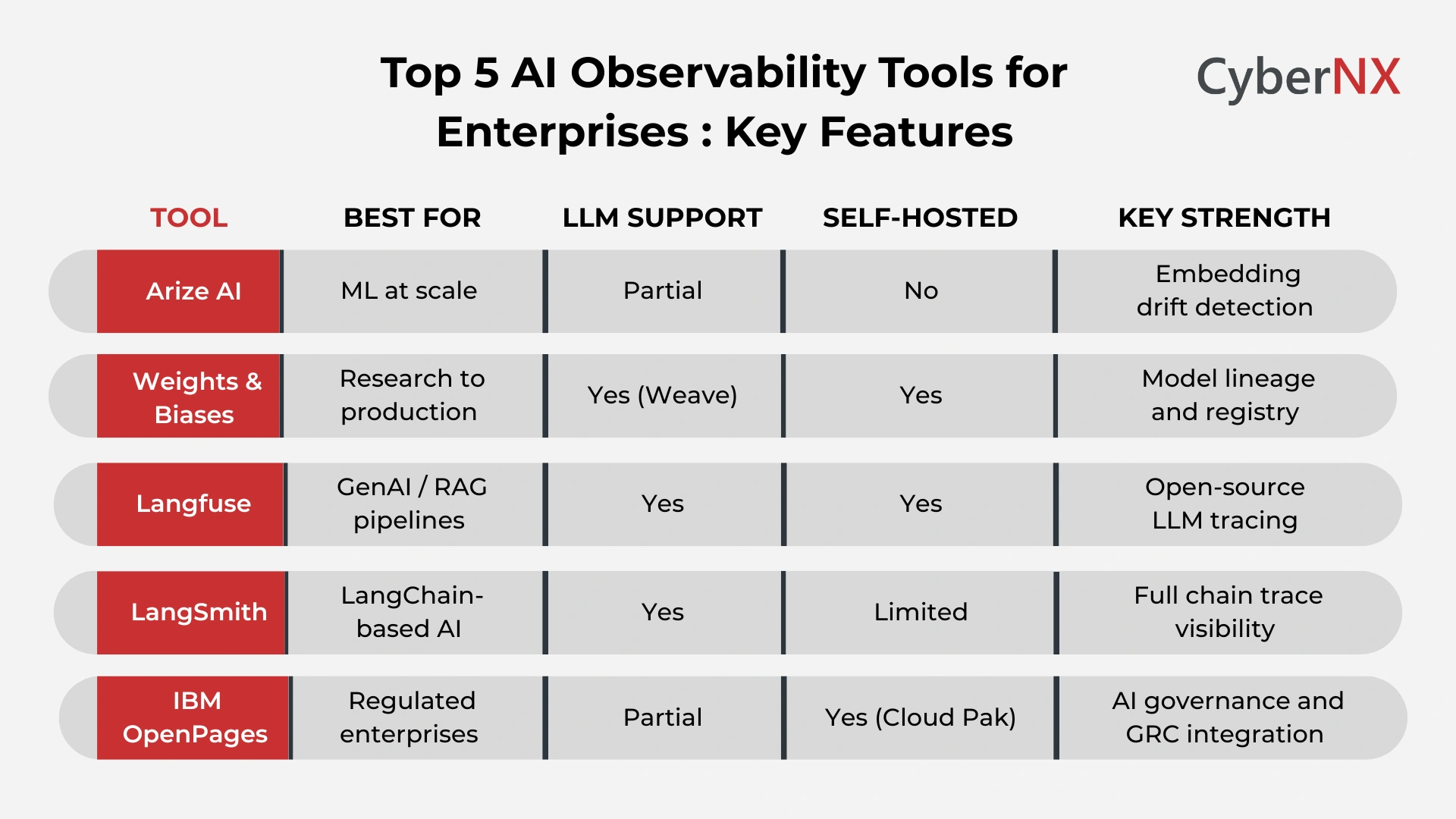
Quick comparison of AI observability tools list
Here is a side-by-side view of the five platforms to help you match each tool to your enterprise context.
Which tool fits which enterprise use case
There is no single “best” platform. The right choice depends on what you are actually building and what your compliance obligations require.
- Building LLM or GenAI applications: Langfuse or LangSmith will give you the deepest visibility with the least friction.
- Running traditional ML models in BFSI or e-commerce: Arize AI is hard to beat for production monitoring at scale.
- Bridging research and production teams: Weights & Biases offers the broadest coverage across the ML lifecycle.
- Operating in a regulated enterprise with GRC requirements: IBM OpenPages is the governance-native choice.
Why AI observability matters for security and compliance teams
AI observability is not just an MLOps concern. It is a security concern and increasingly, a regulatory one.
Model drift, data poisoning
When a model drifts, when its inputs or outputs shift significantly from what it was trained on, the consequences can range from degraded performance to actively harmful decisions. In a fraud detection system, drift can mean fraudulent transactions going undetected. In a lending model, it can mean discriminatory outcomes that create legal exposure.
Data poisoning is a subtler threat. An attacker who can influence your model’s training data can manipulate its behaviour, without ever touching your infrastructure. AI observability tools create the monitoring layer that makes these attacks detectable.
Supports regulatory compliance
Regulators across sectors are catching up with AI. The Reserve Bank of India (RBI) and Securities and Exchange Board of India (SEBI) have both issued guidance on the use of AI in financial services with expectations around explainability, auditability and human oversight. Globally, GDPR’s “right to explanation” and emerging EU AI Act requirements are raising the bar further.
The best AI observability tools produce the documentation, logs and audit trails that make regulatory response tractable. They turn “we think the model was working correctly” into “here is the evidence.”
Conclusion
The five platforms in this review represent the best of what is available for enterprise-scale deployment today. Each has distinct strengths. The right one for your organisation depends on your AI stack, your compliance obligations and how mature your MLOps practice is.
What they share is this: they turn AI from a black box into an accountable, auditable system. That is the standard your boards, your regulators and your clients are beginning to expect.
At CyberNX, our experts work alongside security professionals in India and abroad to help enterprises build AI governance frameworks that hold up under scrutiny – from model deployment to compliance reporting. Our full stack observability solutions can help you assess your current risk posture and identify the right observability and governance controls for your environment.
Ready to get visibility into your systems? Talk to our experts at and we’ll help you build the observability and governance foundation your enterprise deserves.
AI observability tools FAQs
What are AI observability tools?
AI observability tools are platforms that give engineering, security and compliance teams visibility into how AI and machine learning models behave in production. They surface data drift, performance degradation, unexpected outputs and other signals that standard monitoring tools miss. The best AI observability tools also produce audit trails and explainability evidence for regulatory purposes.
What is the difference between AI monitoring and AI observability?
AI monitoring typically tracks infrastructure metrics – uptime, latency, throughput. AI observability goes deeper: it tells you why a model is producing the outputs it is, how its behaviour is changing over time and whether it is operating within acceptable bounds. Observability is a superset of monitoring – and it is what enterprise security and compliance teams actually need.
Which industries need AI observability tools the most?
Any industry where AI models make or influence consequential decisions needs robust observability. This includes banking and financial services, insurance, healthcare, retail and large-scale technology operations. Regulated industries – where decisions must be explainable and auditable – have the highest need. If your AI influences credit decisions, fraud detection, clinical outcomes or compliance reporting, observability is not optional.
How do the best AI observability tools handle LLM and generative AI?
Modern AI observability platforms have evolved significantly to address LLM-specific challenges. Langfuse and LangSmith provide full trace visibility across LLM pipelines – capturing prompts, retrieved context, model outputs and latency at every step. Weights & Biases’ Weave product extends its observability capabilities to conversational AI. For enterprise teams deploying GenAI, look for platforms that support prompt versioning, output scoring, RAG pipeline tracing and self-hosted deployment for data residency compliance.