Your Digital Risk Protection (DRP) platform just flagged a suspicious domain. A near-perfect clone of your brand, already sending phishing emails to your customers. Your team acts. the domain comes down and it feels like a win.
But here is a question: where did that alert actually come from?
Every DRP alert, a fake domain, a leaked credential, a dark web mention of your organisation, originates from a specific threat intelligence feed category. The platform did not “just know.” It was watching a data source that, in most cases, your team cannot name.
That gap matters. Many organisations subscribe to threat intelligence feeds, receive DRP alerts and act on them without ever evaluating whether their feed stack covers the threats they face.
In this blog, you will learn which feed categories power your DRP program, why a significant share of modern threats bypass even well-resourced stacks, how to evaluate whether your feeds are working and what it takes to move from passive subscription to active operationalization.
What threat intelligence feeds power in a DRP program
Threat intelligence feeds are continuous data streams delivering real-time information about active and emerging threats. This could be malicious domains, credential dumps, phishing URLs, dark web listings and more. They are the raw detection layer beneath every alert your DRP program generates.
Digital risk monitoring only works if the right feeds are underneath it. Each feed category maps to a different external threat surface.
Five feed types and the DRP outcomes they drive
Here is how each feed category connects to a DRP use case:
- Domain registration and DNS feeds: Detect typo-squatting, lookalike domains and brand impersonation infrastructure being built before a phishing campaign launches
- Dark web intelligence feeds: Surface credential leaks, initial access listings and threat actor chatter about your organisation across forums, marketplaces and encrypted channels
- Phishing URL and brand abuse feeds: Track live phishing pages, rogue mobile apps and social media impersonation accounts actively abusing your brand identity
- Credential and data leak feeds: Monitor paste sites and breach markets for employee or customer credentials exposed in third-party breaches
- OSINT and social intelligence feeds: Aggregate open-source signals from social platforms, code repositories and news sources for brand misuse and executive targeting
Understanding this mapping is the first step in evaluating whether your digital risk protection program has real coverage or just the appearance of it.
The DRP market is sold on outcomes: takedown counts, time-to-detect, coverage breadth. Vendors rarely specify which upstream feeds deliver those outcomes. When a fake domain slips through for three weeks, the assumption is slow takedown. The more likely explanation is a gap in the domain registration feed – wrong registrar coverage, subdomain blind spot or infrequent polling. You cannot benchmark your DRP coverage without knowing what feeds are underneath it.
The 52% blind spot in traditional threat intelligence feeds
Traditional threat intelligence feeds were built for a specific era of attacker infrastructure. That era is ending.
A June 2026 report by Palo Alto Networks found that 52% of threats at the network layer communicate directly with IP addresses rather than named domains. These direct-to-IP threats bypass domain-based intelligence feeds entirely with no domain registered, no hostname created, no footprint in the feed categories most DRP stacks monitor.
Attackers route command-and-control traffic through trusted cloud providers – AWS, Azure, Cloudflare CDN – blending malicious activity with legitimate business traffic. IP addresses may not appear in any reputation database at the moment the security decision is made. AI-assisted frameworks make this worse, rotating infrastructure faster than traditional feeds can track.
The implication for your external attack surface is direct: your DRP program has a surveillance perimeter, and direct-to-IP attacks operate just outside it. Feeds defending against domain impersonation, credential leaks and social media abuse remain essential but they are insufficient on their own. They need to be complemented by network-layer telemetry and behavioural analytics.
The 52% figure is not a reason to distrust your feeds but to understand precisely what they cover and what they do not.
Are your feeds good? How to evaluate feed quality
Subscribing to more feeds does not automatically improve coverage. A significant proportion of commercial and open-source feeds share upstream sources. Adding a fourth or fifth feed often adds duplication and alert noise rather than new signal. Research published in 2026 on the TIFCE (Threat Intelligence Feed Content Evaluation) model identified this as a structural problem: more feeds creates a false sense of coverage while making operations harder.
Four quality pillars to measure every feed against
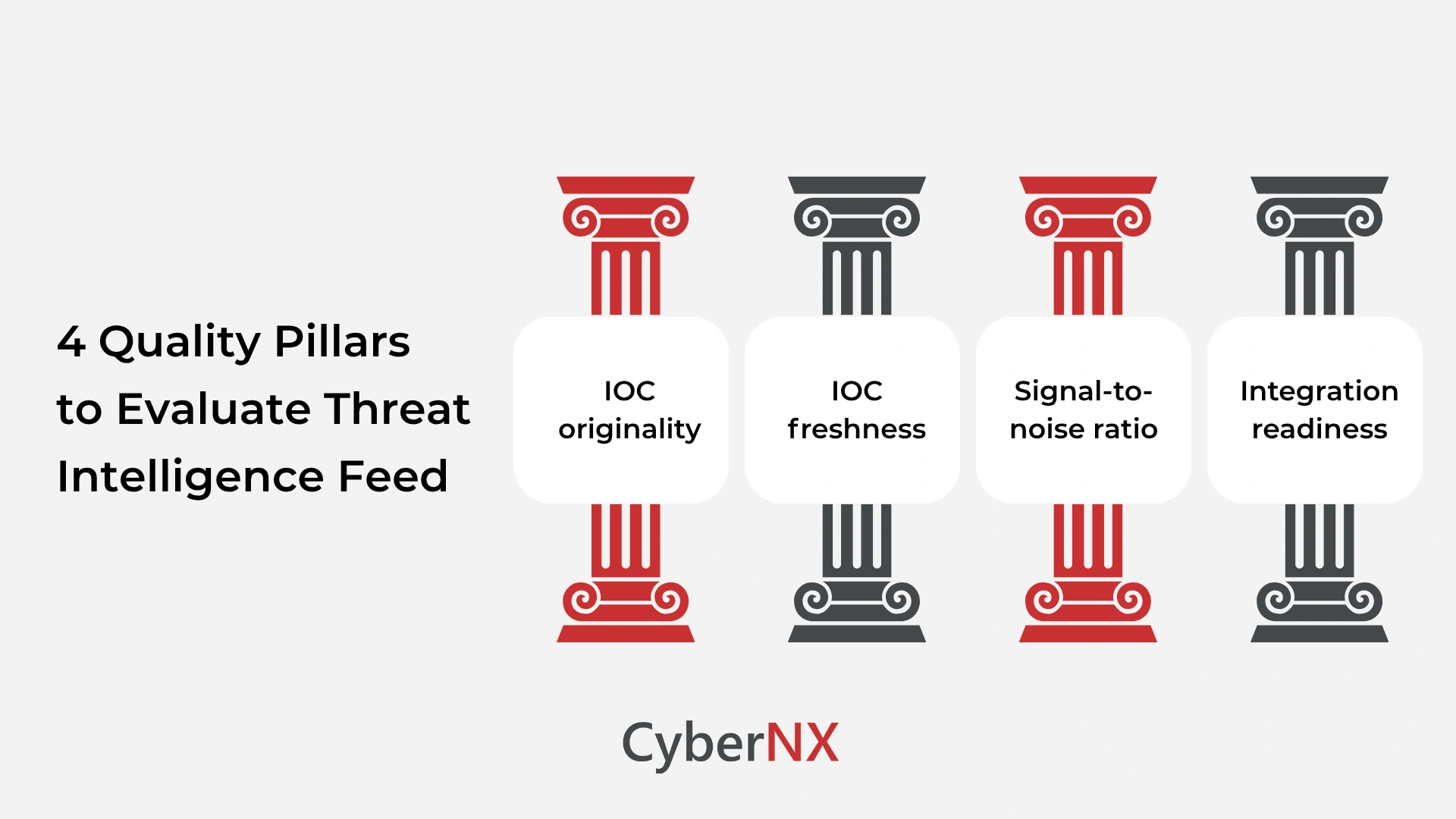
Before adding or renewing any feed, evaluate it across these dimensions:
- IOC originality: What percentage of indicators are unique to this feed? High originality means the feed surfaces threats your current stack would otherwise miss
- IOC freshness: How quickly does the feed reflect new threat activity? For brand risk protection use cases, update frequency is critical – phishing kits and credential auctions expire within hours
- Signal-to-noise ratio: What percentage of alerts are genuinely actionable? Noisy feeds drive analyst fatigue and erode trust in the entire stack
- Integration readiness: Can the feed be ingested automatically by your SIEM, SOAR or TIP? A feed requiring manual processing will not be used consistently
The diagnostic question for each existing feed: if I removed this tomorrow, which threats would I stop catching? If the answer is none you can identify, the feed is generating noise without improving coverage.
Operationalizing your threat intelligence feeds
Subscribing to feeds is not the same as using them. Forrester’s Q1 2026 External Threat Intelligence Landscape identified “turning data into action” as the number one unmet challenge in the TI market and it has been for years.
The operationalization steps that determine whether feeds improve outcomes are where programmes stall. Here is the sequence most teams skip:
- Normalise: Standardise feed data into a consistent format so indicators from different sources can be compared and correlated
- Deduplicate: Remove indicators that appear across multiple feeds; this step alone cuts alert volume by 30–40% without any loss of coverage
- Enrich: Add context to raw indicators. An IP address without context is an alert without meaning; enrichment connects it to a threat actor, campaign or sector
- Tune: New feeds generate higher false positive rates in the first 30–60 days; without active threshold tuning, teams abandon feeds they label as “too noisy” rather than fixing the configuration
- Measure: Organisations that integrate and measure their feeds properly reduce mean time to detection (MTTD) and false positive rates. Without a baseline, you cannot demonstrate ROI or identify underperforming feeds
Reviewing your digital risk monitoring checklist alongside your feed operationalization plan is a practical way to identify where your external monitoring has structural gaps before they become incidents.
Conclusion
Threat intelligence feeds are the foundation of every DRP alert your team acts on – but subscribing is not the same as having coverage. The five feed types each defend a different threat surface. A structural 52% blind spot exists in domain-centric stacks. Feed quality must be evaluated, not assumed. And operationalization – not collection – is where most programmes underperform.
CyberNX’s Digital Risk Protection service combines curated intelligence across all five feed categories with active monitoring, human validation and coordinated takedown support. Your team acts on real threats – not feed noise. Have questions about your current DRP coverage? Talk to our team.
Threat intelligence feeds FAQs
What are threat intelligence feeds?
Threat intelligence feeds are automated data streams delivering real-time indicators of cyber threats – malicious IPs, domains, phishing URLs, credential leaks and attacker TTPs. They form the detection layer beneath DRP platforms and SOC monitoring tools.
How do threat intelligence feeds support digital risk protection?
DRP platforms draw on specific feed categories – domain, dark web, phishing, credential and OSINT feeds – to detect external threats to your brand and organisation. Feed quality and coverage determine the effectiveness of every DRP alert your team receives.
Why do some threats not appear in threat intelligence feeds?
Threats that communicate directly with IP addresses – without registering a domain – bypass domain-centric feeds entirely. A June 2026 study found 52% of network-layer threats fall into this category, making complementary behavioural and network controls essential.
How do I know if my threat intelligence feeds are working?
Evaluate each feed on IOC originality, freshness, signal-to-noise ratio and integration readiness. Set baseline MTTD and false positive metrics before deployment and track change over 60–90 days.